
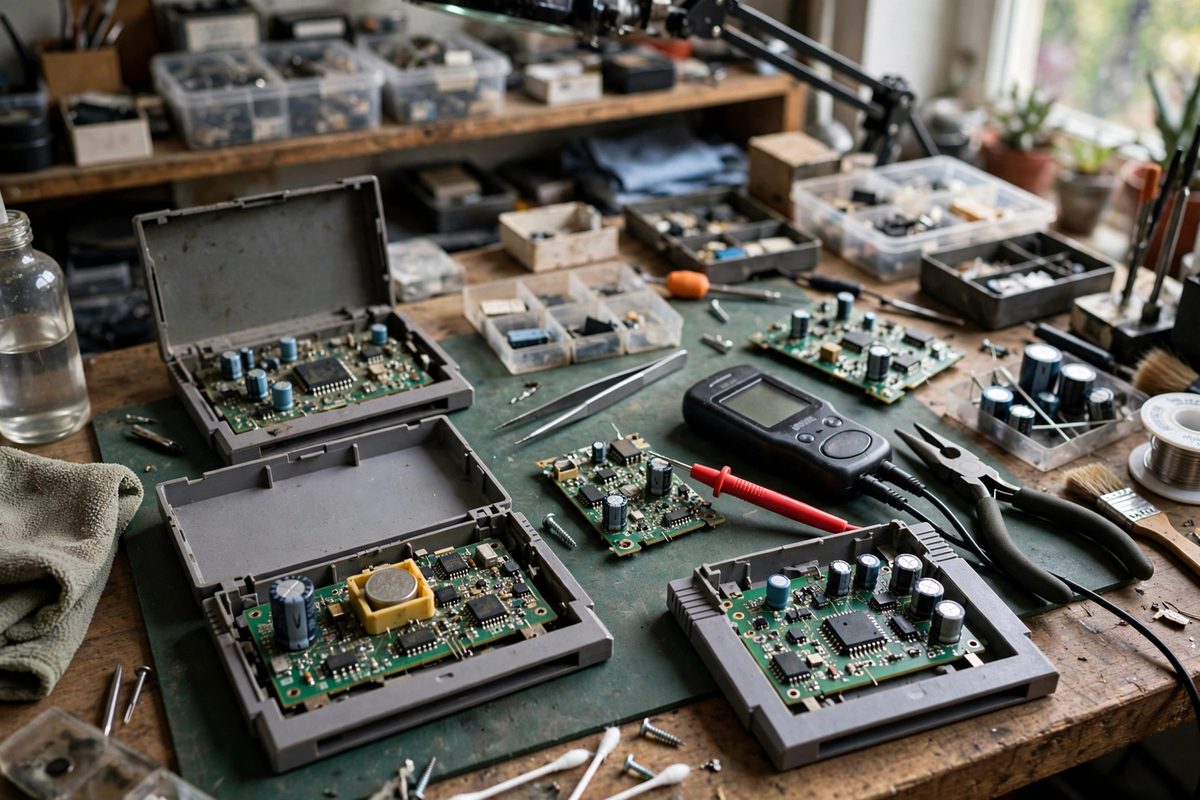
Some vintage game cartridges, particularly those with save batteries, audio circuitry, or special coprocessor chips, contain small electrolytic capacitors. After decades, these capacitors dry out: their capacitance drops and their equivalent series resistance (ESR) climbs. A cartridge that glitches, loses saves, or produces distorted audio may have perfectly good chips and simply need its capacitors tested and replaced. ESR testing finds the bad ones without desoldering every component.
What ESR Tells You
Equivalent series resistance is the internal resistance of a capacitor, and it rises as the electrolyte dries out. A capacitor can still measure close to its marked capacitance on a basic meter while having ESR so high that it cannot do its job in circuit. In a cartridge, failing capacitors show up as unstable power rails (glitches, crashes), weak or distorted audio (coupling capacitors), and unreliable save memory (decoupling near the SRAM). ESR is the parameter that correlates most directly with these failures, which is why experienced repair techs test ESR rather than just capacitance. A capacitor with high ESR is a capacitor that is done, even if its capacitance reading looks plausible.
Testing In Circuit Versus Out of Circuit
Dedicated ESR meters apply a low-voltage, high-frequency test signal that can often measure a capacitor while it remains soldered in the cartridge. This works because at the test frequency, surrounding circuitry typically presents a high impedance relative to the capacitor's low impedance path. In-circuit testing is a huge time saver on densely packed cartridge boards. However, parallel capacitors and low-impedance paths in the circuit can fool the meter, giving a falsely good reading when one of several parallel caps has failed. If an in-circuit reading is suspicious or borderline, desolder one leg of the capacitor and test it isolated. For cartridges with only one or two electrolytics, many techs simply replace them all as preventive maintenance, since the parts cost pennies and the labor of testing exceeds the labor of replacing.
Reading the Results
Compare the measured ESR against the expected value for the capacitor's rating; general ESR tables list typical maximum values by capacitance and voltage. As a rule of thumb, an ESR several times higher than typical for that size is a failure, and any capacitor that reads open or wildly high is definitely bad. Also watch for capacitors that test well cold but fail when warm; heat the cartridge gently with a hair dryer and retest if you suspect an intermittent. Physical inspection complements the meter: bulging tops, leaking electrolyte, or corroded leads mean replacement regardless of what the meter says. Electrolyte leakage can also damage board traces, so inspect the surrounding copper carefully on any cartridge with a visibly failed capacitor.
Replacement Practice
Replace with capacitors of the same capacitance and equal or higher voltage rating. Low-ESR types are the correct choice for power filtering positions. Observe polarity strictly; electrolytics installed backwards vent or fail, sometimes dramatically. Match the physical size so the replacement fits the board and the cartridge shell closes properly. Use fresh solder and clean the pads; old cartridge boards have fragile pads, so use moderate heat and avoid dwelling on any one joint. After replacement, clean any leaked electrolyte residue from the board with isopropyl alcohol, since the residue is corrosive and conductive. Test the cartridge thoroughly: play it, save and reload, and listen to the audio before declaring victory.
Preventive Recapping Strategy
For a personal collection, a sensible policy is to test the electrolytics in any cartridge that shows symptoms and to proactively recap cartridges with known failure-prone designs or visible capacitor distress. Keep a small stock of the common values used in cartridges so a repair is a single bench session, not a parts order. Document which cartridges you have recapped; in a large collection, that record saves you from re-diagnosing the same cartridge years later. Capacitors are consumables with a finite life, and treating them that way keeps vintage cartridges running for decades more.
ESR testing finds dried-out capacitors before they cause symptoms, and replacement is cheap insurance. Test in circuit where you can, verify out of circuit where you must, replace with correct low-ESR parts, and keep records. The chips in these cartridges will outlive us; the capacitors just need periodic renewal.
Related Guides
- Bypass Capacitor Soldering on Retro Memory Boards: Retro memory boards fail in subtle ways: random glitches, corrupted saves, crashes that come and go with temperature. Often the culprit is not a dead
- Reflowing Cold Solder Joints on ROM Chip Pins: A vintage game cartridge that boots intermittently, shows garbled graphics, or needs a ritualistic wiggle to work often suffers from cold solder
- Battery Holder Retrofitting on Memory Save PCBs: Countless retro game cartridges keep their saves alive with a small battery soldered to the PCB, usually a CR2032 or equivalent. After thirty years