
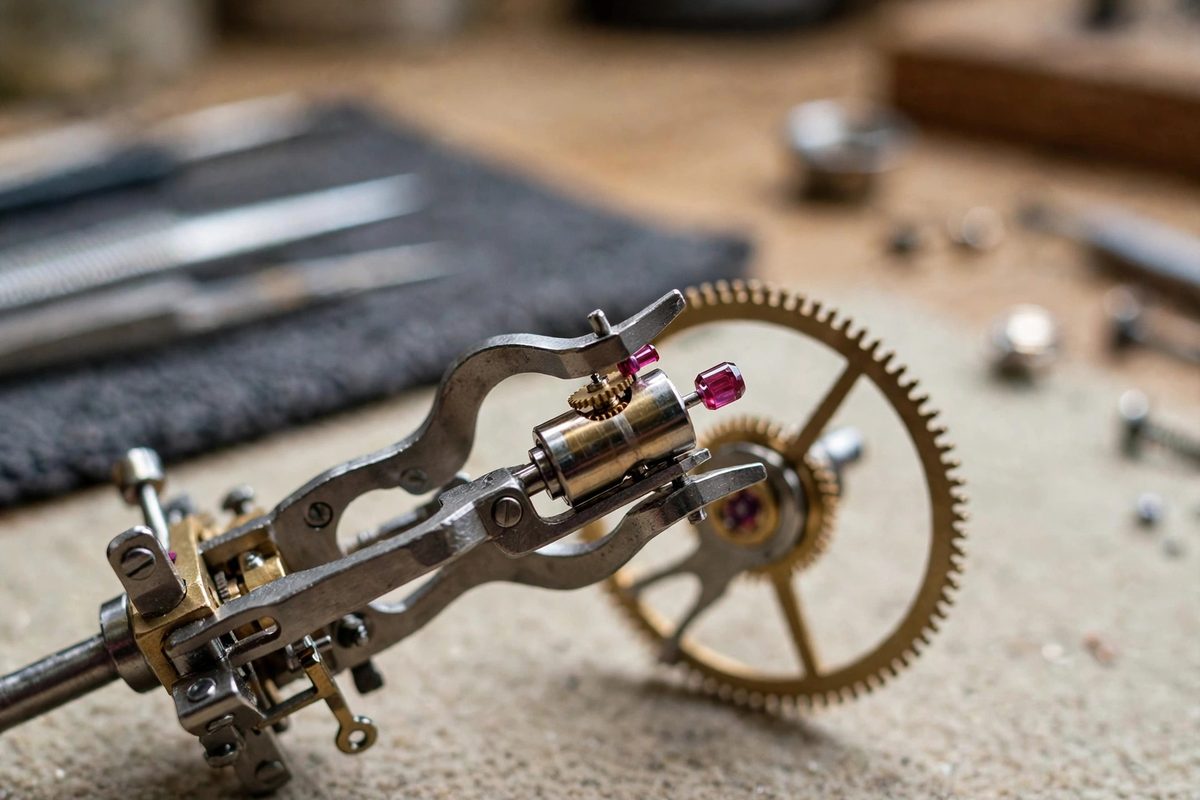
In a lever escapement, the impulse jewel (roller jewel) is the tiny ruby pin on the balance roller that the pallet fork's horns engage to give the balance its push. Its alignment, its position relative to the roller and the fork, determines whether the escapement unlocks cleanly, delivers impulse symmetrically, and banks safely. A misaligned roller jewel causes poor amplitude, uneven beat, and in bad cases a watch that stops. It is one of the smallest components in the movement and one of the most consequential.
What the roller jewel does
Each oscillation, the pallet fork's horns capture the roller jewel, and as the fork moves, the jewel transmits the impulse to the balance, sustaining its swing. The jewel also unlocks the escapement: its entry into the fork horns begins the unlocking sequence. For this to work symmetrically in both directions, the jewel must sit at exactly the right angular position on the roller and project the correct distance. A jewel set too deep or shallow changes the depth of engagement; a jewel rotated off its correct angle makes one direction's impulse stronger than the other's, showing up as beat error.
Checking the alignment
With the balance removed, examine the roller jewel under magnification: it should be centered in its setting, upright (not tilted), and secured with shellac that is intact, not cracked or melted. The jewel's projection from the roller table must match the fork horns' slot depth; too little projection and the horns barely engage, risking missed impulse, while too much causes the jewel to bottom in the slot. Check the angular position against the roller's timing marks or a known-good reference; even a few degrees of rotation introduces measurable beat error.
Correcting position
Repositioning a roller jewel means warming the shellac just enough to soften it, moving the jewel with fine tweezers or a sharpened pegwood point, and letting it set. This is delicate: overheating destroys the shellac's hold and can damage the roller's temper, while too little heat cracks the jewel's setting when forced. Work under magnification with minimal, controlled heat, and verify the position after the shellac cools, since jewels can drift as the shellac sets. If the shellac is old and crumbling, clean it out completely and re-shellac rather than trying to adjust in degraded material.
Verifying in the movement
After any roller jewel work, reassemble and check the escapement's function: the beat error should be minimal, amplitude healthy and symmetric, and the fork should snap crisply between banking pins with the balance removed (the fork freedom test). Listen to the tick: an even, crisp tick-tock indicates symmetric impulse, while an uneven beat suggests the jewel still sits off-angle. A timing machine makes this objective, showing beat error numerically; adjust until it reads near zero. Final verification is on the wrist: the watch should run consistently in multiple positions.
When replacement is needed
A chipped, cracked, or worn roller jewel cannot be aligned into correctness; it must be replaced with the correct size and shape for the movement. Roller jewels come in specific dimensions, and a wrong-size jewel creates exactly the engagement problems alignment is meant to fix. Source the correct part, set it in fresh shellac at the correct position, and verify as above. Do not reuse a damaged jewel to save time; the escapement's reliability depends on this pin.
Centered, upright, correctly projecting, and at the right angle: the roller jewel is a millimeter of ruby carrying the whole movement's timekeeping. Align it with the respect it deserves.
Related Guides
- Lubricating Pallet Jewels With High Viscosity Oil: The pallet jewels, the two small ruby blocks on the pallet fork that the escape wheel teeth push against, are among the most critical lubrication
- Regulating Hairspring Collet Flatness on Balance Staffs: The hairspring breathes concentrically only if it starts flat and true, and the collet, the tiny collar that pins the hairspring's inner end to the
- Poising Balance Wheels on Screwed Rim Escapements: A balance wheel that is not poised, its weight unevenly distributed around its rim, runs fast in some positions and slow in others. On a screwed-rim