
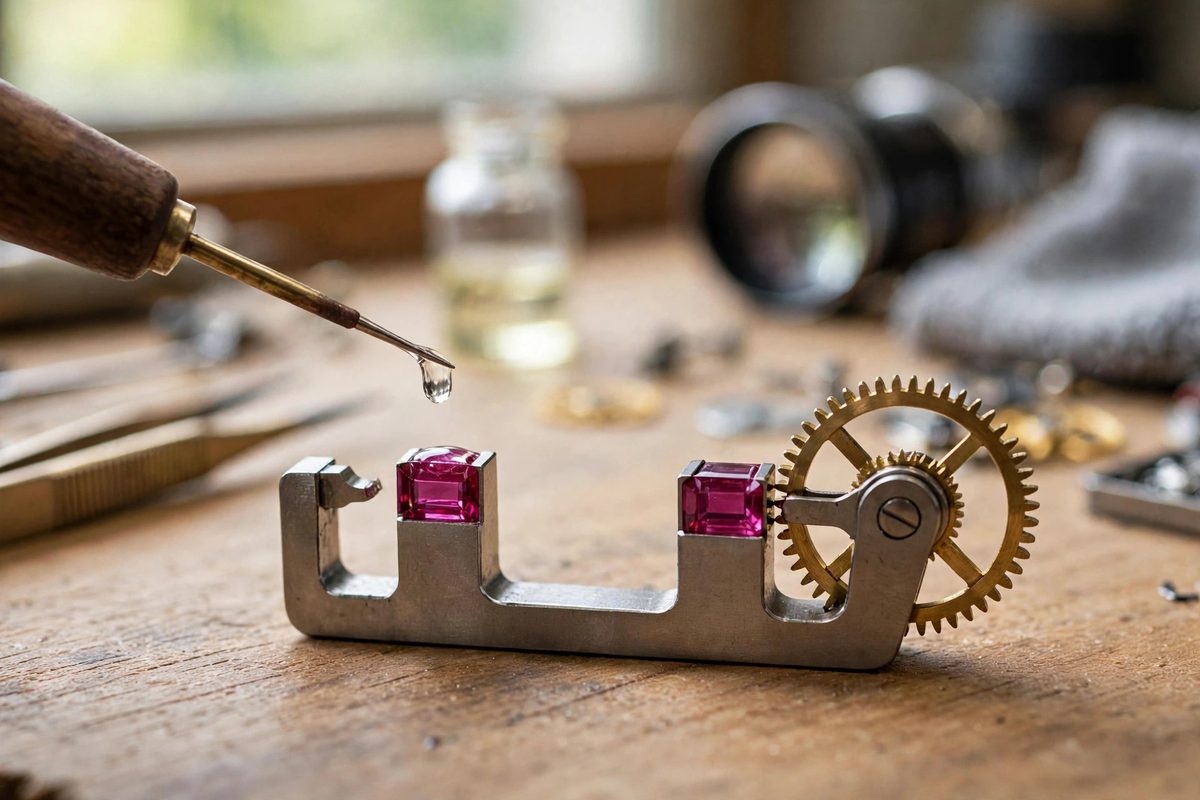
The pallet jewels, the two small ruby blocks on the pallet fork that the escape wheel teeth push against, are among the most critical lubrication points in a mechanical watch. They see high-frequency sliding contact under load, thousands of interactions per hour, and the oil there determines the efficiency of the entire escapement. Too little oil and friction eats amplitude; too much and the oil migrates, gumming the works. High-viscosity oil, applied in exactly the right microscopic quantity, is the standard, and the technique is one of the defining skills of watchmaking service.
Why the pallet jewels need special oil
Most of a watch's jewels are plain bearings: a rotating pivot in a hole, lubricated with a medium oil that stays put by capillary action. The pallet jewels are different. They do not rotate; they slide, as the escape wheel teeth sweep across their impulse faces with a wiping action under significant pressure. This sliding contact needs an oil that resists being squeezed out from between the surfaces, which means high viscosity: a thicker oil maintains its film under the wiping pressure where a thin oil would be pushed aside. But high viscosity brings its own problem, a tendency to creep and migrate, which is why pallet oils are formulated with additives that resist spreading, and why the quantity applied must be minimal. The oil choice is a compromise engineered for this exact contact, and substituting a general watch oil changes the escapement's behavior measurably.
Preparation: clean and epilame
Oil goes onto clean parts or not at all. During service, the pallet fork is cleaned thoroughly, removing every trace of old, degraded oil, because old oil mixed with new oil performs like old oil. Many watchmakers treat the pallet jewels and the escape wheel teeth with epilame, a surface treatment that makes the metal and ruby repel oil, confining the lubricant to exactly where it is placed. Epilame is the professional answer to the migration problem: with treated surfaces, the tiny oil deposit stays on the jewel's impulse face instead of creeping across the pallet fork. Whether or not you use epilame, the parts must be surgically clean and handled with care; a fingerprint's worth of contamination in the escapement is a lubrication failure waiting to happen.
Applying the oil: less than you think
The quantity of oil on a pallet jewel is measured in fractions of a microliter: a tiny, glistening film on the impulse face of each jewel, visible under magnification as a slight wetting, not a droplet. Apply with a fine oiler, touching the oiler to the jewel's impulse face and letting capillary action draw off a minute amount. The classic technique oils the escape wheel teeth instead: a tiny amount on several teeth, which then transfers to the pallet jewels during running, distributing itself naturally across the contact. Either method demands restraint that feels absurd the first time; beginners invariably apply ten times too much. Under magnification, the correct amount barely changes the jewel's appearance. If you can see a distinct bead of oil, there is too much. Excess oil migrates to the pallet fork, the guard pin, and eventually the balance, each migration degrading performance.
Verifying the lubrication
The proof of pallet lubrication is in the watch's performance. After assembly, check the amplitude: a well-lubricated escapement transmits power efficiently, and the balance amplitude reflects that efficiency. Compare against the expected amplitude for the movement; low amplitude with a clean, correctly assembled movement points at the escapement, and the pallet jewels are the first suspect. Listen to the escapement with a timing machine or even by ear: a dry escapement has a harsh, scratchy quality to its tick, while a properly lubricated one sounds clean and crisp. If the watch runs well initially and then degrades over weeks, suspect oil migration, too much oil applied, and plan to redo the job with less. Experience teaches the quantity; the timing machine grades your work.
Service intervals and oil aging
Even perfect pallet lubrication has a lifespan. Watch oils oxidize and thicken with age, and the pallet jewels, with their high-contact-stress sliding, degrade their oil faster than the plain bearings do. This is a major reason mechanical watches need periodic service: the escapement is usually the first thing to suffer as oil ages. During service, all old oil is removed and replaced; topping up old oil with new is never acceptable, since the degraded oil contaminates the fresh. Store watch oils properly, sealed, cool, and dark, and discard oil that has thickened or changed; the oil in your oiler cup has a working life measured in hours, not days. The pallet jewels reward this discipline with years of crisp, efficient timekeeping between services.
Clean the parts, treat the surfaces, apply a film so thin it barely shows, and verify with amplitude and sound. Pallet jewel lubrication is watchmaking in miniature: invisible to the wearer, decisive in the performance, and mastered only through deliberate practice.
Related Guides
- Escapement Impulse Roller Jewel Alignment: In a lever escapement, the impulse jewel (roller jewel) is the tiny ruby pin on the balance roller that the pallet fork's horns engage to give the
- Regulating Hairspring Collet Flatness on Balance Staffs: The hairspring breathes concentrically only if it starts flat and true, and the collet, the tiny collar that pins the hairspring's inner end to the
- Poising Balance Wheels on Screwed Rim Escapements: A balance wheel that is not poised, its weight unevenly distributed around its rim, runs fast in some positions and slow in others. On a screwed-rim