
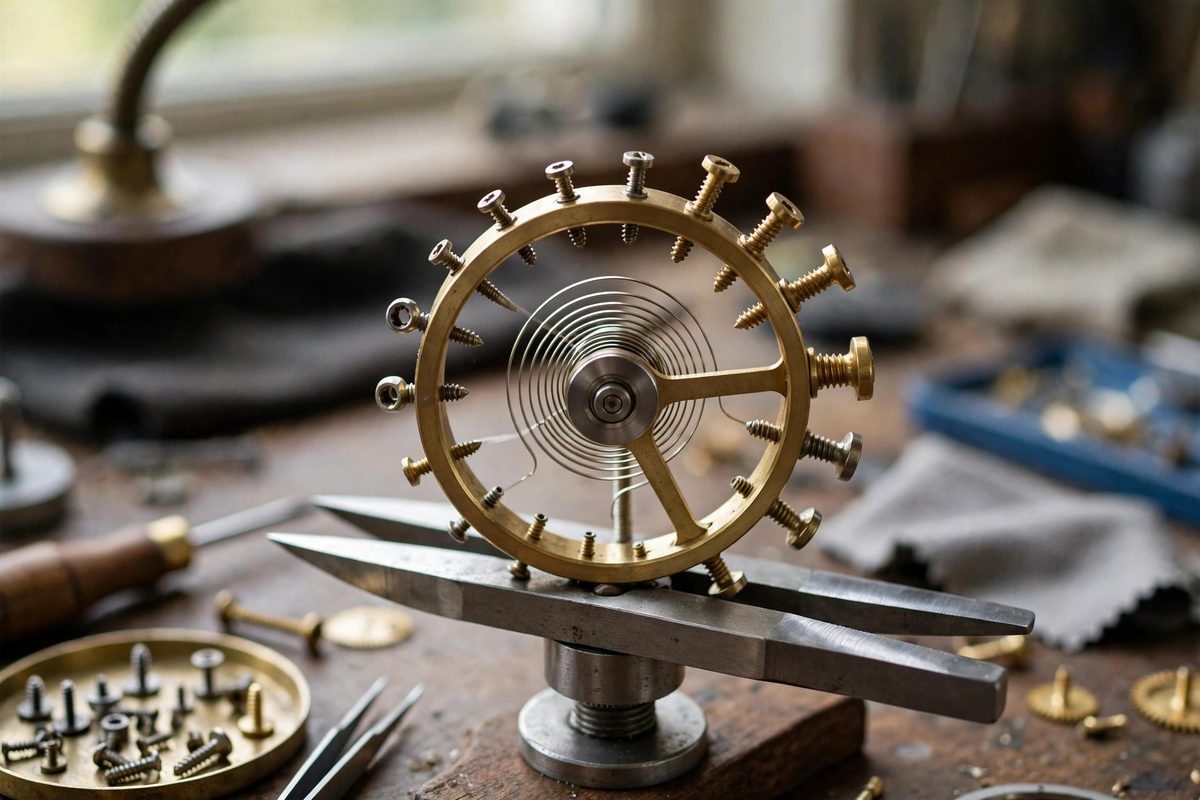
A balance wheel that is not poised, its weight unevenly distributed around its rim, runs fast in some positions and slow in others. On a screwed-rim balance, poising is done by adjusting the rim screws, moving weight in or out to true the wheel's center of mass to its axis. It is patient, precise work, and it is the foundation that all later timing adjustments stand on.
What Poising Corrects
An unpoised balance has its center of mass offset from the rotation axis, so gravity pulls it differently depending on the watch's position. The classic symptom is a large positional variation: the watch runs notably faster dial-up than crown-down, or vice versa. No amount of regulator adjustment fixes this, because the regulator shifts the average rate while poising fixes the spread between positions. Poise first, regulate second; the order is not negotiable because regulating an unpoised balance just centers a moving target.
Static Poising Setup
Static poising checks the wheel at rest. Mount the balance on a poising tool, a pair of level parallel jaws, with the staff horizontal, and let the wheel settle. The heavy side rotates to the bottom. Mark it, rotate the wheel ninety degrees, and check again; a truly poised wheel stays wherever you put it. Work in a still room, because air currents move a light balance enough to lie to you. The staff pivots must be clean and the tool's jaws level, or the test measures the tool's errors instead of the wheel's.
Adjusting the Screws
Screwed rims carry screws around the circumference, and each screw is a movable weight. To correct a heavy spot, either remove weight from the heavy side by backing screws out or turning them to a lighter setting, or add effective weight to the light side. Screws often come in sets of different weights, and swapping a heavy screw for a light one at the right position is the fine adjustment. Move screws in small steps and recheck often; poising converges by iteration, and overshooting means undoing work. Keep the screws' slots aligned radially for tidiness, though the alignment itself does not affect poise.
Dynamic Poising and Timing Machine Checks
Static poise gets the wheel close; dynamic poise verifies it in motion. On the timing machine, compare the rate in multiple positions, dial up, dial down, and the four vertical positions. Residual poise error shows as a consistent pattern: fast in the positions where the heavy spot hangs low, slow where it hangs high. Correlate the pattern to the wheel's angular position and adjust the screws at the indicated spots. The timing machine turns poising from feel into measurement, and the iteration goes much faster with its feedback.
Poise Versus Rate Adjustment
The same screws that poise the wheel also adjust the mean rate: moving screws outward slows the watch, moving them inward speeds it, because the change in radius changes the moment of inertia. This dual role means poising and rating interact. The disciplined sequence is to poise first with opposed screw pairs moved equally, which changes poise without changing rate, then adjust the mean rate with all screws moved together, which changes rate without changing poise. Mixing the two operations randomly produces a wheel that is neither poised nor rated, and the only fix is to start the sequence over properly.
Poise the screwed-rim balance statically, verify dynamically, and keep poising adjustments separate from rate adjustments. The wheel will then run true in every position, and the regulator gets to do fine work on a solid foundation.
Related Guides
- Regulating Hairspring Collet Flatness on Balance Staffs: The hairspring breathes concentrically only if it starts flat and true, and the collet, the tiny collar that pins the hairspring's inner end to the
- Lubricating Pallet Jewels With High Viscosity Oil: The pallet jewels, the two small ruby blocks on the pallet fork that the escape wheel teeth push against, are among the most critical lubrication
- Escapement Impulse Roller Jewel Alignment: In a lever escapement, the impulse jewel (roller jewel) is the tiny ruby pin on the balance roller that the pallet fork's horns engage to give the