
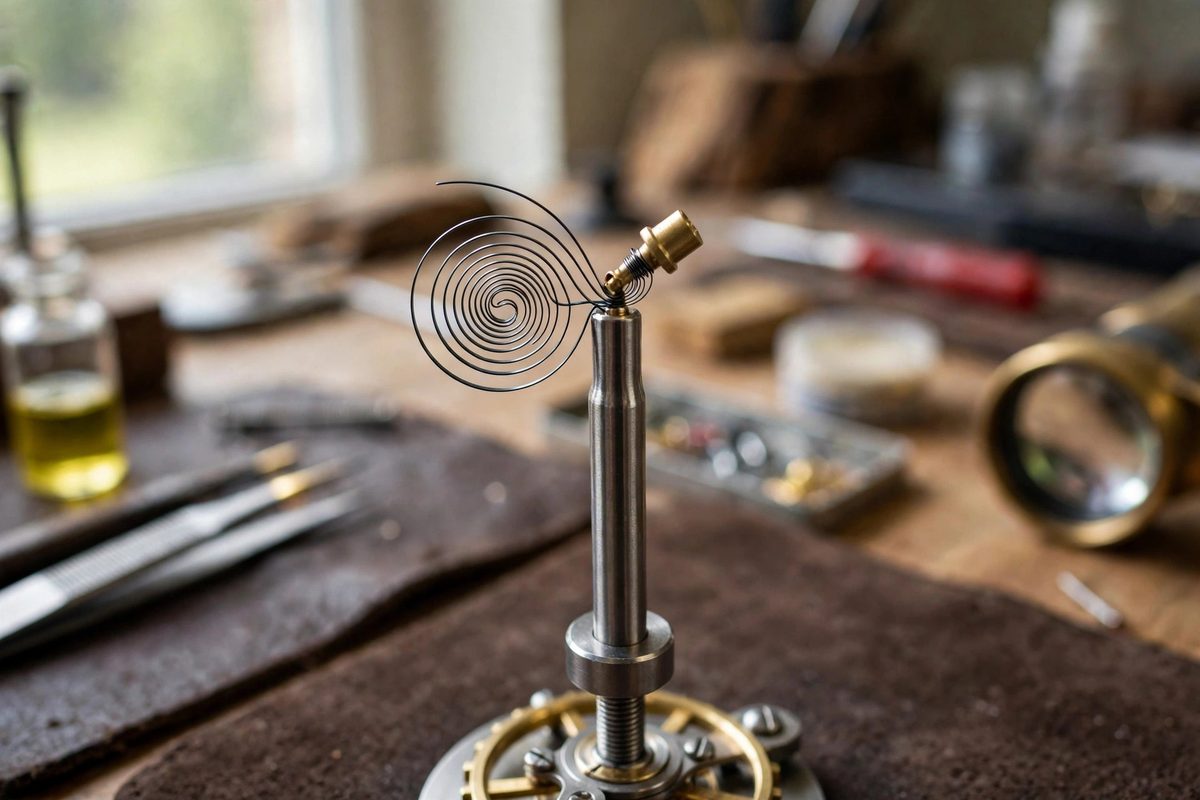
The hairspring breathes concentrically only if it starts flat and true, and the collet, the tiny collar that pins the hairspring's inner end to the balance staff, is where flatness begins. A collet that sits tilted on the staff cants the entire hairspring, and no amount of later truing fully compensates. Getting the collet flat and centered is foundational regulating work.
What the Collet Does
The collet grips the balance staff and holds the inner terminal of the hairspring. Its position sets the hairspring's height relative to the balance wheel and its concentricity with the staff. If the collet is not perpendicular to the staff, the hairspring leaves the collet at an angle, and the whole spring sits tilted; the coils then breathe eccentrically, expanding more on one side than the other. That eccentric breathing shifts the center of gravity of the oscillating system as it runs, which shows up as positional rate variation: the watch runs differently dial-up versus pendant-down. Many positional errors blamed on poising are actually collet problems, because a tilted hairspring mimics an out-of-poise balance.
Checking Collet Flatness
Remove the balance assembly and examine the collet under magnification with the staff vertical. The collet should sit square on the staff with its top surface level; sight across it against a reference, or observe the hairspring's inner coil as it leaves the collet. A telltale sign of a tilted collet is a hairspring that looks flat in the middle but dips or rises at the inner terminal. Another check: with the balance in a truing caliper or held in tweezers, rotate it slowly and watch the inner coil's height relative to a fixed pointer. Any wobble synchronous with rotation points to the collet. Also verify the collet is centered on the staff; an off-center collet throws the spring eccentric even if it is flat.
Correcting a Tilted Collet
Correction is done with the hairspring removed or protected, using smooth-jawed pliers or a collet adjusting tool. Grip the collet, not the hairspring, and apply tiny corrective bends, checking flatness after each touch. The metal is small and work-hardens, so use minimal force and few attempts; repeated bending fatigues the collet and risks cracking it. If the collet is a friction fit that has loosened, it may need closing slightly for a secure grip on the staff, since a loose collet shifts under shock and undoes the adjustment. Some watchmakers prefer to replace a badly damaged collet rather than fight it, which is honest workmanship: the part is small, but its influence is large.
Refitting the Hairspring True
Once the collet is flat, refit the hairspring so the inner terminal sits level in the collet and the spring lies in a single plane. Pin or glue the terminal according to the collet type, keeping the joint minimal; excess adhesive or a bulky pin adds weight asymmetrically and disturbs the breathing. Verify the spring is flat by sighting across the coils and concentric by checking the gap between the inner coil and the collet is even all around. Then check the spring's height relative to the balance arms and the stud: the spring must clear the balance wheel and sit level in the movement. A hairspring that is flat but mounted at the wrong height will touch the wheel or the bridge under shock.
Verifying in the Movement
Install the balance and observe the breathing with the movement running. The coils should expand and contract symmetrically around the staff, with no coil touching its neighbor and no visible wobble of the spring's plane. Check the rate in multiple positions; a collet correction often improves the positional spread noticeably. Then check the beat: an eccentric hairspring can also disturb the beat rate, and correcting the collet may require re-setting the beat via the stud position. Final regulation of the rate with the regulator pins or screws comes last, after the geometry is right. Regulating a watch with a tilted collet is like tuning a piano with a cracked soundboard; fix the foundation first.
The collet sets the plane the hairspring breathes in. Check it flat and centered, correct it with minimal force, refit the spring true, and verify the breathing in the running movement. Positional consistency starts at this tiny collar.
Related Guides
- Poising Balance Wheels on Screwed Rim Escapements: A balance wheel that is not poised, its weight unevenly distributed around its rim, runs fast in some positions and slow in others. On a screwed-rim
- Lubricating Pallet Jewels With High Viscosity Oil: The pallet jewels, the two small ruby blocks on the pallet fork that the escape wheel teeth push against, are among the most critical lubrication
- Escapement Impulse Roller Jewel Alignment: In a lever escapement, the impulse jewel (roller jewel) is the tiny ruby pin on the balance roller that the pallet fork's horns engage to give the