
Epoxy cures through an exothermic reaction: as the resin and hardener crosslink, they release heat. In a thin coating that heat dissipates harmlessly into the air. In a deep pour, the mass of curing resin insulates itself, the heat builds, and the rising temperature accelerates the reaction, which releases more heat. This feedback loop is called thermal runaway, and it is the reason deep pours crack, yellow, smoke, or in extreme cases ignite. Controlling exotherm is not an advanced technique; it is the fundamental skill of deep casting.
The Runaway Mechanism
Chemical reaction rates roughly double with every 10 degrees Celsius of temperature rise, and epoxy curing is no exception. In a deep pour, the center of the mass cannot shed heat fast enough: the surface and edges cool into the mold and the air, but the core keeps warming. As the core warms, it cures faster, releasing heat faster, warming further. Once this loop takes hold, temperatures can climb far beyond the resin's design range in minutes. The visible consequences arrive in sequence: first the resin gels prematurely and traps bubbles, then it yellows or darkens as the heat degrades the polymer, then it cracks as the overheated core shrinks against the already-set outer layers, and in the worst case it chars or smokes. The critical insight is that the danger scales with volume and depth, not just with the amount of resin: a wide, shallow pour of the same volume is safe where a deep, narrow one runs away.
Choosing a Deep-Pour Formulation
Resins are formulated for maximum pour depths, and this rating is the single most important number on the product. A tabletop or coating epoxy rated for pours up to a quarter inch will run away catastrophically at two inches; a deep-pour casting resin rated for two inches per layer handles that depth because its chemistry releases heat more slowly. The slower cure is the mechanism: deep-pour resins use hardeners and reaction profiles that spread the exotherm over many hours instead of concentrating it. Always work within the rated depth, and treat the rating as a maximum, not a target. Pouring to exactly the rated depth in a warm shop with no airflow is still riskier than pouring slightly under it in cool, ventilated conditions. When a project needs more depth than one pour allows, the answer is multiple sequential pours, not one heroic one.
Staging Multiple Pours
Building depth in layers is the standard solution, and the timing between layers matters. Each pour must cure enough to support the next without the fresh resin's heat re-liquefying or stressing the layer below, but not so fully cured that the layers fail to bond. The usual window is when the previous layer has gelled firmly and cooled back to near room temperature but is still chemically active, often described as firm but tacky. Pouring onto a fully cold-cured layer requires scuffing and sometimes a bonding approach to prevent delamination. Pouring onto a still-warm layer stacks the exotherms and defeats the purpose of layering. For very deep projects, some casters extend the interval to a full day between pours, accepting slower progress for maximum safety. Patience here is thermal management.
Environmental Cooling
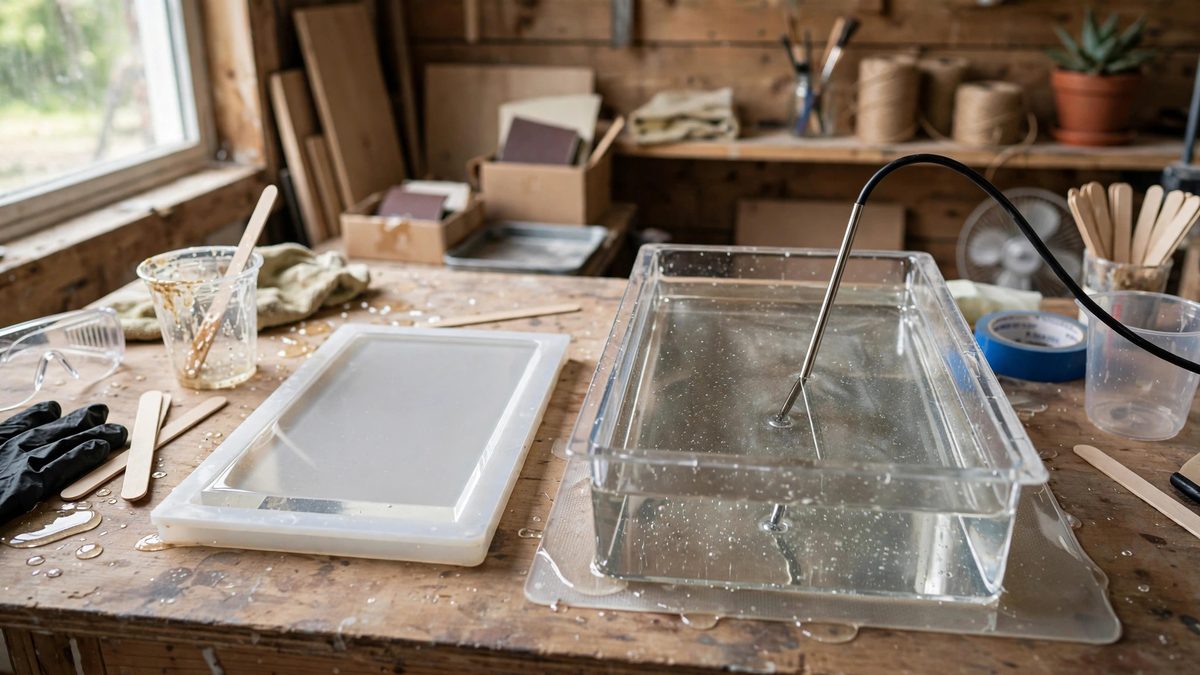
The shop environment is a cooling system, and you can tune it. Cooler ambient temperatures slow the reaction and give heat more time to escape; many experienced casters pour in the coolest part of the day or run air conditioning during large casts. Airflow across the mold surface carries heat away from the top of the pour, which is often the hottest zone's nearest exit. A gentle fan, not blowing dust into the resin, makes a measurable difference. The mold itself matters: a mold sitting on an insulating surface traps heat underneath, while one on a conductive surface or elevated for airflow sheds it. Some casters place molds on aluminum sheet or wire racks specifically to improve underside cooling. Water baths are an advanced option for small molds, but they introduce moisture risks and are unnecessary if pour depth and ambient control are handled.
Monitoring During the Cure
For any pour near the rated depth limit, monitor the temperature. An inexpensive infrared thermometer aimed at the pour surface gives you a trend line; a steady climb that keeps accelerating is the warning sign. If the surface temperature climbs rapidly and the resin is still liquid, you are watching runaway begin. Emergency responses: increase airflow immediately, and if the pour is in a removable mold, getting it onto a cool conductive surface helps. Do not pour water on curing epoxy and do not try to stir it; both make things worse. The better emergency is the one you never need: staying well within rated depth, in a cool shop, with staged pours. Also monitor for the subtler failure, a pour that gets hot but not catastrophically so: it may look fine but cure with internal stress that cracks weeks later. If a pour ran hotter than expected, inspect it carefully before investing more work on top of it.
Deep-pour epoxy work is heat management wearing a craft disguise. Respect the rated depth, stage your pours, keep the shop cool with moving air, and watch the temperature on anything ambitious. The resin will cure on its own schedule; your job is making sure that schedule never becomes a sprint.
Related Guides
- Surface Skimming Skin Elimination on Curing Epoxy: Epoxy resin sometimes cures with a thin, wrinkled, or rubbery skin on the surface while the body underneath is fine. This surface skimming defect
- Thermal Mass Cooling Ratios in Deep Resin Blocks: Deep resin casting, pouring blocks, river tables, and sculptural masses inches thick, is a thermal management problem disguised as an art project
- Pressure Pot PSI Calibration to Prevent Epoxy Micro-Voids: Micro-voids, the tiny bubbles trapped in cured epoxy that show up as pinholes and cloudy spots, are a pressure problem with a pressure solution. A