
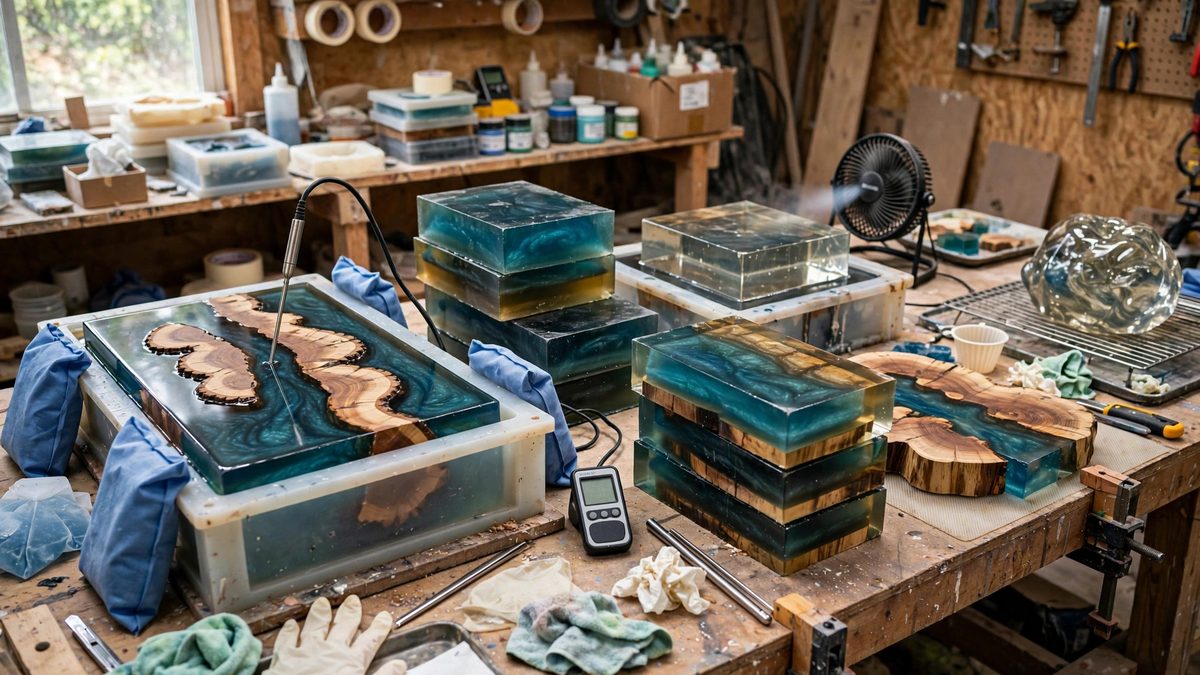
Deep resin casting, pouring blocks, river tables, and sculptural masses inches thick, is a thermal management problem disguised as an art project. Epoxy cures exothermically: the chemical reaction generates heat, and in a deep mass that heat cannot escape fast enough. The center of the pour gets hotter than the surface, cures faster, and the resulting thermal gradients cause cracking, yellowing, warping, and in extreme cases a runaway exotherm that boils, smokes, or catches fire. Cooling ratios, how heat generation balances against heat loss, govern whether a deep pour succeeds or fails.
The Exotherm Problem in Deep Masses
In a thin pour, heat escapes through the large surface area relative to the volume, and the resin cures at near room temperature. In a deep block, the volume grows faster than the surface area as dimensions increase; the center becomes thermally insulated by the surrounding resin, and its temperature climbs. Hotter resin cures faster, generating heat faster, which raises the temperature further: the feedback loop that defines thermal runaway.
The symptoms scale with the severity. Mild overheating yellows the resin and causes internal stresses that crack days later. Moderate overheating warps the block as the hot center expands against the cooler shell. Severe overheating boils the resin, fills it with bubbles, and can produce enough heat to scorch molds or ignite nearby materials. Respect the exotherm; it does not negotiate.
Pour Depth and the Layer Strategy
The standard defense is pouring in layers: instead of one deep mass, build the block as a series of thinner pours, each allowed to cool and partially cure before the next. Each layer's heat dissipates before the next layer adds its own, breaking the feedback loop. The layer thickness that is safe depends on the resin formulation; deep-pour resins tolerate thicker layers than general-purpose resins, but every resin has a limit.
Time the layers correctly. Pour the next layer when the previous one has cooled and firmed but is still chemically active enough to bond; too soon and the heats combine, too late and the layers may not bond fully, creating a visible seam or a delamination plane. The resin's documentation gives the window; the shop's temperature modifies it.
Cooling the Mass Actively
Environmental cooling helps: pour in a cool room, use fans to move air over the mold's surfaces, and consider the mold material. Metal and thin silicone molds conduct heat away better than thick wooden molds, which insulate. Some casters set molds on cooling surfaces or circulate air beneath them; every degree removed from the surface steepens the gradient that pulls heat from the center.
- Monitor the pour's temperature with an infrared thermometer; the surface temperature predicts the center's trajectory.
- If the surface climbs rapidly, increase airflow and consider pausing subsequent layers.
- Never pour deeper than the resin's rated maximum in a single layer, regardless of schedule pressure.
- Keep a fire-safe area around large pours; runaway exotherm is rare but real.
Resin Selection for Deep Work
Deep-pour formulations exist specifically for this challenge: slower hardeners, lower exotherm profiles, and extended cure times that spread the heat generation over hours instead of minutes. Using a general-purpose resin for a deep block because it is on hand is the most common cause of thermal failures. The formulation is the primary thermal management tool; everything else is secondary.
Read the technical data for maximum pour depth and mass, and treat those numbers as limits under ideal conditions. Hot shops, insulating molds, and embedded objects that displace resin unevenly all reduce the safe depth. When in doubt, pour thinner layers; the extra time costs less than a ruined block.
Embedded Objects and Thermal Behavior
Objects embedded in the pour change the thermal picture. Dense objects (stones, metal) act as heat sinks that moderate the exotherm locally; insulating objects (wood, foam) trap heat. Large embedded pieces also displace resin, creating thin resin sections that cure differently from thick ones. Plan the pour around the embedments, not in spite of them, and consider pouring in thinner layers around complex inclusions.
Seal porous embedments before pouring. Wood and similar materials release air bubbles as they heat in the curing resin, and those bubbles rise through the pour, marring the surface and creating voids. Sealing is a separate step from thermal management, but the two interact: a bubbling embedment in an overheating pour is a compounded failure.
Choose the deep-pour resin, layer within its limits, cool the environment, watch the temperature, and respect the exotherm. Deep resin blocks are thermodynamics with a deadline; manage the heat and the art follows.
Related Guides
- Exotherm Temperature Control in Deep Epoxy Pours: Epoxy cures through an exothermic reaction: as the resin and hardener crosslink, they release heat. In a thin coating that heat dissipates harmlessly
- Surface Skimming Skin Elimination on Curing Epoxy: Epoxy resin sometimes cures with a thin, wrinkled, or rubbery skin on the surface while the body underneath is fine. This surface skimming defect
- Pressure Pot PSI Calibration to Prevent Epoxy Micro-Voids: Micro-voids, the tiny bubbles trapped in cured epoxy that show up as pinholes and cloudy spots, are a pressure problem with a pressure solution. A