
Micro-voids, the tiny bubbles trapped in cured epoxy that show up as pinholes and cloudy spots, are a pressure problem with a pressure solution. A pressure pot squeezes the casting while it cures, compressing trapped air bubbles so small they cannot be seen and forcing dissolved air to stay in solution. But the pot only works if the pressure is right: too little and the bubbles survive, too much and you risk the pot, the mold, or the casting itself. Calibration is the whole craft.
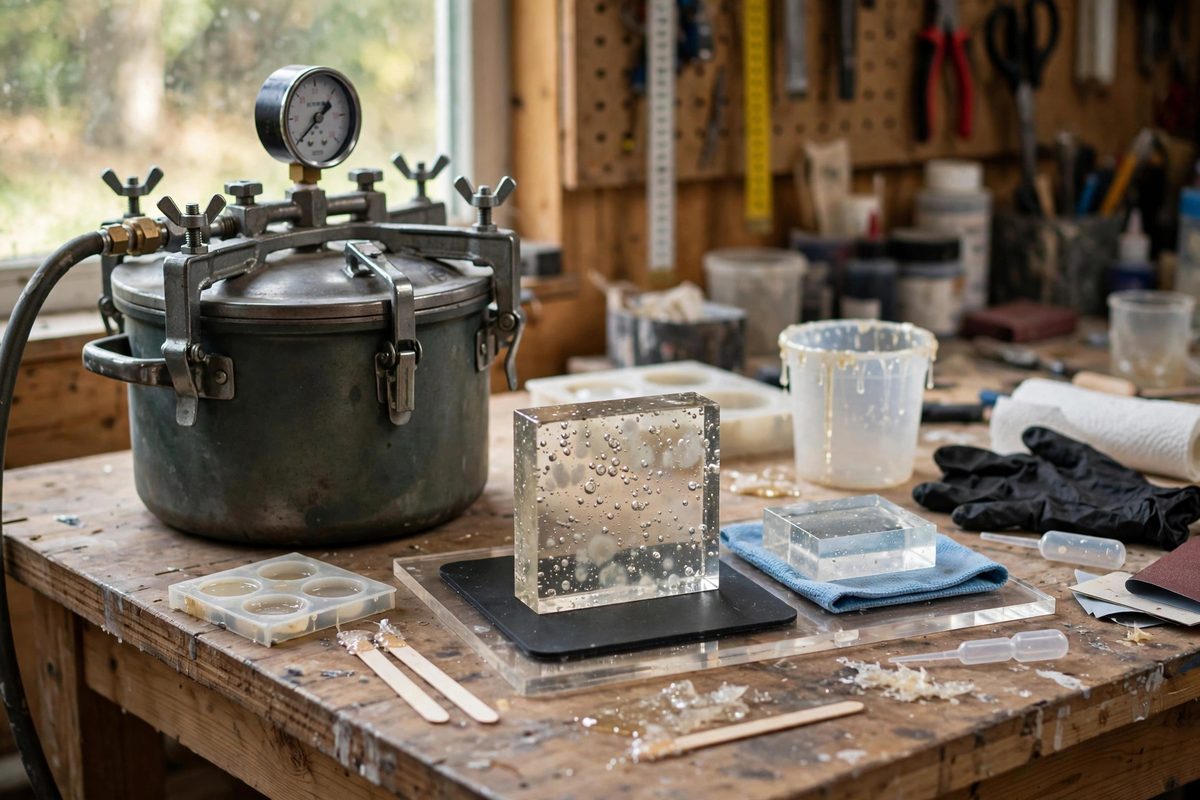
How pressure eliminates bubbles
The physics is straightforward. A bubble's volume shrinks as the surrounding pressure rises, following the basic gas laws: double the absolute pressure and the bubble shrinks to roughly half its volume. At the pressures used in casting, typically in the range of 40 to 60 PSI above atmospheric, a visible bubble compresses down to a fraction of its original size, small enough to be invisible in the cured piece. The pressure also drives the air in the bubble into solution in the resin, so many bubbles do not just shrink, they disappear entirely.
This is different from vacuum degassing, which pulls bubbles out before the pour. Pressure casting crushes them after the pour. The two methods complement each other, but pressure alone handles most casting situations, and it has the advantage of working on the resin already in the mold, where vacuum cannot reach.
Finding the right pressure for the resin
Start with the resin manufacturer's guidance, since resin viscosity and cure behavior affect how much pressure is needed. As a general working range, most art epoxies respond well between about 40 and 50 PSI, with thicker or faster-curing resins benefiting from the higher end. The goal is the minimum pressure that reliably eliminates visible voids, not the maximum the pot can hold.
Calibrate with test castings, not finished pieces. Pour a small test mold with the same resin, same mix ratio, and same mold material as the real project, cure it at a candidate pressure, and inspect the result under magnification. Increase in modest steps until the voids disappear, then add a small margin for production. Every resin and mold combination has its own threshold, and guessing from someone else's numbers is how voids survive.
Pressurize early in the working time
Timing matters as much as pressure. The pot must reach full pressure while the resin is still fluid enough for bubbles to compress and for dissolved air to move. Pressurizing late, when the resin has already begun to gel, locks the bubbles in at whatever size they have reached. Get the mold into the pot and the pot up to pressure as quickly as practical after the pour, ideally within the first portion of the resin's working time.
This means having the pot ready before mixing: lid gasket checked, fittings tight, compressor or air supply connected. Mixing the resin and then discovering the pot needs attention wastes the most valuable minutes of the working time.
Pressure safety is not optional
A pressure pot is a pressure vessel, and it demands the respect that implies. Never exceed the pot's rated maximum pressure, which is stamped on the vessel or stated in its documentation. Inspect the gasket, lid clamps, and fittings before every use; a deteriorated gasket can fail suddenly under pressure. Keep the pressure relief valve functional and unobstructed, since it is the last line of defense if the regulator malfunctions.
Release pressure slowly at the end of the cure. Dropping the pressure suddenly while the resin is still soft can let compressed bubbles re-expand before the resin has fully hardened, undoing the entire point of the pressure cure. Wait until the resin has reached a firm cure, then bleed the pressure down gradually.
Mold behavior under pressure
Silicone molds compress slightly under pressure, which is usually harmless but can distort very thin mold walls or shift multi-part molds. Support flexible molds in a rigid outer container or mother mold so the pressure acts on the resin, not on reshaping the mold. Rigid molds need no special treatment beyond making sure the resin cannot be forced out through vents or parting lines, since pressure will find every leak the mold has.
Calibrate the pressure, pressurize early, respect the vessel, and support the mold. Micro-voids are not a mystery; they are what happens when any one of those four is neglected.
Related Guides
- Exotherm Temperature Control in Deep Epoxy Pours: Epoxy cures through an exothermic reaction: as the resin and hardener crosslink, they release heat. In a thin coating that heat dissipates harmlessly
- Surface Skimming Skin Elimination on Curing Epoxy: Epoxy resin sometimes cures with a thin, wrinkled, or rubbery skin on the surface while the body underneath is fine. This surface skimming defect
- Thermal Mass Cooling Ratios in Deep Resin Blocks: Deep resin casting, pouring blocks, river tables, and sculptural masses inches thick, is a thermal management problem disguised as an art project