
Turning jigs on the lathe often need to grip a workpiece by its bore, and the expanding mandrel is the elegant solution: a tapered plug that expands a slotted sleeve to grip the bore from the inside. Fitting the mandrel's collet correctly, with the right expansion range and contact, determines whether the work runs true or chatters, slips, and ruins the part.
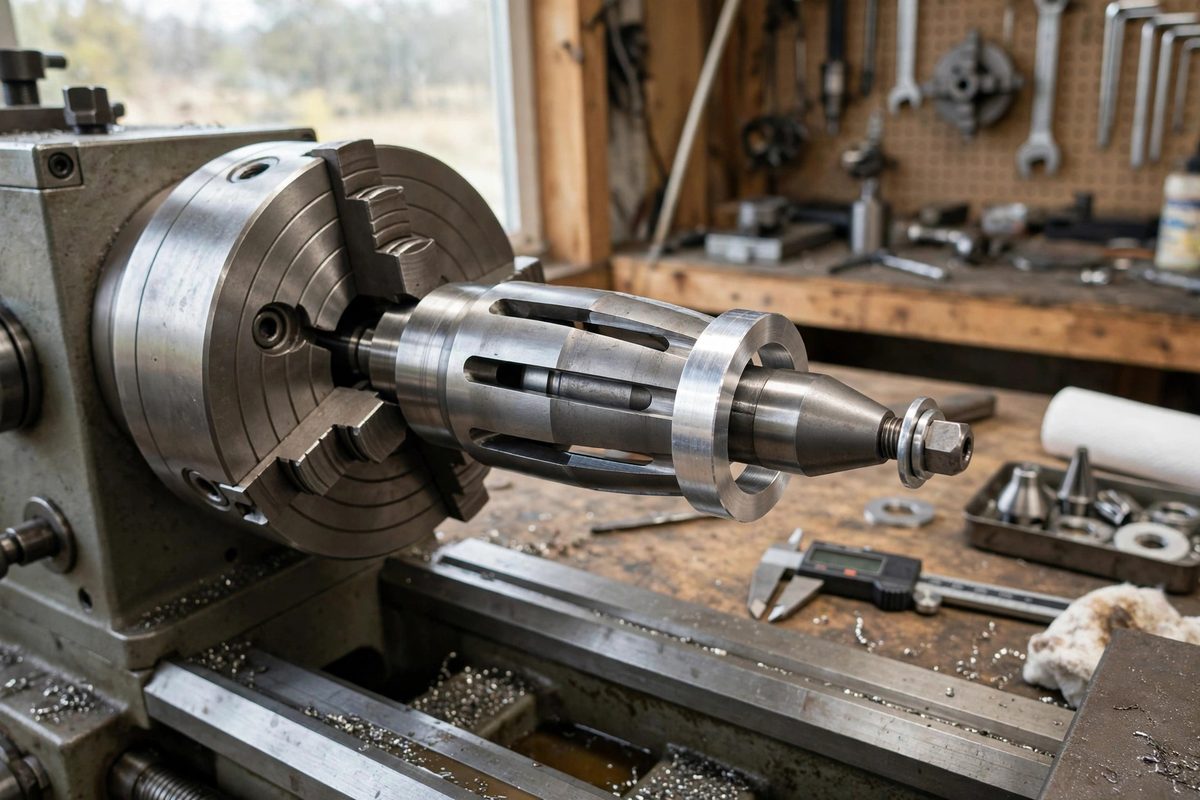
How Expanding Mandrels Work
The mandrel has a tapered section, and the collet, a slotted sleeve, rides on that taper. Drawing the collet up the taper with a nut or drawbar expands the sleeve's outer diameter; the slots let the sleeve grow without binding. The workpiece's bore slides over the relaxed collet, then expansion locks it concentrically. The beauty of the system is self-centering: the uniform expansion pushes the bore into concentricity automatically, as long as the bore is round and the collet expands evenly. The limitation is range: a given collet expands only a small amount, typically a few thousandths to a few hundredths of an inch, so the bore must be close to the collet's nominal size. This is a precision gripping method, not a universal chuck.
Sizing the Collet to the Bore
Measure the workpiece bore accurately; the collet's relaxed diameter should be slightly under the bore, and its expanded diameter slightly over, so the working expansion falls in the middle of the collet's range. Too small a collet must expand to its limit to grip, which stresses the sleeve unevenly and gives poor contact; too large a collet cannot enter the bore at all. For production work, make or buy collets in steps covering the bore sizes you run. The collet's outer surface should be smooth and true; nicks or bell-mouthing from over-expansion create high spots that mark the bore and reduce grip. A collet is a consumable precision tool: inspect it regularly and replace it when it no longer expands evenly.
Achieving Even Expansion
Even expansion depends on the taper and the slots. The mandrel's taper must be smooth, clean, and lightly lubricated; a dry or galled taper makes the collet cock sideways instead of expanding uniformly. The slots must be clean and deburred so the sleeve's segments move freely; a slot clogged with chips binds its segment, and the collet expands lopsided. Tighten the draw nut gradually, rotating the assembly by hand to feel for even resistance; a collet that tightens in jerks is binding somewhere. Verify concentricity with a dial indicator on the workpiece after gripping; runout at the work should be minimal. If the indicator shows runout, the cause is usually a dirty taper, a damaged collet, or a bore that is not round, in that order of likelihood.
Grip Force and Workpiece Safety
The expanding collet grips by friction, and the grip force must exceed the cutting forces with margin. Take light, sensible cuts on mandrel-held work, especially on the first passes; heavy interrupted cuts can spin the workpiece on the mandrel, which ruins the part and can throw it. The bore's surface matters: a smooth, clean bore grips better than an oily or rough one, so degrease the bore before mounting. Thin-walled workpieces need gentle expansion; over-tightening the mandrel bell-mouths thin bores, distorting the very precision the mandrel is supposed to provide. Tighten only until the work is secure, then check with a test cut. More force is not more precision; it is more distortion.
Mandrel Maintenance
Keep the taper and collet clean and lightly oiled; this is a precision sliding fit that lives in a chip-filled environment. Store collets so the slots cannot get bent; a dropped collet with a bent segment never expands evenly again. Check the drawbar threads and nut for wear, since a worn thread gives uneven draw and false tightness. Make dedicated mandrels for repeat jobs rather than readjusting one mandrel constantly; a mandrel set up for a specific bore and left alone holds its accuracy far longer than one that is continually reset. The expanding mandrel is one of the lathe's most precise workholding methods, and it stays precise exactly as long as it is maintained.
Expanding mandrels grip bores with self-centering precision when the collet is sized to the bore, the taper is clean, expansion is even, and force is moderate. Measure the bore, fit the collet to its middle range, verify with an indicator, and cut sensibly. Concentricity follows.
Related Guides
- Vacuum Hold-Down Plenum Grid Engineering: A vacuum hold-down table replaces clamps with atmospheric pressure, holding sheet stock flat and immobile across its whole surface while the spindle
- Modular Fixture Plate Hole Grid Pitch Standards: A fixture plate turns a CNC router bed into a universal workholding system: a flat plate drilled with a regular grid of holes that accept clamps
- Doweling Alignment Tolerance in Aluminum Fixtures: CNC fixtures locate workpieces repeatably, and dowel pins are the classic locating elements: precise, simple, and cheap. In aluminum fixtures, which
- Pneumatic Clamp Cylinder Sizing for Sheet Routing: Pneumatic clamps hold sheet stock on a CNC router with speed and repeatability that screws and toggle clamps cannot match, but only if the cylinders