
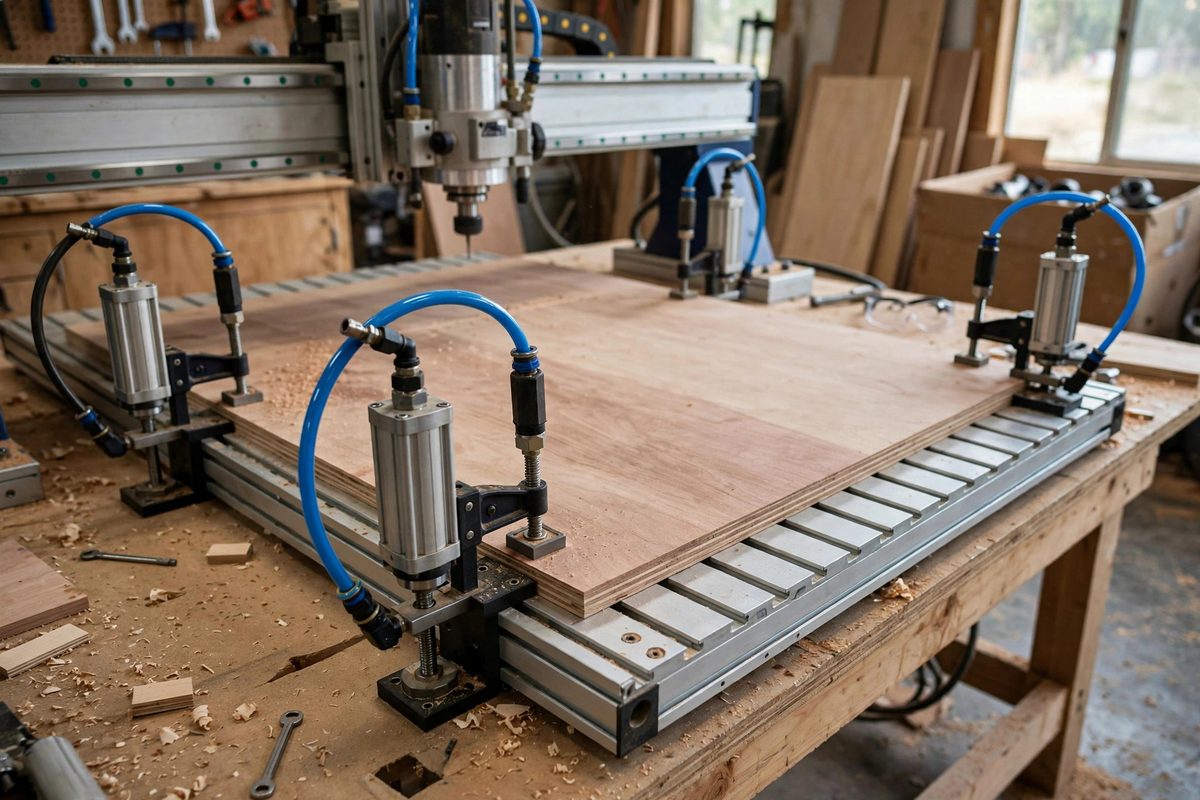
Pneumatic clamps hold sheet stock on a CNC router with speed and repeatability that screws and toggle clamps cannot match, but only if the cylinders are sized to the job. An undersized cylinder lets the sheet shift mid-cut; an oversized one wastes air, risks denting the stock, and cycles sluggishly. Sizing is a straightforward calculation of force, pressure, and geometry, and getting it right is what separates a fixture that just works from one that works all day without attention.
How much force the cut demands
The clamp's job is to resist the cutting forces trying to move the sheet. Routing forces depend on the cutter diameter, depth of cut, feed rate, and material, but for fixture design you do not need a precise cutting-force model; you need a conservative holding requirement. A common shop approach is to estimate the worst-case lateral cutting force for the heaviest operation the fixture will see, then require the clamping system to resist several times that force through friction.
Friction is the actual holding mechanism in most sheet fixtures: the clamp presses the sheet against the fixture bed, and friction between the sheet and the bed resists sliding. The friction force equals the clamping force times the coefficient of friction between the sheet and the bed surface. Smooth sheet on a smooth bed has a low coefficient, which is why fixture beds are often surfaced with a high-friction material or why clamps are positioned to press near the cutting action where leverage is smallest.
The cylinder force calculation
A pneumatic cylinder's theoretical force is pressure times piston area: a cylinder with a 2-inch bore at 80 PSI produces roughly 250 pounds of force on extension. In practice, apply an efficiency factor for seal friction and pressure losses, typically treating the cylinder as delivering about 85 to 90 percent of theoretical force. Then compare against the requirement: the total clamping force from all cylinders, times the friction coefficient, must exceed the worst-case cutting force with a healthy safety margin.
Size for the available shop pressure, not the cylinder's maximum rating. If the shop line runs at 80 PSI, calculate at 80 PSI, and consider what happens when the compressor cycles and line pressure dips. A fixture that holds at 90 PSI but slips at 70 will fail on a busy afternoon. Either regulate the fixture at a pressure the shop reliably maintains or size the cylinders so the minimum expected pressure still holds.
Bore size, stroke, and clamp geometry
Bore diameter sets the force; stroke sets the travel. Choose the stroke for the thickest stock the fixture will see plus clearance to load and unload: too short and the clamp cannot open enough for thick sheets, too long and the cylinder is bulky and slow. Most sheet fixtures need only a short stroke, an inch or two, since sheet thickness varies little.
Clamp geometry multiplies or divides the cylinder's force. A direct-acting cylinder pressing straight down delivers its full force to the sheet. A toggle or lever arrangement trades force for travel or vice versa: a lever that doubles the clamping point's travel halves the force there. Sketch the linkage, compute the mechanical advantage, and make sure the force at the sheet, not just at the cylinder rod, meets the requirement.
Speed, air consumption, and sequencing
Larger bores consume more air per cycle, which matters on a busy router where the compressor also feeds dust collection gates, air blast, and other fixtures. If the shop air supply is marginal, smaller cylinders at higher pressure, or fewer cylinders positioned well, beat brute force. Flow controls on the cylinder ports let you tune the clamp and release speed independently: fast enough for quick loading, gentle enough not to slam the sheet or bounce the clamp.
For fixtures with multiple clamps, sequence them so the sheet is located before it is clamped hard: light initial pressure or a locating clamp first, then full clamping force. Clamping hard on a mislocated sheet just holds it confidently in the wrong place.
Safety around pneumatic clamping
Pneumatic clamps store energy in the compressed air and move with real force. Keep hands clear of the clamp points during actuation, and design the control so clamps cannot fire unexpectedly: a deliberate two-step or guarded actuation for the clamping circuit is cheap insurance. Add a pressure switch or indicator that confirms clamping pressure before the cycle starts; cutting with unclamped or partially clamped stock is how sheets become projectiles.
Calculate the force, size to the shop's real pressure, mind the linkage geometry, and confirm pressure before cutting. Sized right, pneumatic clamps turn sheet loading into a one-button operation that holds all day.
Related Guides
- Vacuum Hold-Down Plenum Grid Engineering: A vacuum hold-down table replaces clamps with atmospheric pressure, holding sheet stock flat and immobile across its whole surface while the spindle
- Modular Fixture Plate Hole Grid Pitch Standards: A fixture plate turns a CNC router bed into a universal workholding system: a flat plate drilled with a regular grid of holes that accept clamps
- Doweling Alignment Tolerance in Aluminum Fixtures: CNC fixtures locate workpieces repeatably, and dowel pins are the classic locating elements: precise, simple, and cheap. In aluminum fixtures, which
- Expanding Mandrel Collet Fits for Lathe Turning Jigs: Turning jigs on the lathe often need to grip a workpiece by its bore, and the expanding mandrel is the elegant solution: a tapered plug that expands