
Pressure-treated lumber protects against rot and insects, but the preservative chemicals that do the protecting are corrosive to steel fasteners. The rim joist and sill plate connections on a deck sit at the dampest, most chemically active part of the structure, and a fastener that would last decades in dry indoor framing can fail in years there. Understanding the corrosion limits, which fasteners survive and which do not, is structural safety, not just longevity.
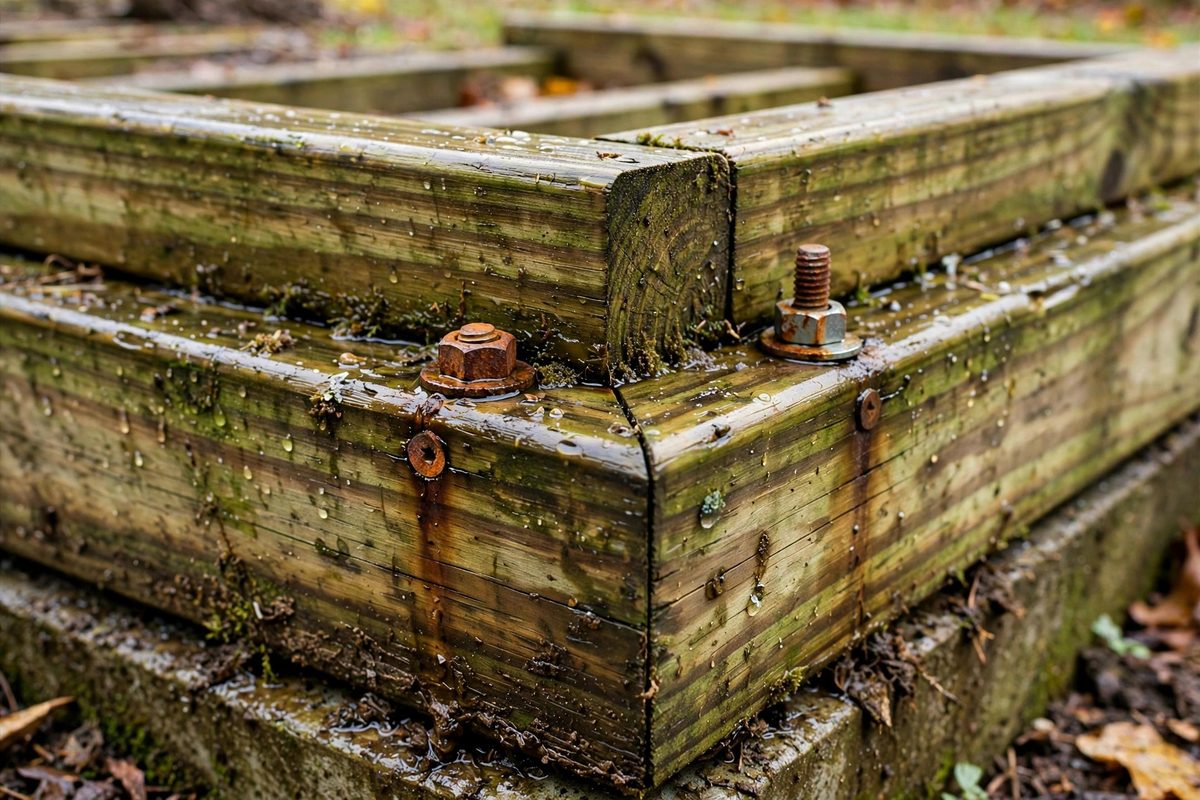
Why treated lumber eats fasteners
Modern pressure treatments use copper-based preservatives, and copper plus steel plus moisture forms a galvanic cell: the copper in the wood is cathodic to the steel fastener, and the moisture in the outdoor environment completes the circuit. The steel corrodes preferentially, sacrificing itself to protect the copper it touches. The wetter the connection stays, the faster this proceeds, which is why rim and sill connections, exposed to splashback and slow drying, corrode fastest.
Older treatments were worse in some ways and better in others, but the current copper-based formulations are consistently aggressive toward plain steel. The corrosion is often hidden: the fastener head looks fine while the shank inside the wood is thinning, so visual inspection of the surface dramatically underestimates the damage.
Which fasteners are acceptable
Hot-dip galvanized fasteners, with a thick zinc coating, are the minimum acceptable for pressure-treated lumber. The zinc corrodes preferentially, protecting the steel beneath, and the hot-dip process deposits a much thicker coating than electro-galvanizing, which matters because the coating is consumed over time. Stainless steel fasteners, typically the 304 or 316 grades, are the premium option: essentially immune to the preservative chemistry and the right choice for the most exposed or most critical connections, and for coastal environments where salt joins the attack.
Plain steel, electro-galvanized (the thin, shiny coating), and aluminum fasteners are all unacceptable in treated lumber. Plain and electro-galvanized steel corrode unacceptably fast; aluminum suffers its own galvanic reaction with the copper treatment. The fastener manufacturer's packaging usually states suitability for pressure-treated lumber explicitly; if it does not say so, assume it is not.
Connectors and the mixed-metal problem
Joist hangers, post bases, and other structural connectors must meet the same standard as the fasteners: hot-dip galvanized or stainless, rated for treated lumber. A stainless fastener in a plain-steel hanger just moves the corrosion to the hanger. Match the metals: use connectors and fasteners of compatible materials, and follow the connector manufacturer's fastener schedule exactly, since the structural rating assumes specific fasteners in specific holes.
Where dissimilar metals must meet, such as a stainless bolt through a galvanized hanger, the combination is generally acceptable in this application because both are corrosion-resistant and the galvanic difference between zinc and stainless is modest in the treated-lumber environment. Avoid pairing stainless with plain steel or aluminum anywhere in the assembly.
Design details that slow corrosion
Fastener selection is the first defense; detailing is the second. Keep the rim and sill connections as dry as possible: flashing that sheds water away from the ledger and rim, gaps between deck boards that let the rim dry, and avoidance of details that trap water against the fasteners. A connection that dries between wettings corrodes far slower than one that stays damp, regardless of fastener type.
Do not let treated lumber sit in direct contact with untreated steel anywhere in the structure, including temporary bracing left in place or steel shims. Every steel-to-treated-wood contact is a corrosion site; audit the finished structure for accidental contacts before calling it done.
Inspection and replacement reality
Inspect deck fasteners and connectors periodically, probing with an awl or screwdriver at the most exposed connections. Surface rust on a hot-dip galvanized fastener head is often just the outer zinc oxidizing and is not alarming by itself; what matters is the shank inside the wood, which can be checked when a board is lifted or a fastener is removed for another reason. If a removed fastener shows significant section loss, the connection needs attention beyond that one fastener.
There is no safe way to extend the life of an under-spec fastener in treated lumber. When the wrong fasteners were used, the correct fix is replacement with properly rated ones, not coatings or hope. The rim and sill hold the deck to the house; their fasteners are not the place to economize.
Hot-dip galvanized minimum, stainless where it counts, matched connectors, dry details, and honest inspection. The treatment protects the wood; the fastener specification protects everything the wood is holding up.
Related Guides
- Ledger Board Fastener Shear Load Spacing: A deck ledger is the board bolted to the house that carries half the deck's weight, and its fasteners carry that weight in shear while resisting the
- Rim Joist Flashing Detail Under Composite Facia Boards: Composite fascia looks crisp on day one and hides a slow problem behind it. Water running off the deck surface finds its way behind the fascia board
- Post-to-Beam Knee Bracing for Lateral Sway Limits: A deck's posts and beams handle vertical loads naturally, but lateral loads, wind, foot traffic shifting, the occasional enthusiastic gathering, push
- Stair Stringer Throat Depth for Exterior Landings: Cut stringers are the backbone of most exterior stairs, and the weakest point of every cut stringer is the throat: the thinnest section of wood left