
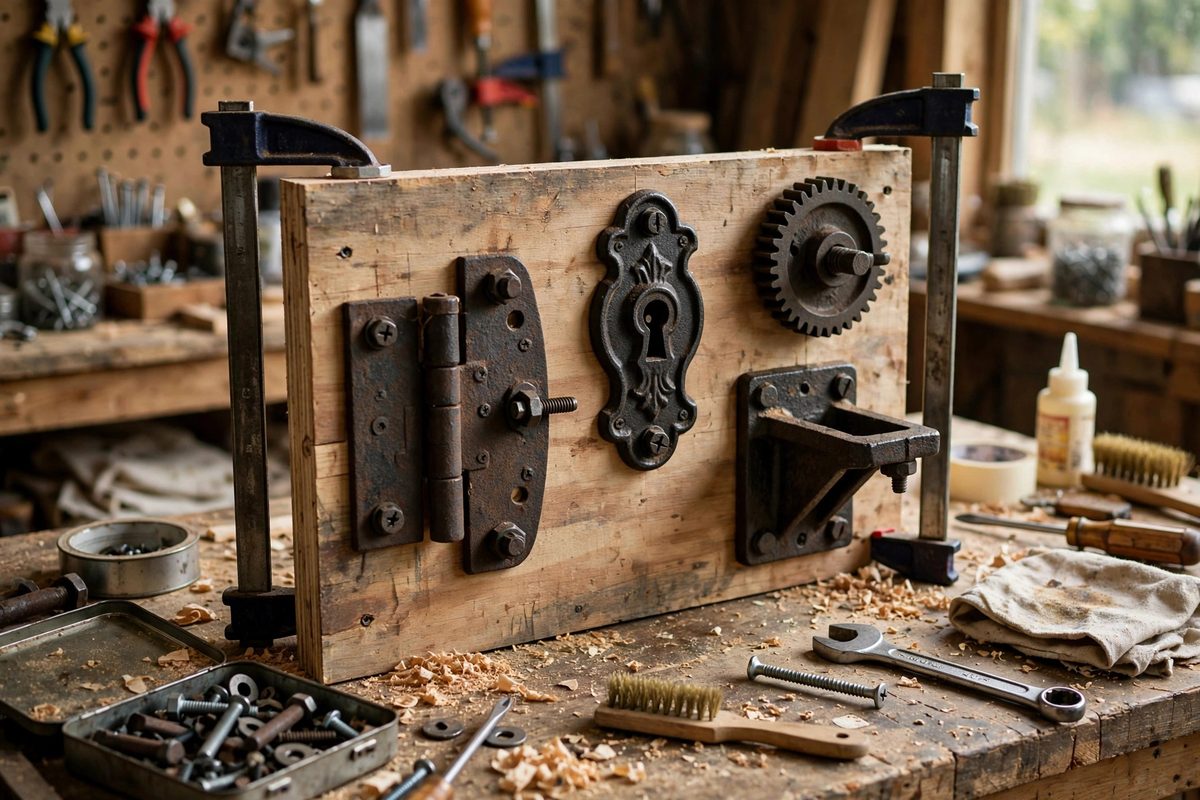
Assemblage art often marries heavy cast iron hardware, old hinges, brackets, gears, escutcheons, to wood panels, and the joint between them carries real weight. Cast iron is dense, brittle, and unforgiving of the wrong fastener; wood is fibrous and moves. Fastening the two together permanently takes fasteners chosen for the load and techniques that respect both materials.
Understanding the Loads
A cast iron bracket screwed to a wood panel loads the fasteners in shear and withdrawal simultaneously, and the load is often eccentric: the iron's weight hangs off the panel face, prying at the top fasteners while pushing at the bottom. Vibration, handling, and the wood's seasonal movement add cyclic stress. The fastener system must handle the static weight with a generous margin and tolerate the movement without working loose. Screws that are merely adequate on day one will loosen as the wood shrinks and swells around them. Design for the long term: through-bolts where possible, screws only where bolts cannot go, and always with the wood's movement in mind.
Choosing Fasteners for Cast Iron
Cast iron typically has existing holes from its original use; use them rather than drilling new ones, since drilling cast iron risks cracking it, especially near edges. Machine screws or bolts through those holes, with washers to spread the load on the iron's face, are the strongest approach. The iron's holes may be threaded from a previous life, but old threads in cast iron are unreliable; through-bolting with a nut is more trustworthy than trusting a tapped hole. Where the iron has no usable holes, consider mechanical capture instead of drilling: straps, clamps, or a routed recess in the wood that cradles the iron piece. Adhesive alone is not a structural fastener for heavy iron; it can supplement bolts but never replace them.
Fastening Into the Wood Panel
The wood side needs equal care. Through-bolts with washers and nuts on the back of the panel are the gold standard: they clamp the iron to the wood with the full strength of the bolt, and they cannot pull out the way screws can. Where through-bolting is impossible because the panel back must stay clean, use the longest, coarsest-threaded screws the panel thickness allows, driven into pilot holes to avoid splitting. For end grain or thin panels, add threaded inserts or T-nuts on the back; screws in end grain or thin stock have poor holding power. If the panel is plywood, the plies give good screw holding, but keep fasteners away from the panel edges where the plies can delaminate under load.
Isolating the Materials
Iron and wood in direct contact cause problems over time. Moisture trapped between them rusts the iron and stains the wood; the iron's hard edges can crush wood fibers under load. Place a thin barrier between them: a leather or felt gasket, a coat of wax, or a stable adhesive film. The barrier also accommodates the slight movement differential between the rigid iron and the moving wood. Seal the iron against rust before mounting, since maintenance access after assembly is limited; a mounted piece that rusts in place stains everything around it. Finish the wood panel fully, including the area hidden behind the iron, because unfinished wood under iron is a moisture trap.
Layout and Long-Term Stability
Plan the hardware layout on paper before drilling the panel; cast iron pieces are heavy and awkward to hold in position while marking. Support the iron's weight during installation so the fasteners are not carrying the load while being tightened; an extra pair of hands or a temporary prop prevents stripped holes and cracked iron. Tighten in stages, checking alignment, since cast iron does not forgive being forced into position. After assembly, check the fasteners periodically during the first year as the wood acclimates; a single re-tightening usually settles everything. A well-fastened iron-on-wood assemblage should feel like one object, with no rattle, no flex, and no doubt.
Heavy cast iron on wood wants through-bolts, washers, and a barrier between the materials: use the iron's existing holes, anchor into the wood's full thickness, isolate against moisture, and plan the layout before drilling. The joint should outlast the artist's doubts about it.
Related Guides
- Drilling and Tapping Cast Metals for Mixed Media Beds: Cast metal objects, the old hardware, plumbing fittings, and found fragments that end up in assemblage work, are wonderful as mixed media beds and
- Mechanical Fastener Cleats for Mixed Media Art: Mixed media assemblage lives or dies by its joins. Glue alone fails on heavy, dissimilar materials: wood to metal, plaster to canvas, found objects
- Epoxy Putty Mechanical Anchors on Found Metal: Assemblage lives on found metal: rusted gears, bent brackets, weathered hardware, each with a history and a surface that no adhesive trusts. Epoxy