
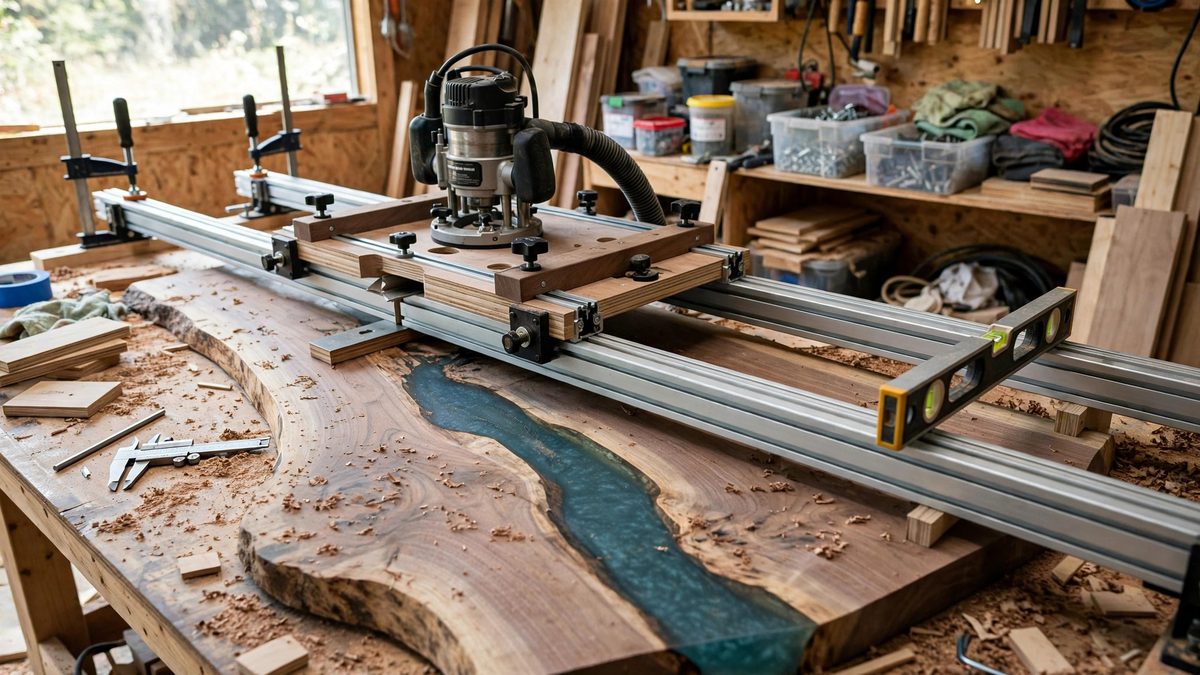
A river table pour is only as level as the slab was before the resin went in, and the slab is only as level as the flattening sled's tracks. The router sled rides on two rails, and any deviation in those rails, a twist, a sag, a height mismatch, transfers directly into the wood surface as a wave or a slope. Resin self-levels to a degree, but it cannot fix a slab that is wedge-shaped or twisted; it just follows the error. Track alignment is the foundation the whole table stands on.
Why the tracks matter more than the router
The router bit cuts at a fixed distance below the sled, and the sled rides on the tracks, so the cut surface is a perfect copy of the track plane, including all of its errors. A track that sags a sixteenth in the middle produces a slab that is a sixteenth low in the middle. A pair of tracks at slightly different heights produces a slab with a consistent slope from one side to the other. No amount of careful router technique compensates, because the error is in the reference, not the cut.
This is why experienced builders spend more time on the track setup than on the routing itself. An hour aligning tracks saves the far longer job of trying to correct a misflattened slab, which usually means re-flattening from a worse starting point.
Setting the tracks coplanar
The two tracks must lie in the same plane: level with each other along their length and at the same height. Start by supporting each track on shims or adjustable feet at multiple points, not just the ends, since a long track supported only at the ends will sag under the sled's weight. Three or more support points per track is a reasonable minimum for typical table lengths.
Check height with a long straightedge laid across both tracks at several positions along their length, and check with a precision level. The straightedge reveals twist and height mismatch between the tracks; the level reveals overall slope. Adjust the shims until the straightedge sits without rocking at every position and the level reads the same everywhere. Then lock everything down so the setup cannot shift when the sled moves.
Track straightness and rigidity
Straightness along each track matters as much as height. A track that bows sideways pushes the sled off its line, leaving a wavy surface. Sight down each track from the end, the way you would sight a board for straightness, and correct any bow with additional supports or by replacing the track. Aluminum extrusion and steel box tube both work well; dimensional lumber works only if it is verified straight and stays that way, which it often does not in a humid shop.
Rigidity under load is the other half. The sled plus router is a meaningful weight, and it moves, so the tracks see a rolling load. If a track deflects under the sled, the cut depth varies with the sled's position. Test by placing the sled at mid-span and checking for deflection with a dial indicator or simply by watching whether the straightedge reading changes. Stiffen or add supports until it does not.
Routing strategy on aligned tracks
With the tracks true, the routing itself is straightforward: shallow passes, consistent feed direction, and generous overlap between passes. Take light cuts, roughly a sixteenth to an eighth per pass depending on the wood and the bit, because heavy cuts deflect the router in the sled and chatter the surface. Overlap each pass by at least half the bit diameter so no ridges remain between passes.
Work from one end to the other systematically rather than hopping around. A systematic pattern makes it obvious where you have been and ensures the entire surface sees the same treatment. Mark completed areas lightly in pencil if the slab is large enough to lose track.
Verifying before the pour
After flattening, verify the slab before mixing any resin. Lay a long straightedge across the surface in multiple directions and look for light under it; check diagonals as well as length and width, since twist shows on the diagonal. Check with winding sticks if you want to be thorough. The resin pour is the point of no return for surface geometry, and ten minutes of verification is cheap insurance.
Aligned tracks, light passes, systematic coverage, and verification before pouring. The river gets the attention, but the tracks decide whether it sits level.
Related Guides
- Surface Leveling Tension on Large River Tables: A river table is a large, heavy, unforgiving object: two wood slabs with a channel of epoxy between them, spanning several feet. Getting that top
- Leveling Large Live Edge Slabs Inside Resin Troughs: River tables and live edge resin tabletops start with a slab suspended in a trough, resin poured around it, and a prayer that everything ends up
- Routing Structural C-Channel Slots in Live Edge Wood: Live edge slabs make stunning river tables and tabletops, but wide slabs move, cup, and crack with seasonal humidity changes. Steel C-channel