
Live edge slabs make stunning river tables and tabletops, but wide slabs move, cup, and crack with seasonal humidity changes. Steel C-channel, recessed into slots routed across the underside, holds the slab flat while allowing that movement. Routing the slots correctly, to the right depth, width, and position, is structural woodworking that the finished table never shows but always depends on.
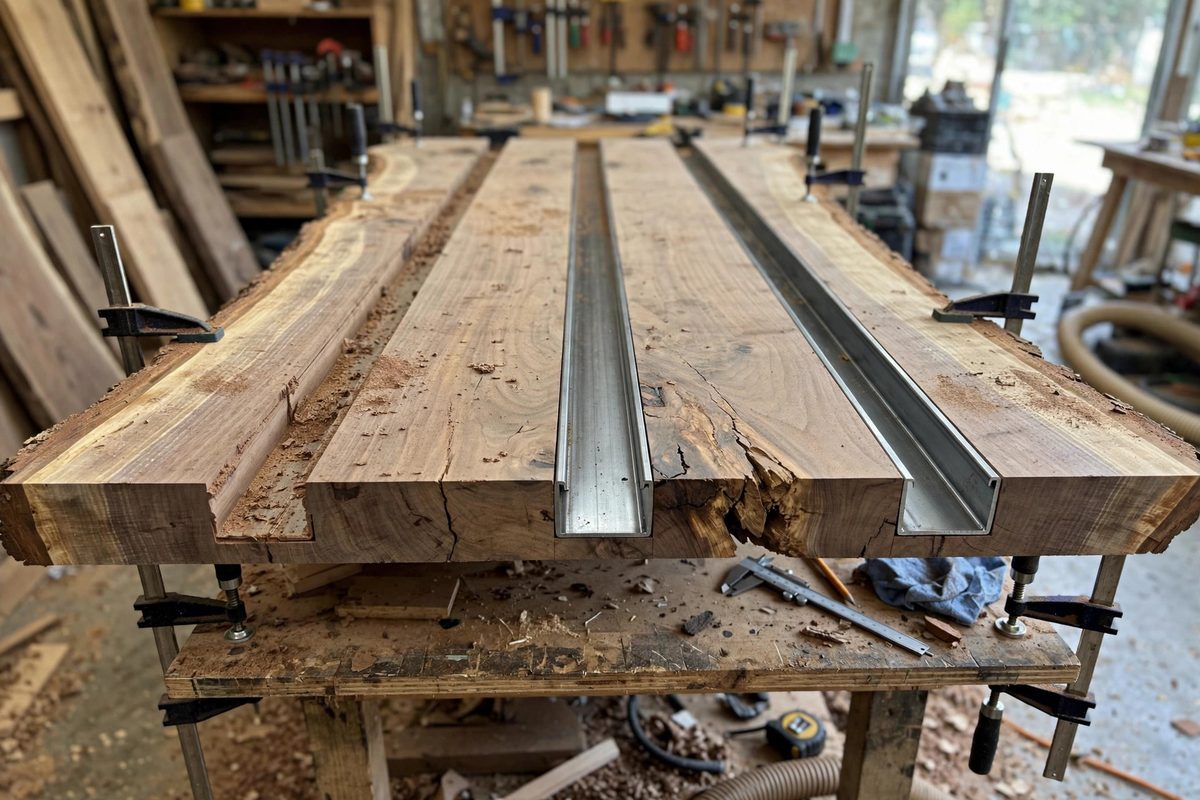
Why C-Channel and Why Slots
A wide slab wants to cup across its width as moisture changes; a stiff steel channel screwed across the underside resists that cupping with far more authority than any wooden batten. The C-channel profile, with its flat back and turned edges, sits stably in a routed slot and provides excellent bending stiffness for its weight. Routing a slot rather than surface-mounting keeps the channel flush with the underside, so the table sits flat and the steel is invisible. The slot also registers the channel's position precisely, preventing it from shifting over time. This is the standard professional solution for keeping large slab tables flat, and it works because steel barely moves while wood moves constantly; the channel wins the argument every season.
Slot Dimensions and Fit
The slot must match the channel: wide enough for the channel to drop in without forcing, deep enough that the channel sits flush or a hair below the surface, and no deeper. A slot too tight pinches the channel and can split the slab when the steel is driven in; a slot too loose lets the channel rattle and work the screws loose. Aim for a slip fit with a whisper of clearance, and cut the slot depth so the channel's back sits just below the wood surface, allowing for finish buildup. The slot length should match the channel with a small allowance at each end for the wood's seasonal movement along its length; wood moves little along the grain, but the allowance costs nothing. Test-fit the channel before finishing the slab.
Routing Technique on Irregular Slabs
Live edge slabs are rarely flat on the underside, which complicates routing a consistent-depth slot. Flatten the underside first, at least in the channel zones, with a router sled or hand planes; the slot depth is measured from the surface, so a wavy surface gives a wavy slot. Use a straight bit in a router with an edge guide or a template, taking the depth in multiple passes rather than one deep cut; deep single passes strain the router and tear the grain. Climb-cut carefully or not at all on the final pass; a clean slot wall grips the channel better and looks professional if ever seen. Clear the chips frequently, since packed chips cause the bit to overheat and the slot to wander. Mark the slot positions to avoid knots and checks, which weaken the wood around the slot.
Fastening for Strength With Movement
The channel holds the slab flat, but the slab must still be free to expand and contract across its width; bolting it rigidly invites cracked wood or sheared screws. The standard solution is slotted screw holes in the channel, or screws in oversized holes with washers, at all but one or two fixed points. The fixed points anchor the channel's position, typically near the center, while the slotted holes let the wood slide beneath the channel as it moves. Use screws long enough for solid purchase but not so long they approach the top surface; pan-head or washer-head screws spread the load. Do not use adhesive between the channel and the slot; glue locks the movement the whole system is designed to allow. Tighten firmly but not crushingly, and recheck after the first seasonal cycle.
Placement and Number of Channels
Place channels where they do the most good: across the full width of the slab, positioned to counter the expected cupping. For a typical dining table slab, two channels, one near each end, handle most cases; very wide or very long slabs may want a third in the middle. Keep the channels clear of the leg mounting zones so the fasteners do not collide. The channels should span nearly the full width but stop short of the live edges, both for appearance and because the edge wood is often the most irregular. A well-planned C-channel installation is invisible, silent, and permanent: the table stays flat year after year, and nobody ever knows why.
Routed C-channel slots keep live edge slabs flat by letting steel do what wood cannot: cut slip-fit slots in a flattened underside, fasten with slotted holes for movement, and place the channels to fight cupping. Hidden structure, lasting flatness.
Related Guides
- Leveling Large Live Edge Slabs Inside Resin Troughs: River tables and live edge resin tabletops start with a slab suspended in a trough, resin poured around it, and a prayer that everything ends up
- Surface Leveling Tension on Large River Tables: A river table is a large, heavy, unforgiving object: two wood slabs with a channel of epoxy between them, spanning several feet. Getting that top
- Flattening Sled Track Alignment for Level River Pours: A river table pour is only as level as the slab was before the resin went in, and the slab is only as level as the flattening sled's tracks. The