
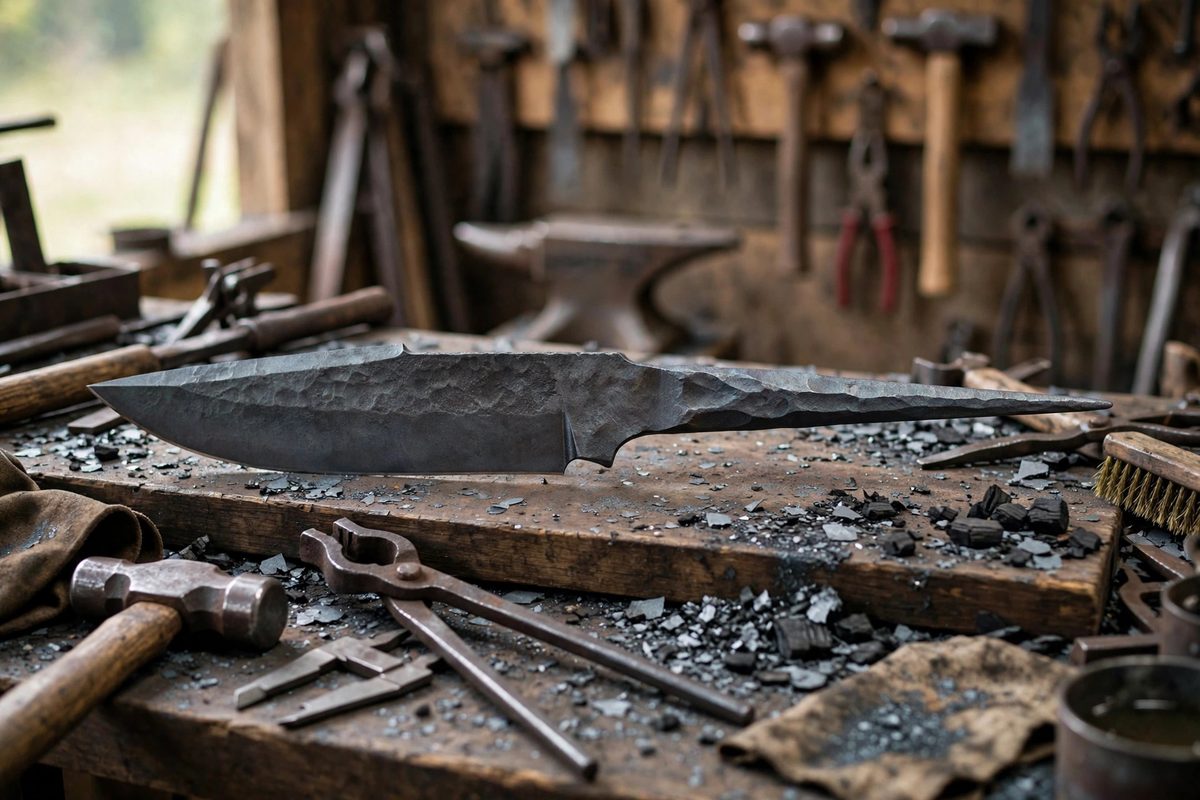
A tapered tang, thinning from the blade toward the butt, is the mark of a well-made hunting knife. It moves the balance point forward toward the blade, reduces unnecessary weight in the handle, and shows the maker's control of the steel. Forging the taper in, rather than grinding it afterward, keeps the grain structure continuous and saves steel. It is one of the core skills of bladesmithing.
Why Taper the Tang
A full-thickness tang puts dead weight in the handle, making the knife feel butt-heavy and clumsy. Tapering the tang shifts the balance forward, so the knife feels lively and the edge does the work. The taper also lets the handle scales sit closer to the hand's natural grip shape, since the handle can be slimmer at the butt. Structurally, a forged taper is superior to a ground taper: forging refines the grain and keeps the steel's fibers flowing along the taper, while grinding cuts across them and can introduce stress risers at the plunge. A forged taper is stronger, lighter, and better looking. There is no downside except the skill required.
Forging Sequence
Forge the blade first, leaving the tang as a thick rectangular section. Then, working from the blade-tang junction toward the butt, draw the tang out with the peen or the edge of the hammer, thinning it progressively. Keep the tang centered: work both faces evenly, flipping the steel regularly, so the taper stays symmetrical top to bottom. The classic profile thins the tang to roughly half its starting thickness at the butt, sometimes less on a slim hunter. Keep the tang's width roughly constant or taper it slightly narrower toward the butt as well; a tang that tapers in both dimensions looks refined and saves the most weight. Work at a bright orange heat; forging high carbon steel too cold cracks it, and the tang is no place for a crack.
Keeping It Straight and True
The challenge of tang tapering is keeping everything straight. Check frequently by sighting down the tang; the taper should be a smooth, continuous wedge with no kinks or S-curves. Correct bends while the steel is hot, using light taps, because cold correction work-hardens and risks cracking high carbon steel. Keep the blade-tang junction, the ricasso area, crisp and square; a sloppy shoulder makes fitting the guard miserable. Some smiths forge the tang slightly oversize and normalize before final straightening, since normalization relieves the stresses that cause the tang to move during grinding. Straightness at the forge saves hours at the grinder.
Normalizing and the Taper
High carbon steel must be normalized after forging to refine the grain, and the thin tapered tang needs attention during this step. Thin sections heat and cool faster than the thick blade, so the tang can overshoot temperature while the blade is still coming up. Heat the blade to the target temperature and let the heat soak into the tang rather than blasting the tang directly. During the quench, the thin tang cools fastest; this is fine, since the tang is not the cutting edge, but avoid quenching cracks by keeping the quenchant appropriate and the entry smooth. Temper the whole blade with the tang included; a fully hard tang is brittle, and the tang endures shock loads from the handle. A springy tang survives drops that would snap a glass-hard one.
Fitting Guards and Handles to the Taper
The tapered tang changes how the guard and handle fit. The guard slot must match the tang's thickness at the shoulder, which is the thickest point; file the slot to a snug fit, since gaps here show. Handle scales bed against the tapered faces, so flatten and true the tang faces after heat treat with careful filing or surface grinding, keeping the taper intact. Drill pin holes perpendicular to the tang faces, accounting for the taper angle so the pins sit correctly. Epoxy the assembly with the pins in place, and shape the handle to flow with the taper. A well-executed tapered tang disappears into the handle, felt only as perfect balance.
Forge the taper in from the shoulder to the butt, keep it straight and symmetrical, normalize with the thin section in mind, and temper for toughness. The tapered tang is where forging skill becomes handling quality.
Related Guides
- Normalizing High Carbon Steel Before Quenching: Between forging a blade and hardening it lies a heat treatment step that beginners routinely skip and experienced smiths never do: normalizing
- Differential Clay Quenching for Clean Hamons: The hamon, the visible line separating the hardened edge from the softer spine on a differentially hardened blade, is both beautiful and functional
- Clay Coat Thickness for Defined Hamons in 1095 Steel: The hamon, the visible line separating hardened edge from softer spine, is the signature of a differentially hardened blade. On 1095 steel, the clay