
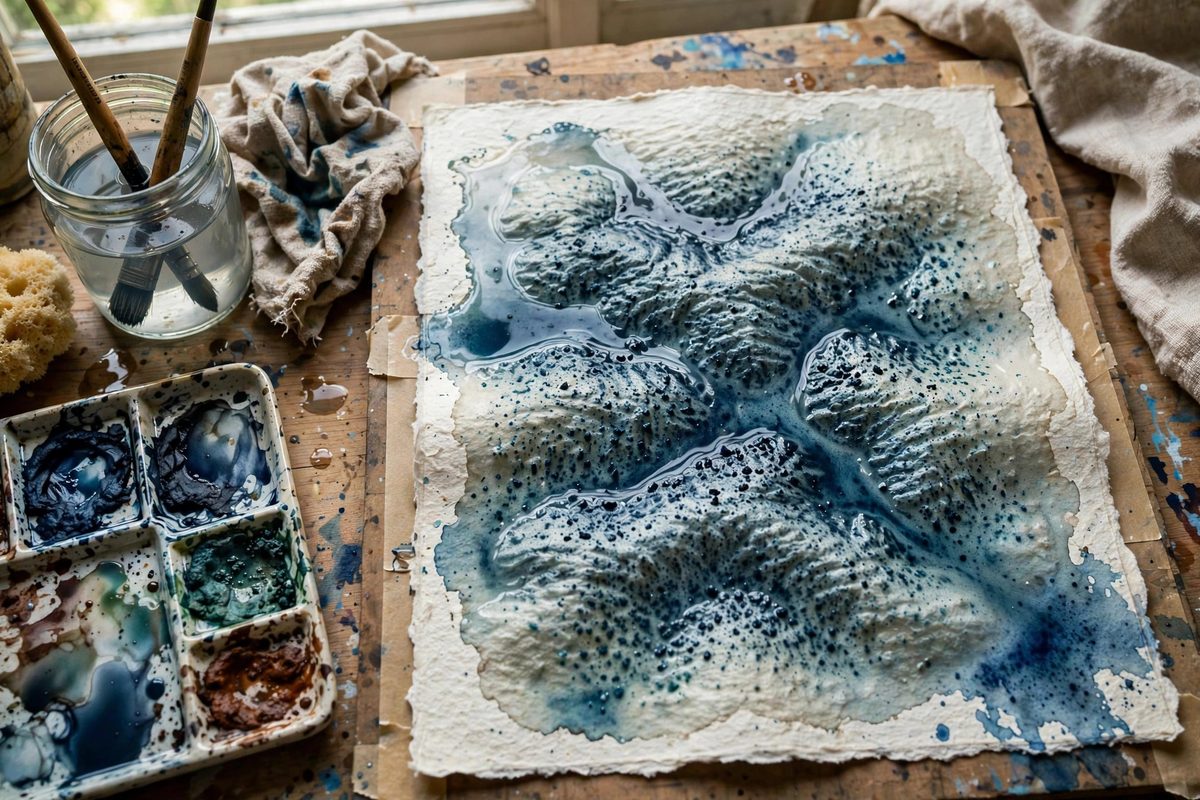
Granulating pigments are the ones that separate on the paper, settling into the valleys of the texture and leaving the hills lighter, and flooding is the technique that gives them room to do it. On rough watercolor rag, with its pronounced peaks and valleys, a granulating pigment in a generous wash produces a mottled, stony texture that no brushwork can imitate. It is one of watercolor's signature effects, and it depends on understanding what the pigment wants to do and then getting out of its way.
What granulation actually is
Granulation happens when pigment particles are heavy or large enough to settle out of the wash as it dries rather than staying evenly suspended. Particle size is the main driver: pigments ground coarsely, or made from minerals with naturally heavy particles, drop into the paper's texture while the water is still mobile. As the wash dries, the settled particles stay where they landed, producing the characteristic mottled pattern.
This is a physical process, not a chemical one, which means it is predictable once you know your pigments. The same pigment will granulate the same way every time under the same conditions. Learning which of your pigments granulate, and how strongly, is the foundation of using the effect deliberately instead of being surprised by it.
Flooding: giving the pigment room to move
Flooding means applying the wash generously, with more water than the paper strictly needs, so the pigment stays mobile long enough to settle. On rough rag, tilt the board slightly so the wash drifts, and watch the pigment pool in the texture. The temptation is to even it out with the brush; resist it. Every brushstroke after the initial application disrupts the settling pattern and produces streaks instead of mottle.
Load matters too. A wash that is too dilute has too few particles to form a visible pattern; one that is too concentrated dries as a flat mass before the particles can sort themselves. The sweet spot is a wash rich enough to read as strong color but fluid enough to move freely, roughly the consistency of whole milk as a starting point, adjusted by testing.
The paper's role in the pattern
Rough watercolor rag earns its name: the surface has deep, irregular texture, and that texture is the mold the granulation pattern forms in. Different manufacturers' rough papers have different valley depths and spacing, so the same pigment floods differently on each. Cold press paper granulates too, but the pattern is finer and less dramatic; hot press barely granulates at all, because there is nowhere for the particles to settle.
Paper sizing also plays a part. Heavily sized paper holds the wash on the surface longer, giving particles more time to settle into a pronounced pattern. Lightly sized paper lets the wash sink faster, which can mute the effect. If a favorite granulating pigment suddenly looks flat, the paper batch may have changed more than the pigment did.
Controlling and combining the effect
Granulation can be steered. To encourage it, keep the wash wet longer: work in a humid room, mist the paper, or flood more generously. To suppress it in passages where you want flat color, use less water, work the wash with the brush to keep particles suspended, or choose a non-granulating pigment for those areas. Mixing a granulating pigment with a staining, non-granulating one produces a split effect: the granulating color settles into texture while the staining color tints everything evenly, which is a beautiful way to model form.
Timing the tilt is the subtlest control. Tilt early and the pigment runs before it settles, giving directional streaks. Tilt late, when the wash is losing its shine, and the pigment barely moves, giving a tight mottle. The full, open granulation pattern comes from a moderate tilt applied while the wash is fully wet, then leaving it completely alone.
Letting it dry undisturbed
The final rule is the hardest: once the wash is down and moving, do not touch it until it is bone dry. Granulation patterns continue developing as the last of the water leaves, and a brush introduced at the damp stage will scar the pattern permanently. Set the board flat for the final drying so gravity does not drag the last mobile pigment to one edge.
Flood generously, tilt thoughtfully, and then leave the wash alone. The pigment knows how to granulate; the painter's job is to set the conditions and step back.
Related Guides
- Granulating Pigment Washes on Cold Press Paper: Some watercolor pigments settle into the paper's texture as they dry, creating a mottled, grainy effect called granulation. On cold press paper, with
- Ox Gall Dropping Liquid Dynamics on Wet Rag Paper: Ox gall liquid is watercolor's secret dispersant: a drop of it makes paint explode across wet paper in blooms and granulations that no brush can
- Stretching Heavy 300lb Cotton Paper for Washes: Heavyweight cotton watercolor paper, the 300lb (640gsm) sheets, is famous for not needing to be stretched. Compared to lighter papers that buckle