
Heavyweight cotton watercolor paper, the 300lb (640gsm) sheets, is famous for not needing to be stretched. Compared to lighter papers that buckle into hills and valleys under a wet wash, 300lb paper stays impressively flat. So why stretch it at all? Because "impressively flat" is not "perfectly flat," and certain kinds of painting, large wet washes, precise architectural edges, puddled granulating passages, punish even slight buckling. Stretching 300lb paper is also simply different from stretching light paper: the sheet is stiff, heavy when wet, and strong enough to tear tape that lighter paper would never challenge. The technique adapts accordingly.
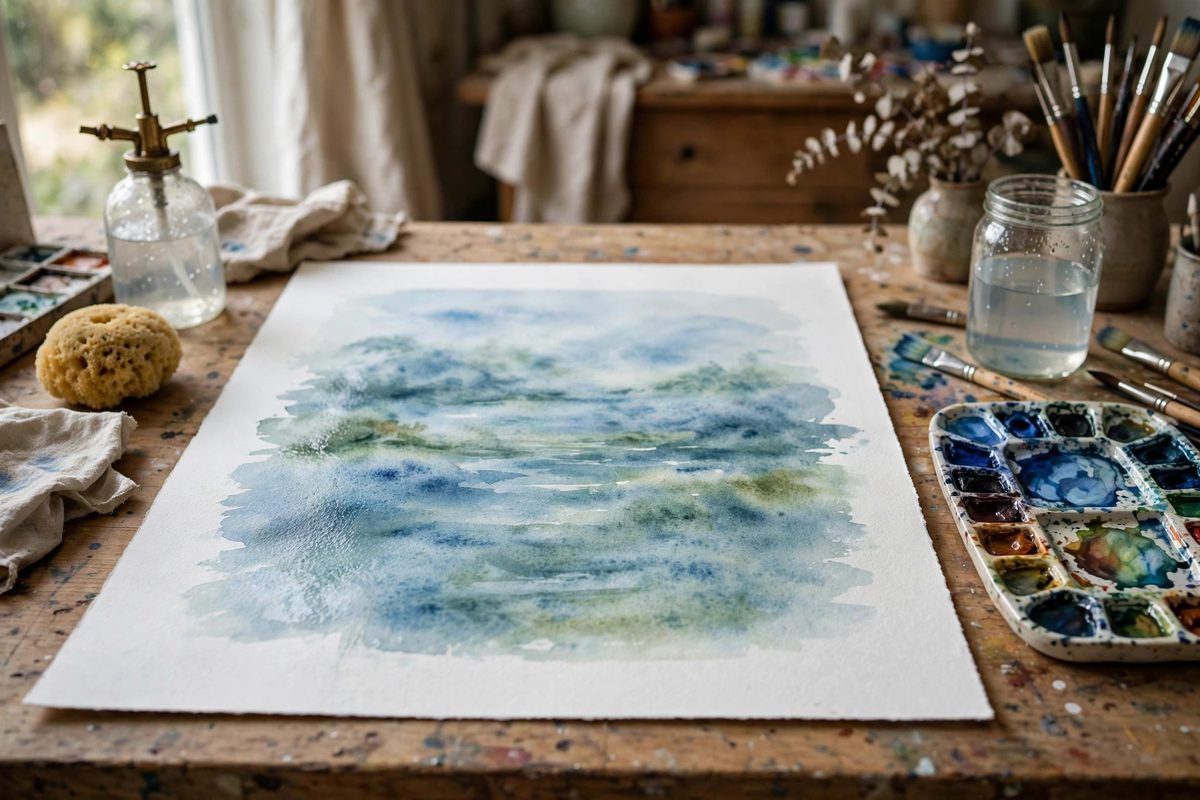
When Heavy Paper Still Needs Stretching
A 300lb sheet will absorb an astonishing amount of water without complaint, but "without complaint" has limits. A full-sheet wash that keeps the paper wet for twenty minutes or more will eventually develop a gentle dish or ripple, especially toward the center where the sheet is unsupported. That ripple matters when you are laying a graded sky wash: pigment pools in the low spots and dries in bands, and the smooth gradient you wanted becomes a tide line. It also matters for masking work, where even a millimeter of lift lets paint creep under the tape. If your painting style keeps the paper damp for extended periods, or if you are working at full-sheet scale, stretching buys you a drum-tight surface that behaves. For quick sketches and small studies, skip it; the paper genuinely does not need the help.
Soaking: Longer Than You Think
The classic stretching sequence, soak, lay flat, tape the edges, let dry, applies to heavy paper with one major adjustment: the soak must be thorough. A 300lb cotton sheet is dense, and a quick dip wets the surface while the core stays dry. The core then expands later, after taping, which works against the tension you just created. Soak the sheet for a full five to ten minutes, until it feels uniformly limp and heavy, like a wet towel. You will know it is ready when the sheet drapes instead of springing back when you lift a corner. Use a clean tub or bathtub with room-temperature water; hot water is unnecessary and can soften the paper's internal sizing more than you want. Handle the soaked sheet with care: wet cotton is strong but a 300lb sheet full of water is genuinely heavy, and its own weight can crease it if you lift it by one corner.
Taping a Sheet That Fights Back
Here is where heavy paper diverges from the standard method. As a soaked 300lb sheet dries, it contracts with considerable force, enough to peel ordinary masking tape and enough to warp a flimsy board. Use a wide, strong gum-backed paper tape, the brown kraft kind that you wet to activate, at least two inches wide. It bonds to the board tenaciously and shrinks along with the paper, maintaining tension. Apply it generously, overlapping well onto both the paper margin and the board. The board itself must be rigid and waterproof: sealed plywood, a sheet of acrylic, or a purpose-made stretching board. Unsealed wood swells and warps under the sustained dampness, and a warped board defeats the purpose. Tape all four edges completely; any gap becomes a weak point where the contracting sheet pulls free and the tension goes slack.
Drying Flat Under Tension
Let the taped sheet dry naturally, flat, in normal room conditions. Do not aim a fan or heater at it: fast, uneven drying sets up tension gradients that leave the sheet tight in some areas and slack in others. Expect the drying to take several hours; a 300lb sheet holds a lot of water. As it dries you will hear faint ticking and creaking, which is the fibers tensioning, and you will see the surface pull drum-tight. That is the goal. Do not cut the painting free until you are entirely finished, including any final details, because the tension is part of the working surface. One caution: if the tape fails on one edge mid-dry, do not try to re-tape a half-dry sheet. The tension is already set unevenly; finish the painting as is or start over with a fresh soak.
Working on the Stretched Surface
A stretched 300lb sheet behaves beautifully under wet work. Washes sit evenly because there are no low spots to pool in. Lifting, blotting a damp wash to reclaim highlights, works more predictably because the water film is uniform. The paper also takes scrubbing and reworking better when tensioned, since the taut surface resists the mechanical stress that would pill a slack sheet. Keep in mind that the taped margin, usually an inch or more, is sacrificial: plan your composition inside it. And remember that the sheet will relax slightly the first time it gets thoroughly wet during painting, then re-tighten as it dries; this is normal and the tape holds through it.
Stretching 300lb paper is a minority practice for a reason: most of the time, the paper handles itself. But for the paintings where flatness is the whole game, the extra hour of soaking and taping pays for itself in every wash. Strong tape, a rigid board, a patient dry: that is the entire method.
Related Guides
- Granulating Pigment Washes on Cold Press Paper: Some watercolor pigments settle into the paper's texture as they dry, creating a mottled, grainy effect called granulation. On cold press paper, with
- Ox Gall Dropping Liquid Dynamics on Wet Rag Paper: Ox gall liquid is watercolor's secret dispersant: a drop of it makes paint explode across wet paper in blooms and granulations that no brush can
- Granulating Pigment Flooding on Rough Watercolor Rag: Granulating pigments are the ones that separate on the paper, settling into the valleys of the texture and leaving the hills lighter, and flooding is