
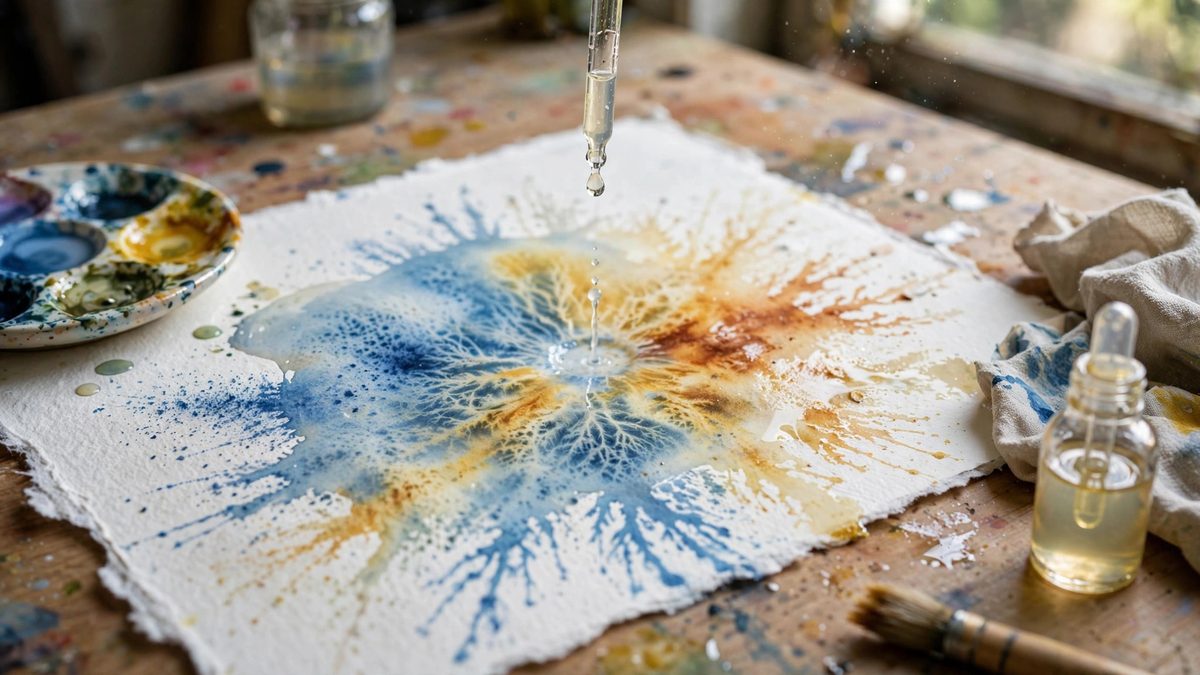
Ox gall liquid is watercolor's secret dispersant: a drop of it makes paint explode across wet paper in blooms and granulations that no brush can produce directly. The dynamics of how the drop spreads on wet rag paper, pushing pigment ahead of it in feathery fingers, are both beautiful and controllable once you understand the surface tension physics at work.
What Ox Gall Does
Ox gall is a wetting agent, a surfactant derived traditionally from bovine gall. Added to watercolor, it dramatically lowers the liquid's surface tension. On wet paper, a drop of ox gall liquid creates a surface tension gradient: the low-tension gall solution pushes outward against the higher-tension surrounding water, carrying pigment with it in branching, organic patterns. This is the same physics behind blooms and backruns, but concentrated and directed. The effect is strongest on thoroughly wet paper, where there is a continuous water film for the gall to push against; on damp paper the effect is weaker and more localized. A little goes a long way: a single drop from a pipette transforms a whole wash.
Paper, Wetness, and Timing
Rag watercolor paper, with its absorbent cotton fibers and sizing, is the ideal substrate; the sizing controls how fast the water sinks in, giving the gall time to work on the surface. Timing is everything. Drop the gall into a wash that is wet and glistening for maximum spread and drama; drop it into a wash that is losing its shine for tighter, more controlled blooms. The paper's wetness also determines how long you have: on saturated paper the gall keeps moving for a minute or more, while on merely damp paper it stops quickly. Pre-wet the paper evenly for predictable results; uneven wetness makes the gall race across the wettest areas and stall on the drier ones, which can be a feature or a flaw depending on intent.
Directing the Bloom
The gall drop spreads radially from where it lands, so placement is composition. Drop it into the center of a wash for a sunburst effect, at the edge for a bloom that eats inward, or in a line of drops for a connected organic texture. Tilt the board to bias the spread downhill; the gall follows gravity as well as surface tension. You can also drop gall into specific colors within a variegated wash to push one pigment without disturbing the others, since the gall moves the liquid, and the liquid carries whatever pigment is suspended in it. For fine control, touch the drop to the paper with a nearly dry brush tip rather than a pipette; less liquid means a smaller, tighter bloom. Practice on scrap to calibrate drop size to effect size.
Combining With Pigment Properties
Ox gall interacts differently with different pigments. Granulating pigments, the ones that settle into the paper texture, produce spectacular textured blooms under gall; staining pigments produce smoother, more even dispersals. Heavy pigments get pushed into feathery sediment patterns, while light pigments ride the surface film further. Layering order matters too: dropping gall into a wash of mixed pigments can separate them, pushing the lighter ones further in a chromatographic effect that is gorgeous and hard to replicate any other way. Keep notes on which pigments respond how; the combinations are the vocabulary of the technique.
Control, Restraint, and Fixing Mistakes
The biggest risk with ox gall is overdoing it: too many drops turn the wash into chaos, and the surfactant keeps working until the paper dries. Use it sparingly, one or two drops per passage, and let the paper dry before judging; wet blooms always look more dramatic than the dry result. If a bloom goes too far, lift it quickly with a thirsty brush or a paper towel while still wet; once dry, gall blooms are as permanent as the pigment. Do not use ox gall in every painting; like any special effect, it is most powerful when rare. When it is right, though, nothing else in watercolor produces quite that living, organic spread.
Ox gall liquid turns surface tension into a painting tool: drop it into wet washes on rag paper, place each drop deliberately, and let the physics paint the bloom. Sparing, timed, and observed, it produces effects no brush can match.
Related Guides
- Granulating Pigment Flooding on Rough Watercolor Rag: Granulating pigments are the ones that separate on the paper, settling into the valleys of the texture and leaving the hills lighter, and flooding is
- Stretching Heavy 300lb Cotton Paper for Washes: Heavyweight cotton watercolor paper, the 300lb (640gsm) sheets, is famous for not needing to be stretched. Compared to lighter papers that buckle
- Granulating Pigment Washes on Cold Press Paper: Some watercolor pigments settle into the paper's texture as they dry, creating a mottled, grainy effect called granulation. On cold press paper, with