
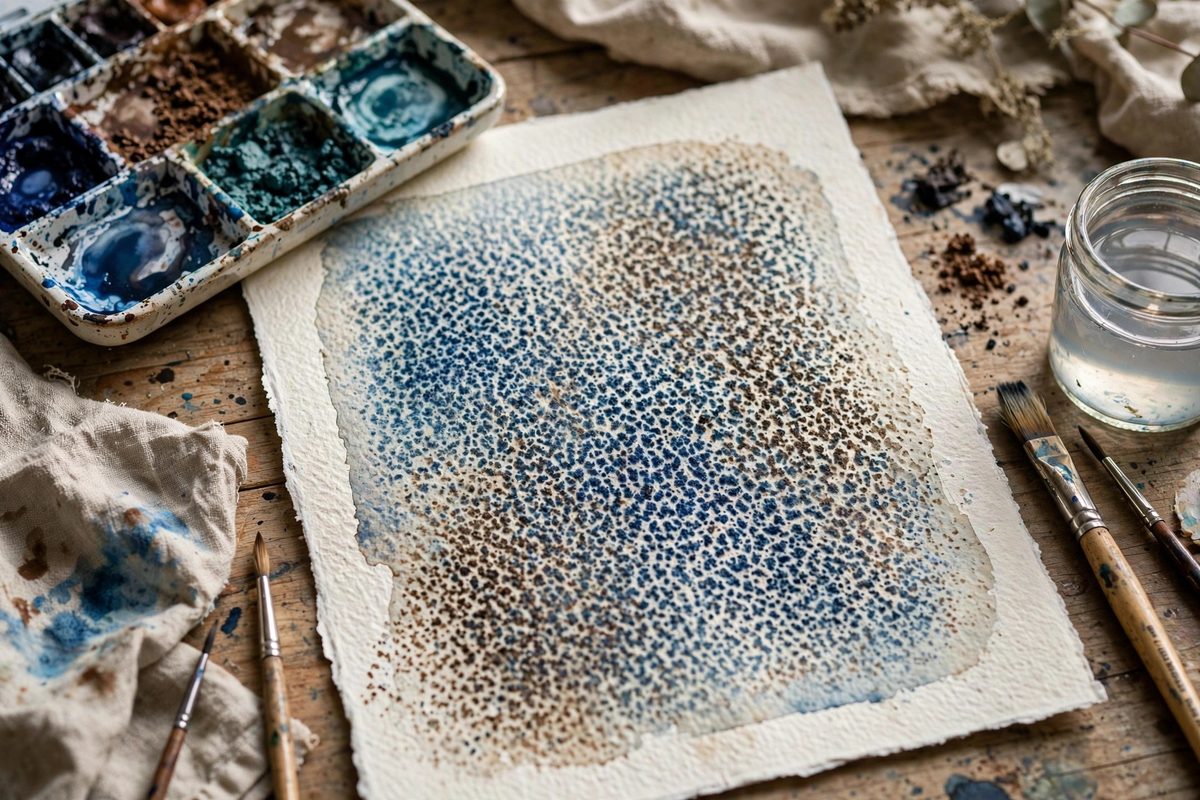
Some watercolor pigments settle into the paper's texture as they dry, creating a mottled, grainy effect called granulation. On cold press paper, with its pronounced tooth, granulating pigments produce some of the most beautiful textures in watercolor: skies with atmosphere, stone with age, water with movement. Understanding which pigments granulate, why, and how to control the effect turns a chemical accident into a deliberate technique.
Why Pigments Granulate
Granulation is about particle size and weight. Pigments made from coarse, heavy particles, traditionally the earth pigments and mineral colors, settle out of the wash water faster than fine, light particles. As the wash dries on textured paper, the heavy particles sink into the paper's valleys while the water carries finer material along, producing the characteristic mottled separation. It is sedimentation, happening in miniature on the paper's surface.
Cold press paper amplifies the effect because its tooth provides deep valleys for particles to settle into. On hot press smooth paper, the same pigment granulates subtly or not at all; the texture that catches the particles is missing. The paper and the pigment are partners in the effect, and cold press is the enthusiastic partner.
Which Pigments Granulate
The classic granulators are the earths and mineral pigments: ultramarine blue (famously), burnt sienna, raw umber, the iron oxides, cobalt blue, cerulean, and many of the cadmium-free mineral colors. Staining, finely ground pigments like phthalo blue or quinacridone rose granulate little; they dye the paper evenly instead. Neither behavior is better; they are different tools.
Pigment manufacturers often note granulation in their literature, and single-pigment paints granulate more predictably than mixtures. When planning a granulating wash, check whether your chosen color is a known granulator; assuming every pigment behaves the same is how the effect surprises you instead of serving you.
Controlling the Wash
Granulation needs water, time, and stillness. Lay the wash wet and generous, giving the particles a water body to settle through; a skimpy wash dries before the particles can separate. Then leave it alone: tilting, brushing back into the drying wash, or blotting disrupts the settling pattern and produces mud instead of texture. Granulation is a watched pot that must not be stirred.
- Wet the paper first for maximum settling time; the damp paper extends the drying window.
- Mix granulating pigments loosely; over-mixed, fully dispersed paint granulates less dramatically.
- Let gravity help: a slight tilt encourages directional settling, useful for skies and water.
- Do not layer wet-into-wet over a granulating wash until it is fully dry; the second wash re-wets and redistributes the first.
Combining Granulating and Non-Granulating Pigments
Some of the most striking effects come from mixing a granulating pigment with a smooth one in the same wash. The granulator settles into the texture while the smooth pigment flows evenly, producing a two-tone separation from a single wash: ultramarine and burnt sienna, the classic combination, separate into blue texture over warm undertone as they dry. The mixture does the painting for you, if you let it.
This separation is why these mixtures are prized and also why they are unpredictable. The exact pattern depends on water amount, drying speed, paper texture, and the ratio of the pigments. Test the mixture on the project paper before committing; the test swatch is a preview of the chemistry you are about to unleash.
When Granulation Is Unwanted
Sometimes the texture fights the subject: a smooth porcelain vase or a calm sky may want no granulation at all. The controls are the inverse of the technique: choose non-granulating pigments, work on smoother paper, use less water, and dry the wash faster with gentle air movement. You can also lift granulation selectively while the wash is damp, though the settled particles resist lifting more than smooth washes do.
Knowing how to suppress the effect is as valuable as knowing how to produce it. The watercolorist's control over granulation, encouraging it here, preventing it there, is part of the medium's mastery.
Coarse pigment, wet wash, cold press tooth, and patience while it settles. Granulation is the pigment showing its mineral nature on the paper's landscape; give it the conditions and get out of the way.
Related Guides
- Granulating Pigment Flooding on Rough Watercolor Rag: Granulating pigments are the ones that separate on the paper, settling into the valleys of the texture and leaving the hills lighter, and flooding is
- Stretching Heavy 300lb Cotton Paper for Washes: Heavyweight cotton watercolor paper, the 300lb (640gsm) sheets, is famous for not needing to be stretched. Compared to lighter papers that buckle
- Ox Gall Dropping Liquid Dynamics on Wet Rag Paper: Ox gall liquid is watercolor's secret dispersant: a drop of it makes paint explode across wet paper in blooms and granulations that no brush can