
A drift punch needs a hard working tip and a tough body that can take hammer blows without shattering. Hardening the whole punch uniformly makes it brittle; leaving it all soft makes the tip mushroom. Differential hardening with controlled water dips gives you both: a hard tip that holds its shape and a body that absorbs the hammer.
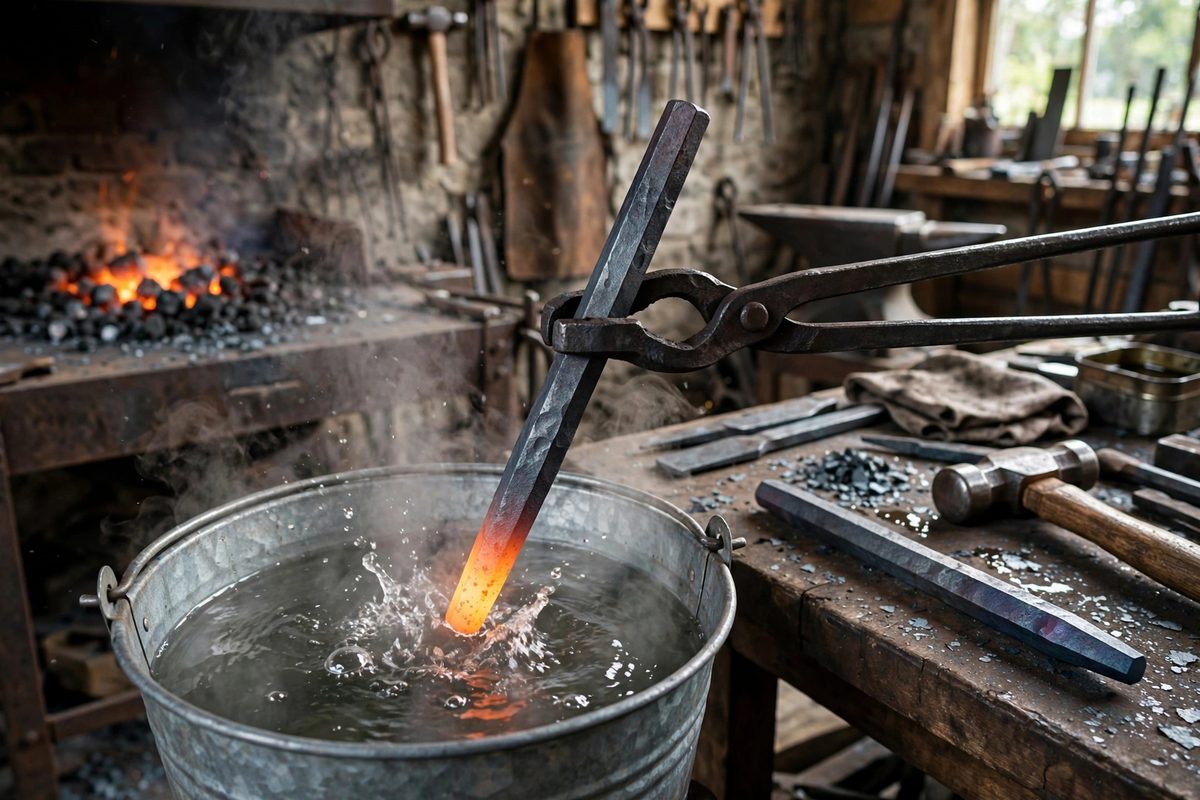
Why Differential Hardening Suits Punches
The punch's tip does the cutting and drifting, so it needs hardness to resist deformation. The body transmits hammer energy, so it needs toughness to avoid cracking. The struck end needs to be soft enough not to chip and send fragments flying. Differential water dipping hardens exactly the working portion while leaving the rest in a tougher state. The technique is old, fast, and perfectly matched to the tool's job description.
Preparing the Punch
Forge the punch to shape and normalize it first, cycling it through critical temperature and air cooling a couple of times to refine the grain. A normalized punch hardens more evenly and is less prone to cracking in the quench. Polish the working tip area bright so you can read the temper colors later; scale hides the colors and the colors are your thermometer. Have the water ready before heating: a container deep enough to submerge the tip with room to move, filled with room-temperature water. Rushing the setup with hot steel in the tongs is how burns and bad quenches happen.
The Dip Sequence
Heat the punch evenly to hardening temperature, then dip just the working tip into the water, roughly the last inch or so, holding it still for a few seconds. Withdraw it and watch the temper colors run up from the quenched section as residual heat from the body tempers the tip. When the desired color reaches the tip, often a straw to light brown for punch tips, quench the whole punch to stop the temper. The differential dip creates a gradient: full hardness at the very tip, transitioning to tougher metal up the body. The depth of the dip sets where the hard zone ends.
Reading Temper Colors
Temper colors are thin oxide films whose color indicates the temperature the steel reached: pale straw is the hardest temper, progressing through brown and purple to blue as temperature rises. For a drift punch tip, straw to bronze gives a hard working edge with enough toughness to avoid chipping. The colors move fast on thin sections, so watch closely and quench decisively when the right color arrives. Work in consistent light, because temper colors read differently under warm shop lights than in daylight, and consistency matters more than the absolute color name.
Safety and the Struck End
The struck end of the punch must never be hard. After the differential treatment, verify the struck end is soft by filing it; the file should bite easily. A hardened struck end chips under the hammer and throws sharp fragments, which is a genuine eye hazard. Dress the struck end with a slight chamfer to prevent mushrooming edges from peeling, and wear eye protection whenever striking punches. The differential dip is about putting hardness where the work is and keeping it away from where the hammer lands.
Differential water dips make the punch what it needs to be: hard at the tip, tough in the body, soft at the struck end. Heat it right, dip the tip, read the colors, and stop the temper at straw. The punch will drift true and take the hammer without complaint.
Related Guides
- Hardening Face Plates on Heavy Anvil Horns: A blacksmith's anvil takes thousands of hammer blows, and its working faces must be hard enough to resist denting while the body stays tough enough
- Punching Drift Holes in Tool Steel Hammer Heads: Forging a hammer head means making an eye: the hole through which the handle passes, and the most structurally critical feature of the tool. The
- Sharpening Hand Forged Drawknives on Stones: The drawknife, pulled toward the user to shave wood, is one of the oldest edge tools, and a hand-forged one carries the smith's geometry in its
- Heat Treating Shock Resistant S7 Steel Cold Chisels: S7 is the shock-resistant tool steel, formulated to absorb impact without chipping or shattering, which makes it the natural choice for cold chisels