
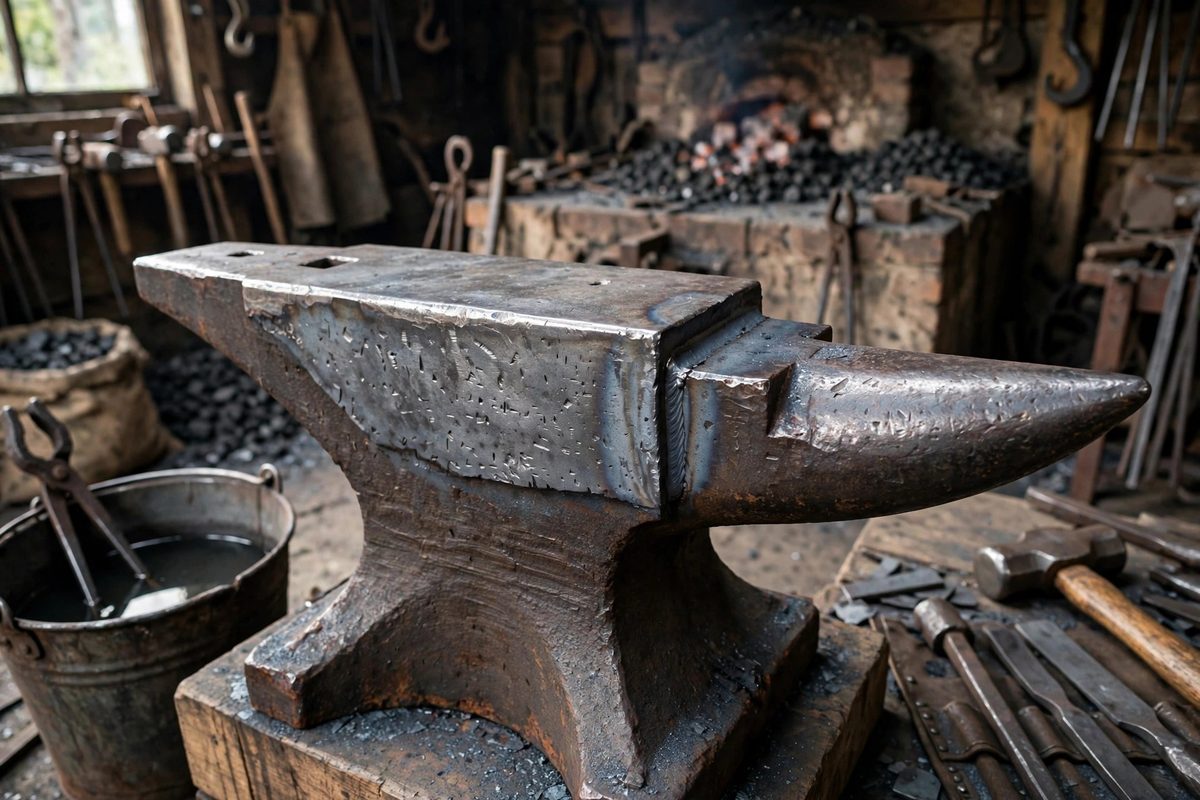
A blacksmith's anvil takes thousands of hammer blows, and its working faces must be hard enough to resist denting while the body stays tough enough not to crack. On heavy anvils, this is achieved with hardened face plates: high-carbon steel plates forge-welded or otherwise bonded to the anvil body's top face and horn. Understanding how those plates are hardened, and how to maintain them, matters to anyone who buys, restores, or works on a serious anvil.
Why the face is a separate plate
Making an entire anvil from hardenable high-carbon steel would be wasteful and risky: the mass needed for an anvil's inertia does not need to be hard, and a fully hardened anvil would be brittle enough to crack under missed hammer blows. The traditional solution is a composite: a tough, lower-carbon body (wrought iron historically, cast steel in modern anvils) carrying a hardenable steel face plate where the work happens. The plate is typically around half an inch to an inch thick on a heavy anvil, thick enough to take decades of wear and occasional resurfacing, thin enough to harden through.
How face plates are hardened
After the plate is bonded to the body, the anvil's working faces are heated to critical temperature and quenched, hardening the high-carbon plate while the low-carbon body stays soft and tough. The quench must be controlled: too violent and the plate can crack or delaminate from the body; too slow and it does not fully harden. Historically this was done with careful water quenching of just the face; modern makers use more controlled methods. The result is a face in the range of roughly 50 to 55 HRC: hard enough to resist hammer dents, soft enough not to chip when struck.
The horn's hardening
The horn, used for curving and drawing out, is part of the same hardening: on many anvils the horn is an extension of the face plate or a separately attached hardenable section. A properly hardened horn resists the denting that comes from hammering work over its curved surface. But the horn's tip, being thin, is the most vulnerable to chipping if over-hardened; this is why anvil faces are tempered back from maximum hardness rather than left glass-hard. A horn that chips is worse than a horn that dents slightly, since chips create stress risers and sharp defects in the work.
Maintaining the hardened face
Use the anvil correctly and the face lasts generations: always have hot metal between hammer and anvil (never strike the face directly with the hammer), keep the face clean of scale and debris that emboss into work, and dress the edges lightly if they chip, easing sharp corners that mark the work. Do not grind the face aggressively; heavy grinding overheats the thin hardened layer and softens it, and it removes the plate's thickness that cannot be replaced. Light stoning or careful flap-disc work for minor cleanup only.
Evaluating a used anvil's face
Test before buying: a ball bearing dropped from a foot or so should rebound smartly off a good face (high rebound means hard, live steel), while a dead thud suggests a soft or delaminated plate. Check for delamination by tapping around the face's edges and listening for hollow sounds. Look for excessive grinding, swayback (dished face from wear), and chipped edges; minor issues are workable, major ones mean the anvil is a decoration. A heavy anvil with a sound hardened face is a lifetime tool; verify before you haul it home.
Hard face, tough body, never struck directly, maintained lightly. The anvil's composite construction is centuries of wisdom in steel; treat it accordingly.
Related Guides
- Hardening Drift Punches With Differential Water Dips: A drift punch needs a hard working tip and a tough body that can take hammer blows without shattering. Hardening the whole punch uniformly makes it
- Punching Drift Holes in Tool Steel Hammer Heads: Forging a hammer head means making an eye: the hole through which the handle passes, and the most structurally critical feature of the tool. The
- Sharpening Hand Forged Drawknives on Stones: The drawknife, pulled toward the user to shave wood, is one of the oldest edge tools, and a hand-forged one carries the smith's geometry in its
- Heat Treating Shock Resistant S7 Steel Cold Chisels: S7 is the shock-resistant tool steel, formulated to absorb impact without chipping or shattering, which makes it the natural choice for cold chisels