
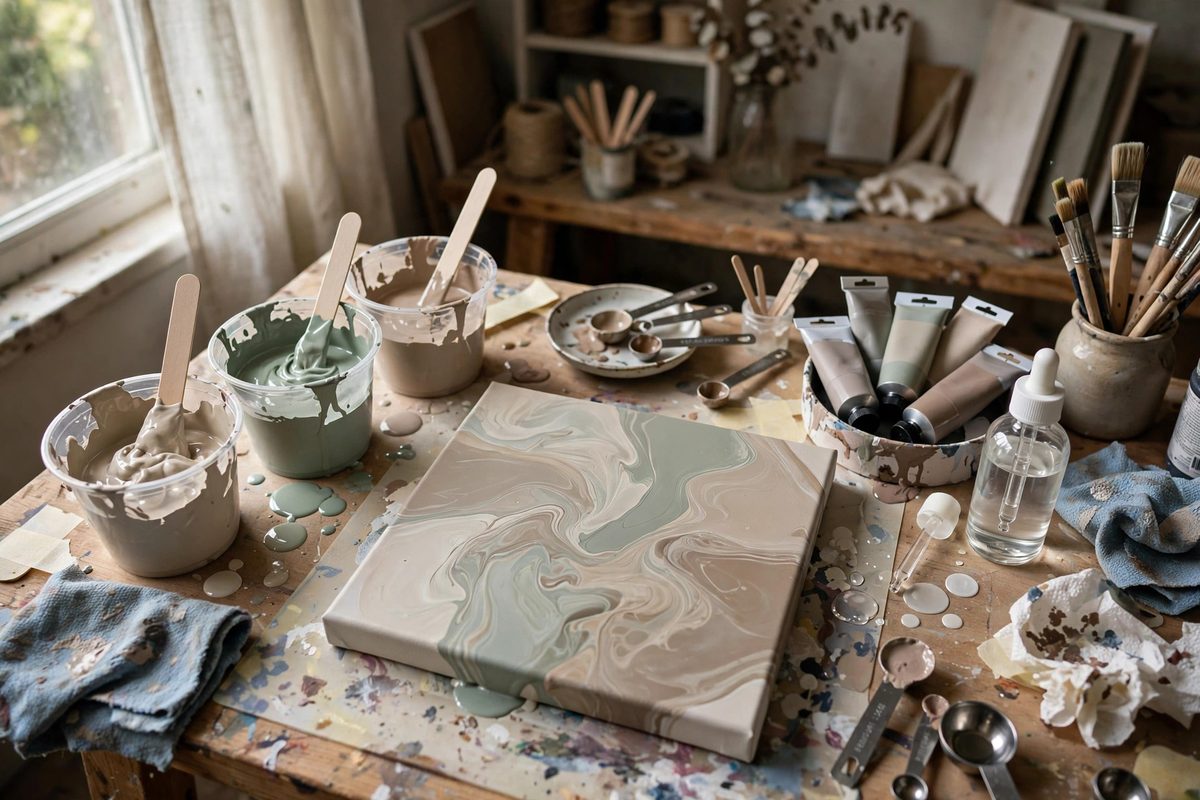
Matte acrylic pouring promises soft, velvety color fields without the plastic glare of gloss pours, but matte paints are thicker, less fluid, and more prone to cracking than their glossy cousins. Flow improver thins the paint without thinning the color, and the ratio of improver to paint determines whether the pour flows beautifully or fails structurally. Getting the ratio right is chemistry in service of aesthetics.
Why Matte Paints Resist Pouring
Matte acrylics get their flat finish from a high proportion of matting solids, fine particles dispersed in the paint film that scatter light. Those same solids make the paint thicker and less willing to flow, and they make the dried film more brittle than a gloss film. Thinning matte paint with water alone breaks down the acrylic binder: the pigment spreads but the binder is too dilute to form a continuous film, leading to cracking, flaking, and dull chalky patches. Flow improver, which is essentially binder-compatible surfactant chemistry, reduces the paint's surface tension and viscosity without diluting the binder below its film-forming threshold. This is why the improver ratio matters more than the water ratio: it is the safe way to gain flow.
Understanding Flow Improver Ratios
Flow improver is potent stuff, and the working ratios are small. A common starting point is around one part improver to ten or twenty parts paint, adjusted for the specific paint's body; heavy-body matte paints need more, fluid matte acrylics need less. Add the improver gradually and stir gently, avoiding whipping air into the mix, then test the flow: the paint should pour off the stir stick in a smooth, continuous stream, not in blobs or a watery rush. Too little improver and the pour will not level, leaving ridges and cells that never formed properly; too much and the paint becomes over-fluid, losing its ability to hold color separation and potentially compromising adhesion. The ratio is found by testing, not by formula, because every paint line formulates differently.
Balancing Flow With Film Integrity
The central tension in matte pouring is flow versus film strength. Every addition of improver and water moves the mixture toward better flow and weaker film. The practical limit is the point where a dried test puddle of the mixture remains flexible and adherent: pour a test, let it dry fully, then flex the dried skin and try to scratch it off the test surface. If it cracks or lifts easily, the mixture is over-thinned and needs more paint or less additive. Matte films are inherently less flexible than gloss, so this test is stricter for matte pouring; a mixture that would survive as a gloss pour may fail as a matte one. Respect the material's limits and the pour will last; push past them for extra flow and the painting will crack within months.
Pouring Technique for Matte Finishes
Pour matte mixtures with a lighter hand than gloss. The paint does not self-level as aggressively, so tilt the canvas gently and let the paint move slowly; aggressive tilting creates thin spots where the matte film is too weak. Work in a dust-free environment, since matte surfaces show every embedded speck and cannot be varnished glossy to hide flaws without defeating the purpose. Avoid over-manipulating the pour: each pass of a tool or breath of air disrupts the matting solids' distribution and can create shiny patches in the matte field. Let the pour do what it will do, then leave it alone. Drying should be slow and even; rapid drying, especially with heat, cracks matte films.
Sealing Without Losing the Matte
Unsealed matte pours are vulnerable to scuffing and moisture, but a gloss varnish destroys the matte effect. Use a matte or dead-flat varnish formulated for acrylics, applied in thin, even coats; test on a corner first, since some matte varnishes still add a slight sheen. Alternatively, leave the pour unvarnished and frame it under glass, which protects the surface while preserving the exact matte quality. Whichever route, the varnish or glass decision should be made before pouring, since it affects how you judge the wet colors. A matte pour, properly ratioed and properly protected, has a soft depth that gloss pours cannot touch.
Matte pouring works when the flow improver ratio gives fluidity without breaking the binder: start around one part in ten to twenty, test the dried film's integrity, pour gently, dry slowly, and seal matte. The velvet surface is worth the discipline.
Related Guides
- Matte Acrylic Medium Ratios for Translucent Glazing: Glazing in acrylics means building color in thin transparent layers, and the medium-to-paint ratio decides whether the glaze is luminous or muddy
- Retarder Ratios for Extended Acrylic Blend Times: Acrylic paint's fast drying is its signature and its curse. On the palette, speed is convenient. On the canvas, it means a blended gradient can lock
- Open Gel Medium Gloss Level Tuning for Glazes: Acrylic glazes, thin transparent color layers that modify what lies beneath, depend on their medium as much as on their pigment. Open gel medium, the