
India ink's permanence comes from shellac: the natural resin that binds the carbon pigment into a waterproof film once dry. That same shellac is what makes India ink challenging in rapid pens, technical pens, and any nib with fine channels. The shellac film that protects the finished drawing will, given the chance, form inside the pen and clog it solid. Balancing the shellac, enough for a durable film on paper but not so much that the pen gums up, is the central tension of inking with India ink in precision tools.
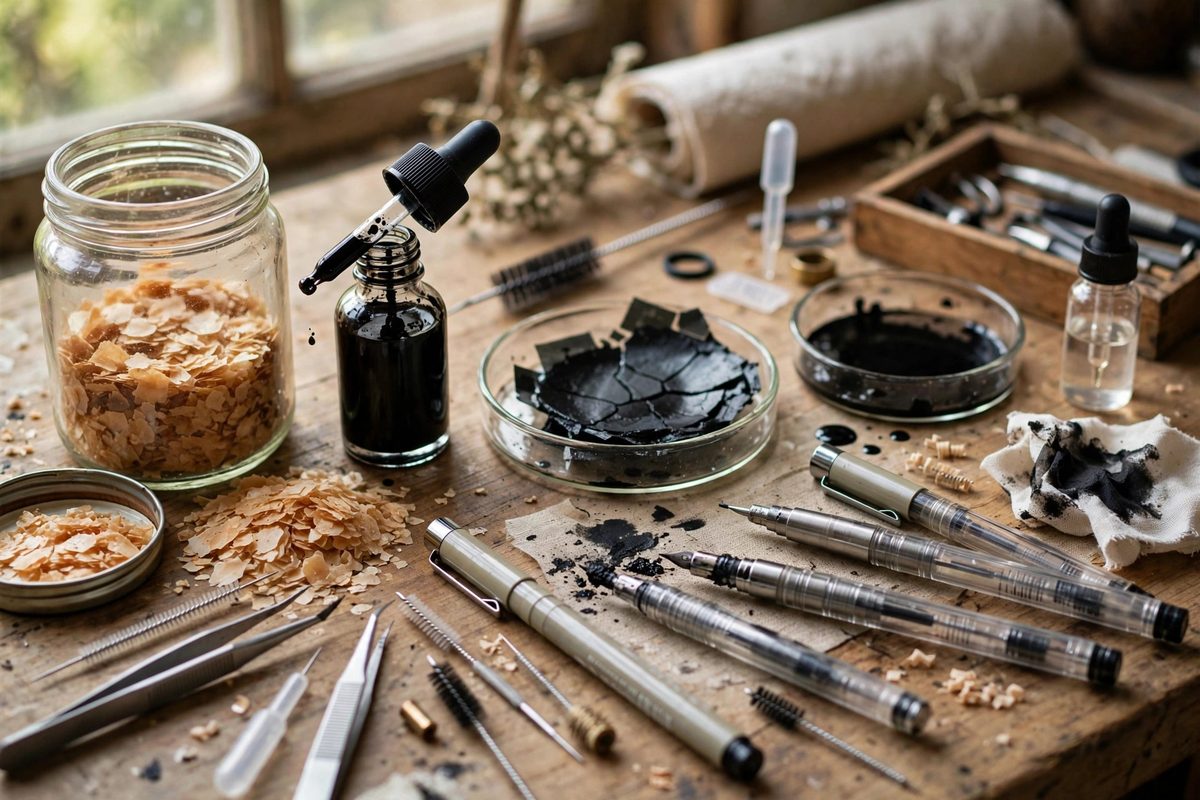
Why Shellac Clogs Pens
Shellac dries by solvent evaporation, and it starts drying the moment it is exposed to air. Inside a rapid pen's fine feed channels, the ink is spread thin with enormous surface area relative to its volume, which means it dries fast. A pen left uncapped for minutes, or even used slowly with long pauses, accumulates dried shellac in the channels. Each layer narrows the channel until flow stops.
The problem compounds because dried shellac does not readily redissolve in fresh ink. Once a channel is filmed over, running more ink through does not clear it; the new ink flows around or over the deposit, and the clog grows. Prevention is everything, because cure is disassembly and solvents.
Choosing Ink for the Pen
Not all India inks are equal in shellac content. Inks formulated for technical pens and airbrushes typically carry less shellac or use modified binders that resist drying in fine channels; inks formulated for brush and dip pen often carry more, prioritizing film toughness over pen-friendliness. Match the ink to the tool: pen-formulated ink in rapid pens, brush ink in brushes and dip pens.
When in doubt, test: run the ink in the pen for a working session with normal pauses, then check flow. An ink that survives your actual working rhythm is the right ink, regardless of what the label promises. Labels describe ideal conditions; your studio describes real ones.
Working Habits That Prevent Clogs
Cap the pen whenever it is not in your hand, even for short pauses. This single habit prevents more clogs than any ink choice. Keep a water cup at the desk and rinse the nib periodically during long sessions; a quick swish dissolves shellac before it films. Do not let ink dry on the nib's exterior, where it migrates into the feed as it cures.
- Work steadily; long contemplative pauses with an uncapped pen are clog invitations.
- Store rapid pens nib-up or horizontal per the manufacturer's guidance; nib-down storage floods the feed.
- Flush the pen with water at the end of every session, without exception.
- Never leave India ink in a rapid pen overnight; the morning will bring a solid feed.
Cleaning When Prevention Fails
A sluggish pen gets an immediate flush: disassemble per the manufacturer's instructions and soak the feed components in water, or in water with a drop of ammonia for stubborn shellac. An ultrasonic cleaner does excellent work on pen feeds, vibrating loose the deposits that soaking softens. Be patient; shellac that took hours to build may take an hour to dissolve.
Avoid picking at feed channels with pins or wires. The channels are precision-molded, and scratching them changes the capillary geometry that makes the pen work. Chemical and ultrasonic cleaning preserve the geometry; mechanical picking destroys it.
Balancing Film Strength on Paper
The other half of the balance is the drawing itself. Pen-formulated inks with less shellac still produce a serviceable film for most drawing purposes, but if the work needs maximum water resistance, for wash over inking, say, the tougher brush-grade ink may be warranted, applied with a dip pen that tolerates it. Choose the film strength the artwork needs, and choose the tool that tolerates the ink that provides it.
Test wash resistance on scrap: ink a line, let it cure fully (shellac continues hardening for hours), then wash over it. If the line holds, the film is sufficient for the technique. If it lifts, step up the shellac content and step the tool down to something that handles it.
Pen-friendly ink in the rapid pen, brush-grade ink in the dip pen, caps on during pauses, and flushing every session. The shellac is not the enemy; it is the reason the drawing survives. Respect its drying, and it will respect your pens.
Related Guides
- Waterproof India Ink Binder Viscosity on Hot Press Rag: Waterproof India ink behaves differently from non-waterproof ink on hot press paper, and the reason sits in the binder. Waterproof India ink carries
- Nib Flex Dynamics for Controlled Feathering Lines: A flexible nib spreads its two tines apart as you press down, letting more ink flow and drawing a wider line. Release the pressure and the tines snap
- Preventing Nib Scratching on Cold Press Rag: Cold press watercolor paper has a beautifully textured surface that gives ink drawings character, but that same texture fights the pen nib. The nib