
A flexible nib spreads its two tines apart as you press down, letting more ink flow and drawing a wider line. Release the pressure and the tines snap back, returning to a hairline. Feathering, the delicate flick of lines at the tips of hair, feathers, or fabric, lives entirely in that release: the controlled transition from a loaded, flexed nib to a closed one. Understanding how the tines behave, and how your hand drives them, turns feathering from a happy accident into a repeatable stroke.
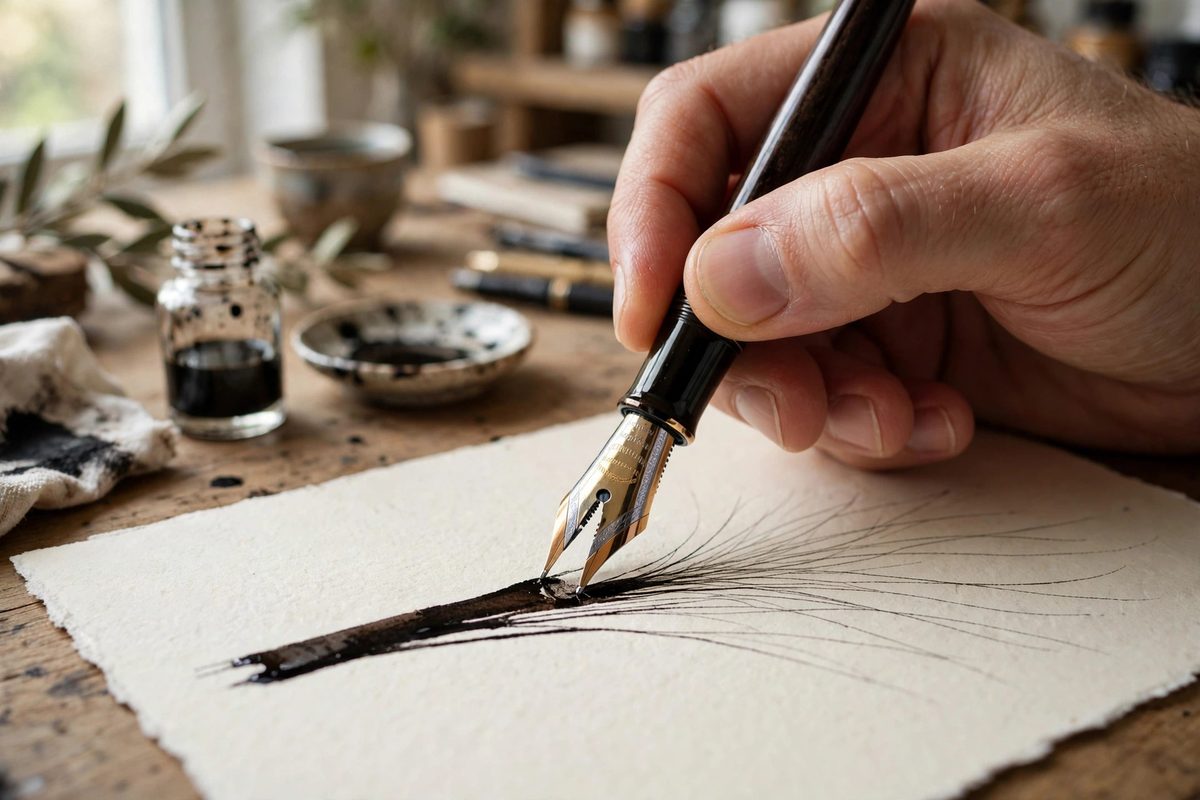
How Tine Spread Works
Cut a slit down the middle of a nib and you have two tines. Press the nib to the paper and the tines lever apart at the tip, widening the slit channel so more ink reaches the paper. The widening follows leverage: pressure applied slightly above the tip bends each tine outward, and the slit gap at the very tip grows. Harder pressure also flattens the tines against the paper, increasing contact area. Both effects widen the line together, which is why flex nibs produce such dramatic variation, often ten times the hairline width or more. Metal has a spring curve: initial pressure barely moves the tines, then they give progressively, then resist sharply near their limit. The expressive middle of a feathered stroke rides on that middle zone.
Matching Nib Stiffness to the Job
Flex nibs range from firm to extra-flexible, and the grade matters more than the brand. A firm flex nib needs deliberate pressure to spread and is forgiving: you can draw long tapered lines without accidentally blowing out the width. For controlled feathering, most artists land on a medium flex. It responds to moderate pressure with a predictable spread and, critically, returns to hairline quickly when pressure lifts, which is the entire mechanic of a feather flick. If your feathers keep ending thick, try a stiffer nib before blaming your hand.
The Angle of Attack
Tine spread depends on nib angle as much as on downward force. Hold the nib nearly flat to the paper, around 30 degrees or less, and pressure drives the tines apart efficiently; the nib glides and the tines do the work. Steepen the angle toward vertical and the same downward force increasingly pushes the nib point into the paper rather than spreading the tines, which risks catching, scratching, and digging in. The classic feathering grip keeps the nib low and pushes the stroke forward with the wrist while the fingers modulate pressure. On a good feathering stroke you can see the slit visibly open and close as your pressure waves. If you cannot see the slit working, you are either pressing too little to flex or too much to release cleanly.
Pressure Rhythms for Feather Clusters
A single feather barb is one pressure wave: touch down light, load pressure to widen, lift smoothly to taper. A cluster of feathers is that wave repeated in rhythm, and the rhythm is what sells it. Keep the beat even and the spacing even; the eye reads irregularity as error. Drill rows of comma shapes: downstroke with a slight pressure swell, then a flicked release where pressure drops to zero before the stroke ends. Beginners lift at the last moment, which leaves a hooked blob. Lifting pressure a fraction early lets the tine spring do the tapering for you, and the nib keeps gliding on residual ink while the tines close. Repeat until the flick becomes a hand rhythm rather than a conscious decision.
Ink Viscosity and Feed
Flex nibs are sensitive to ink flow because the line width depends on the slit channel delivering enough ink to fill the widened gap. Ink that is too thin or too free-flowing floods the feather, blobbing the release and burying the taper. Ink that is too thick or a feed that runs dry starves the stroke, so the wide sections break into rails, two parallel lines with a dry gap between them. Railing under pressure means increase flow or switch inks; blobbing on release means thin the ink slightly or wipe the nib more often. A freshly dipped nib holds a bead of ink at the slit as a reservoir; as it depletes, feathers thin out. Learn your nib's stroke count and redip before it fades, because uneven ink supply masquerades as inconsistent pressure.
Maintenance That Preserves Flex
Springing a nib, bending the tines past their elastic limit so they stay spread, is the classic way to ruin one. A sprung nib railed forever afterward, because the tines no longer close fully. The fix is preventive: keep the angle low, never press past the point where the slit is visibly wide open, and stop the stroke when the ink runs rather than bearing down harder. Clean flex nibs promptly after use, especially with pigmented or shellac-based inks that can cement the slit. A soft brush and plain water, dried tine-down, keeps the slit channel clear. Protect the tips in storage; a dented tip catches paper and breaks the release rhythm.
Feathering looks like magic until you feel the tines working under your fingers, then it becomes mechanics: pressure on, tines spread, pressure off, tines close. Pick a medium flex nib, keep the angle low, and let the spring do the tapering. The hand rhythm follows quickly.
Related Guides
- Preventing Nib Scratching on Cold Press Rag: Cold press watercolor paper has a beautifully textured surface that gives ink drawings character, but that same texture fights the pen nib. The nib
- India Ink Shellac Film Balancing for Rapid Pens: India ink's permanence comes from shellac: the natural resin that binds the carbon pigment into a waterproof film once dry. That same shellac is what
- Waterproof India Ink Binder Viscosity on Hot Press Rag: Waterproof India ink behaves differently from non-waterproof ink on hot press paper, and the reason sits in the binder. Waterproof India ink carries