
Teaching CNC routing to beginners presents a paradox: the machine demands respect for forces that beginners cannot yet feel, and the safest way to learn would be to make all the mistakes, which is exactly what you cannot allow. Instructional scaffolding resolves this by structuring the learning path so each new freedom is earned through demonstrated competence at the previous level. Students progress from observation to simulation to supervised cutting to independent operation, with the instructor's control fading as the student's judgment grows. Done well, scaffolding produces operators who are safe because they understand, not because they memorized rules.
Why scaffolding instead of rules lectures
A safety lecture front-loads abstract rules onto students with no experience to attach them to. They nod, they forget, and the first time the spindle screams they freeze or panic. Scaffolding works differently: it limits what can go wrong at each stage so students can focus on one new concept at a time. At the observation stage, the only lesson is what the machine does and how it sounds when it is happy. At the simulation stage, students learn the software chain with zero physical risk. By the time a student stands at the machine with material loaded, they have already made every software mistake in simulation and watched every mechanical behavior from a safe distance. The rules arrive as explanations of things already seen, which is when rules actually stick.
Stage one: observation and vocabulary
Begin with students watching the instructor run complete jobs, narrated in plain language. Name every part and every action: the spindle, the collet, the workholding, the homing sequence, the feed rate, the depth of cut. Have students keep a simple log of what they observe, including the sounds of good cutting versus the sounds of trouble. This stage builds the mental model and the vocabulary that every later stage depends on. It also normalizes the machine's presence; a CNC router is intimidating, and intimidation produces the tentative, jerky behavior that causes accidents. Familiarity, built through structured observation, replaces fear with attention.
Stage two: simulation and dry runs
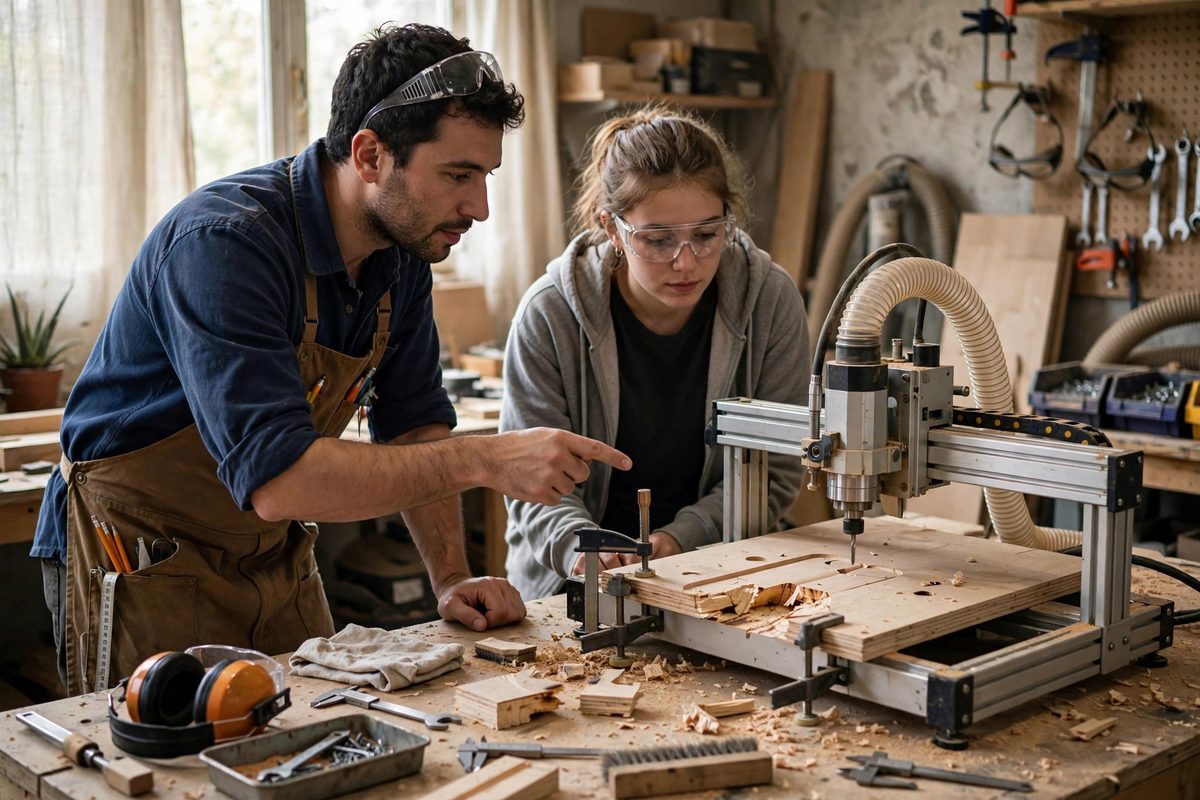
Before touching the machine, students design and toolpath in software, then verify in simulation. Teach them to read the simulated toolpath critically: does the bit clear the clamps, does the cut order make sense, are the feeds and speeds sane for the material? Then run their program on the machine with no bit, or with the spindle off and the Z raised, as a dry run. The dry run is a powerful teaching moment because students see their program's actual motion, including the rapid moves they forgot about, with nothing at stake. Require instructor sign-off on the simulation and the dry run before any cutting. This gate is the heart of the scaffolding: it makes verification a habit rather than a suggestion.
Stage three: supervised cutting with constrained choices
First cuts happen under direct supervision with deliberately constrained parameters. The instructor selects the material, the bit, and the workholding; the student executes the setup and runs the verified program. Constraining the choices is not about distrust. It is about isolating the learning: the student practices setup, zeroing, and machine operation without simultaneously making tooling decisions they are not ready for. During the cut, teach active monitoring: what to watch, what to listen for, and where the feed hold and stop controls are. Run a deliberate pause-and-inspect mid-job so students learn that stopping to check is always allowed. The lesson of this stage is that safe operation is a procedure, not a personality trait.
Stage four: fading support and independent operation
As students demonstrate competence, the scaffolding fades in a planned sequence. First the instructor stops hovering and observes from a distance. Then students choose their own bits and workholding within an approved list, justifying the choices. Then they run jobs start to finish with only a pre-cut check-in. Each fading step is gated on demonstrated performance, not on time served; a student who rushes setup does not advance until the rushing stops. Document the progression with a simple checklist signed at each stage. The checklist protects the student, the instructor, and the program, because it makes the standard explicit and the advancement earned.
Designing for the inevitable mistake
Scaffolding reduces mistakes; it does not eliminate them, so the lab itself must be forgiving. Enforce eye and hearing protection as non-negotiable lab entry requirements. Keep the emergency stop location drilled into every student from day one. Maintain the machine so that a student error produces a broken bit rather than a dangerous event: sharp bits, secure workholding, and sane default feeds. Debrief every incident, including near misses, as a group learning event rather than a punishment. A lab culture where students report their own mistakes is worth more than any guard, because the mistakes you hear about are the ones you can teach from.
Scaffold CNC instruction as a fading sequence: observe, simulate, cut supervised with constrained choices, then earn independence step by step. Gate each stage on demonstrated competence, build verification into the procedure, and treat every mistake as curriculum. The goal is not students who have never erred. It is students who know exactly what to do when something starts going wrong.
Related Guides
- Metacognitive Scaffolding in Open Maker Spaces: An open maker space gives people tools, materials, and freedom. What it does not automatically give them is the ability to think about their own
- Structuring Technical Maker Manuals for Print Delivery: A technical maker manual has to do something most books never attempt: teach hands-on skills through paper alone, in an order the reader can follow
- Kinesthetic Learning Feedback in Shop Tool Mastery: Reading about a hand plane teaches you what a hand plane is; pushing one teaches you what sharp feels like. Tool mastery in the shop is kinesthetic
- Pagination Imposition for Multi-Page Workshop Guides: A workshop guide that reads perfectly on screen can become a confusing mess when printed and bound, because print imposes a physical order on pages
- Typesetting Multi-Column Technical Handbooks for Print: A technical handbook has to be readable, referenceable, and dense with information, three demands that fight each other on the page. Multi-column