
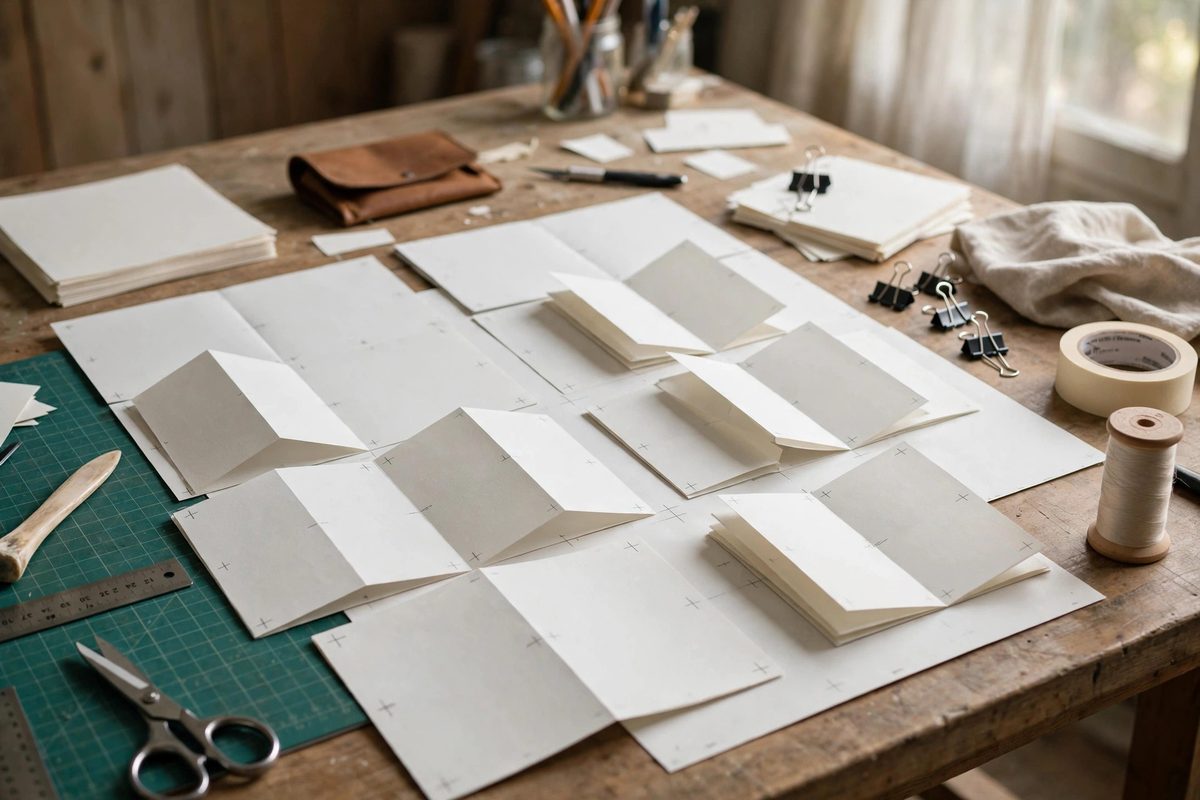
A workshop guide that reads perfectly on screen can become a confusing mess when printed and bound, because print imposes a physical order on pages that screens ignore. Imposition, the arrangement of pages on the printed sheet so they fall in the right order after folding, is the skill that turns a PDF into a proper booklet. For makers producing workshop guides, understanding pagination and imposition means your printed handouts actually work in people's hands.
Why page order is not what you think
When you fold printed sheets into a booklet, each sheet carries four pages: two on the front, two on the back, arranged so that folding puts them in sequence. An eight-page booklet printed on two sheets does not place pages 1 through 4 on the first sheet; it places pages 8 and 1 on one side and 2 and 7 on the other. This non-intuitive ordering is imposition, and getting it wrong produces booklets where the page sequence scrambles. The larger the guide, the more punishing the error: a 32-page guide has an imposition pattern no one can improvise correctly.
Signatures and page counts
Printed booklets are built from signatures, groups of pages printed on one sheet and folded together. The common signature is 4 pages per sheet side pair, meaning total page counts should be multiples of 4. If your guide has 30 pages of content, you need 32 imposed pages; the two extras become blank pages, which you should place deliberately (inside covers, section dividers) rather than letting them land randomly. Plan your content to a multiple of four from the start, and the imposition stays clean.
Pagination conventions for guides
Readers navigate printed guides by page numbers, so paginate thoughtfully. Odd pages fall on the right when the booklet is open; even pages on the left. Start major sections on odd pages so they open facing the reader. Keep procedures unbroken across spreads where possible: a step-by-step that forces the reader to flip mid-procedure loses people. Folios (page numbers) belong in a consistent position, usually the outer bottom corner, and running heads identifying the section help readers who picked the guide up mid-workshop.
Imposition tools and methods
Most makers do not need to impose by hand. PDF tools and print drivers offer booklet printing modes that handle the imposition automatically: you supply pages in reading order, and the software rearranges them for folding. Desktop publishing software can impose directly for more complex jobs. The critical step is proofing: print one full copy on the actual paper, fold and staple it, and read it cover to cover checking that every page is in order and right-side up. Catching an imposition error on the proof costs one copy; catching it after printing fifty costs the run.
Binding and paper choices
Saddle stitching (stapling through the fold) suits guides up to about 48 pages; beyond that, the booklet will not close flat and perfect binding or spiral binding is better. Choose paper heavy enough to survive a workshop: 24-pound stock minimum for interior pages, heavier for covers. If the guide will live in a shop, consider lamination for the cover or printing on synthetic paper that shrugs off oil and sawdust. A guide that disintegrates in the environment it was made for is a failed guide.
Plan to a multiple of four, impose with software, proof one physical copy, and bind for the environment. The guide that survives the workshop is the guide that gets used.
Related Guides
- Pagination and Bleed Setup for Multi-Page Workshop PDF: When your workshop manual, build log, or cut-list guide needs to live as a PDF, how you set up the pages matters as much as what you write
- Digital Asset Imposition for Print Shop Production: Imposition is the quiet engineering behind every printed book, booklet, and multi-page document: the arrangement of pages on the press sheet so that
- Typesetting Multi-Column Technical Handbooks for Print: A technical handbook has to be readable, referenceable, and dense with information, three demands that fight each other on the page. Multi-column
- Structuring Technical Maker Manuals for Print Delivery: A technical maker manual has to do something most books never attempt: teach hands-on skills through paper alone, in an order the reader can follow
- Kinesthetic Learning Feedback in Shop Tool Mastery: Reading about a hand plane teaches you what a hand plane is; pushing one teaches you what sharp feels like. Tool mastery in the shop is kinesthetic