
Amigurumi, the Japanese art of crocheted stuffed creatures, lives or dies on its fabric density: the stitches must be tight enough that stuffing never shows through, and the shaping must be smooth enough that the creature reads as sculpted, not lumpy. The invisible decrease is the technique that shapes without scarring, and tension control is what makes it truly invisible. Master both and your amigurumi looks store-bought in the best way: seamless, firm, and clean. It is one of those skills where a week of deliberate practice permanently upgrades everything you make afterward.
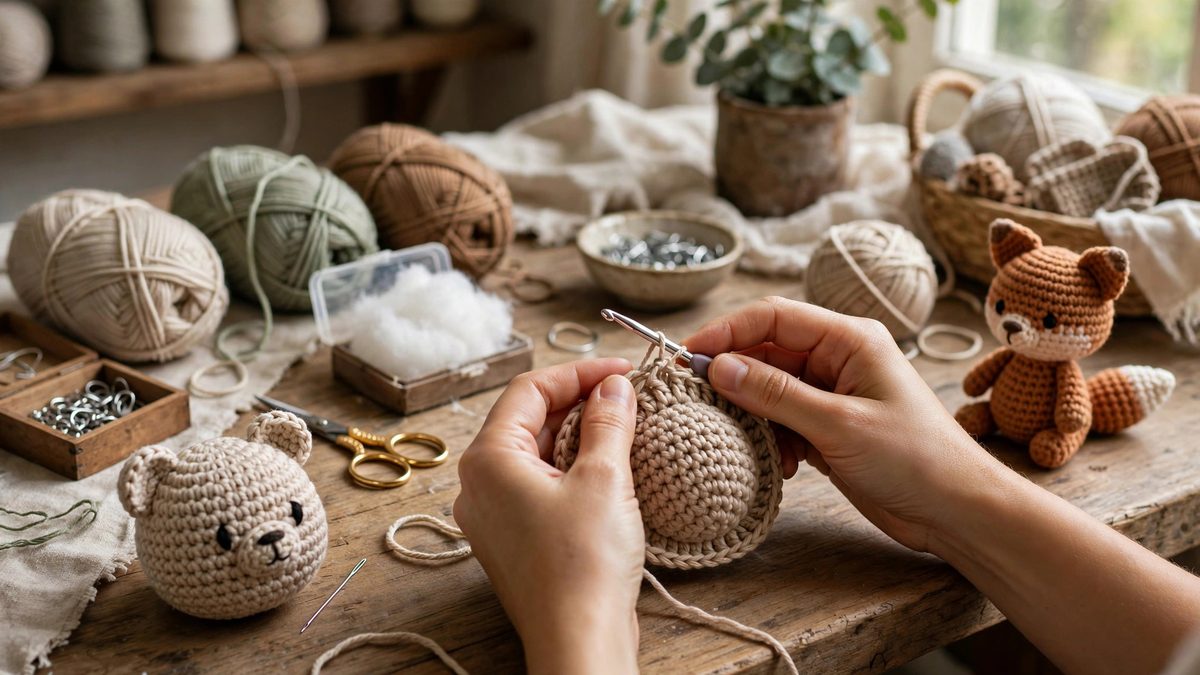
What makes a decrease visible
A standard decrease works the hook through two stitches and pulls them together, which leaves a small horizontal bar across the front of the work and a slight pucker. On open crochet fabric that bar disappears into the texture; on dense amigurumi fabric it stands out as a visible line spiraling around every shaping round. Multiply by dozens of decreases and the piece carries visible rings wherever it was shaped.
The invisible decrease avoids this by working only through the front loops of the two stitches, which rolls the decrease to the inside of the work. The front face shows two stitches leaning together with no bar, no pucker, and no line. It is a small mechanical change with a dramatic visual result.
Executing the invisible decrease
Insert the hook through the front loop only of the next stitch, then through the front loop only of the following stitch, yarn over, and pull through both front loops, then yarn over and complete the single crochet as normal. The key detail is catching only the front loops; catching a full stitch reverts to a standard decrease with all its visibility.
Keep the motion smooth and consistent. Hesitation mid-decrease tends to tighten the first loop and loosen the second, producing an uneven pair. Practice the movement until it flows as one gesture; the rhythm of invisible decreases should match the rhythm of your regular stitches, or tension varies between shaped and unshaped rounds.
Tension: the real invisibility
The technique alone is not enough; tension makes the decrease disappear. Work decreases at the same tension as the surrounding stitches, resisting the urge to tug them tighter. Over-tightened decreases pucker the fabric and draw the neighboring stitches out of alignment, which is more visible than a standard decrease done evenly. Trust the front-loop mechanics and keep your hand relaxed.
Maintain the dense gauge throughout. Amigurumi typically uses a hook smaller than the yarn label suggests, producing a firm fabric with no gaps. If your normal stitches show stuffing, the decreases will too; fix the gauge first, then refine the decreases. Consistency across the piece matters more than absolute tightness: even slightly-loose-but-uniform fabric looks better than fabric that alternates tight and loose.
Placement and shaping strategy
Distribute decreases evenly around the round according to the pattern, and stagger them relative to the previous decrease round so they do not stack vertically. Stacked decreases form a visible seam line even when each individual decrease is invisible; staggering distributes the shaping smoothly around the form. This is why well-written patterns offset their decrease rounds, and why improvisers should do the same.
Count religiously. A missed or extra decrease distorts the shaping symmetrically, producing lopsided creatures. Place a stitch marker at the round start and count decreases per round; the few seconds of counting save hours of frogging a misshapen head.
Stuffing and finishing
Stuff firmly and evenly before the opening gets too small to work through; under-stuffed amigurumi collapses and over-stuffed distorts the shaping. Add stuffing in small amounts, shaping the form with your fingers as you go, and close the final rounds over a well-filled form. The dense fabric and invisible decreases show their value here: firm stuffing against a clean surface with no gaps and no visible shaping lines.
Weave in ends securely through the dense fabric, where they lock in place naturally. The same density that hides stuffing hides ends, which is one of amigurumi's quiet mercies. Run the tail through several stitches in different directions before trimming close; a tail woven in a straight line can work itself out over time, while a zigzagged tail stays put.
Invisible decreases are front loops only, even tension, staggered placement, and accurate counting, worked at a dense gauge over firm stuffing. The shaping vanishes into the fabric, and the creature emerges smooth, firm, and professional. Technique plus tension: that is the whole secret.
Related Guides
- Preventing Stitch Distortion in Spiral Amigurumi Tubes: Amigurumi worked in a spiral has no seam, which is its charm and its trap. Without a joining round to reset the alignment, stitches drift: the spiral
- Yarn Over vs Yarn Under Tension in Miniature Toys: Amigurumi, the Japanese art of crocheting miniature toys, lives or dies on stitch tension. The difference between a toy with a smooth, firm surface
- Seamless Color Changes in Continuous Spiral Crochets: Amigurumi and other spiral-crocheted pieces grow in a continuous helix with no joining seam, which is wonderful until you need to change color: the
- Yarn Under Single Crochet Stitches in Tight Toys: Amigurumi, the Japanese art of crocheted stuffed toys, demands a fabric with no visible holes: the stuffing must stay invisible no matter how the toy