
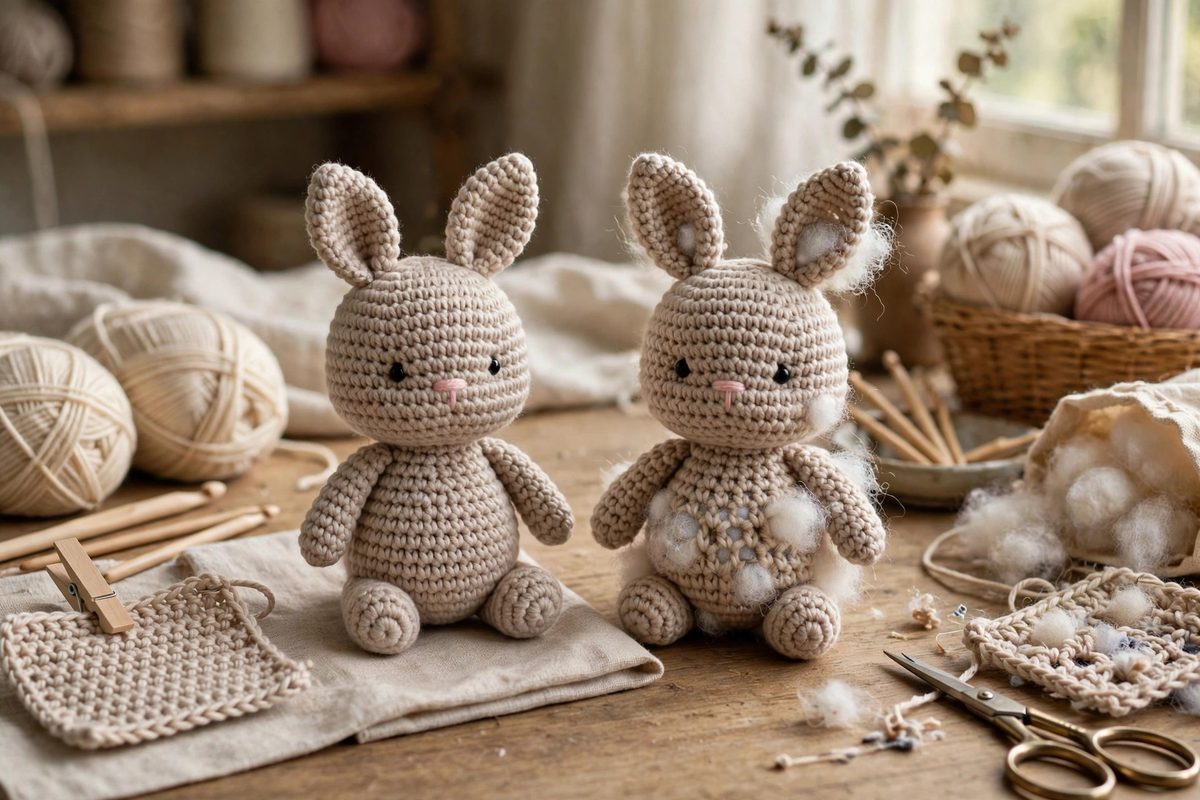
Amigurumi, the Japanese art of crocheting miniature toys, lives or dies on stitch tension. The difference between a toy with a smooth, firm surface and one with visible stuffing poking through often comes down to a single technical choice: whether you yarn over or yarn under when forming each single crochet. It sounds like nothing. It changes everything about how the finished toy looks and holds up.
What Yarn Over and Yarn Under Mean
In a standard single crochet, you insert the hook, yarn over (bring the yarn over the top of the hook from back to front), pull through, yarn over again, and pull through two loops. The yarn-under variation changes the motion: instead of bringing the yarn over the top of the hook, you bring it under the hook from front to back. The stitch that results looks similar at first glance, but its structure is different: the yarn-under stitch twists the yarn slightly and seats the loops tighter and more vertically, while the yarn-over stitch lays the loops a bit more open and slanted. Same hook, same yarn, visibly different fabric.
Why Yarn Under Suits Amigurumi
Amigurumi is almost always worked in the round with single crochet, and the fabric needs to be dense enough to contain stuffing without gaps. Yarn-under stitches produce a tighter, more compact fabric with the characteristic neat "v" or "x" appearance that amigurumi makers prize, and the stitches sit straighter, which makes the rounds look more uniform. The tighter structure also resists stretching: a stuffed toy puts constant outward pressure on its skin, and yarn-under fabric holds its shape under that pressure better than the slightly looser yarn-over fabric. For miniature toys where every millimeter of surface matters, the difference is not subtle.
Tension Control With Each Technique
Technique choice does not replace tension control; it amplifies it. With yarn under, keep your tension even and slightly firm: the technique already tightens the stitch, so strangling the yarn will make the work stiff and hard to get the hook through, while too-loose tension wastes the technique's advantage. With yarn over, which many crocheters learn first, you need consciously tighter tension to approach amigurumi density, often combined with a hook a size or two smaller than the yarn label suggests. Whichever you use, check your fabric early: crochet a few rounds, stuff a test section, and look for gaps between stitches. If you see stuffing, tighten up or switch technique before you are twenty rounds deep.
Switching Techniques Mid-Project
Do not switch between yarn over and yarn under within a single toy unless you are doing it deliberately for texture. The two techniques produce visibly different stitch appearances, yarn under reading as neat x-shaped stitches and yarn over as more open v-shapes, and mixing them creates a patchy surface that looks like a tension problem. Pick one for the project and stay with it. If you are converting from a lifetime of yarn-over crocheting, expect the yarn-under motion to feel awkward for the first few dozen stitches; muscle memory adapts quickly, and most converters never go back for amigurumi.
Yarn Choice Interacts With Technique
The yarn matters too. Smooth, tightly plied yarns show the stitch definition differences most clearly and work beautifully with yarn under. Fuzzy or textured yarns hide stitch structure, which can be forgiving for beginners but also masks the neatness advantage. Splitty yarns are harder to work with yarn under because the under motion can catch the plies; if your yarn splits constantly, try a different yarn rather than fighting it. And match the hook to the goal: amigurumi generally wants the smallest hook that still lets you work comfortably, because hook size is the other half of fabric density.
When Yarn Over Is the Right Call
Yarn under is not universally superior; it is superior for amigurumi. For garments, blankets, and drapey projects, the standard yarn over gives a softer, more fluid fabric, and the slight openness that hurts a stuffed toy is exactly what you want in a shawl. Use each technique where its fabric properties serve the project. The skilled crocheter is not the one who always yarns under; it is the one who knows why they chose it this time.
For miniature toys, yarn under gives you the dense, neat, stuffing-proof fabric the craft demands. Learn the motion, keep the tension even, size the hook down, and your amigurumi will have the crisp professional surface that makes people ask how you did it. Now you know.
Related Guides
- Yarn Under Single Crochet Stitches in Tight Toys: Amigurumi, the Japanese art of crocheted stuffed toys, demands a fabric with no visible holes: the stuffing must stay invisible no matter how the toy
- Invisible Decrease Tension in Dense Amigurumi: Amigurumi, the Japanese art of crocheted stuffed creatures, lives or dies on its fabric density: the stitches must be tight enough that stuffing
- Seamless Color Changes in Continuous Spiral Crochets: Amigurumi and other spiral-crocheted pieces grow in a continuous helix with no joining seam, which is wonderful until you need to change color: the
- Preventing Stitch Distortion in Spiral Amigurumi Tubes: Amigurumi worked in a spiral has no seam, which is its charm and its trap. Without a joining round to reset the alignment, stitches drift: the spiral