
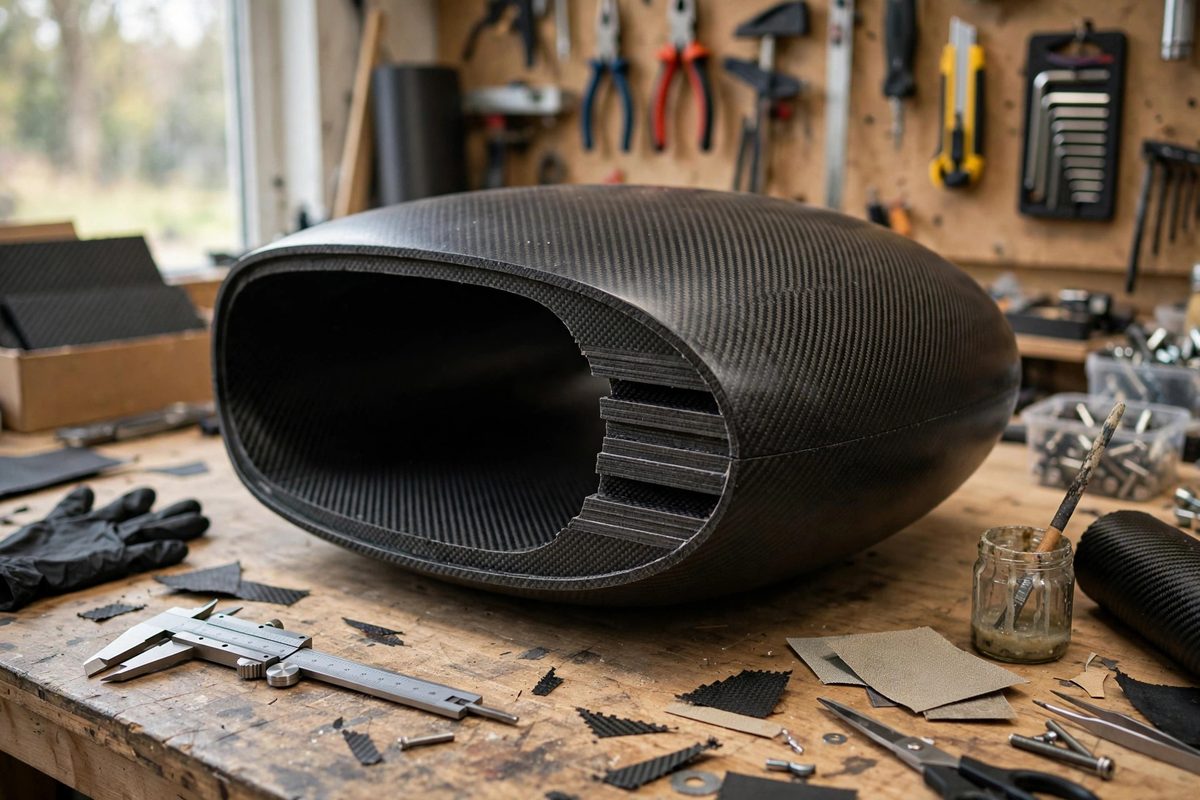
A monocoque robot pod, where the carbon fiber shell itself is the structure rather than a skin over a frame, offers the best strength-to-weight ratio available to the small robot builder. But the shell is only as good as its layup: the number, orientation, and placement of carbon plies determine whether the pod is a rigid, protective structure or an expensive eggshell. Layup thickness is the primary variable, and choosing it is an engineering decision balancing stiffness, strength, weight, and impact tolerance.
How Monocoque Carries Load
In a monocoque, the shell resists bending, torsion, and impact as a continuous structure; there is no internal frame to share the work. Bending stiffness of a thin shell scales with the cube of the wall thickness: doubling the thickness increases stiffness roughly eightfold. This cubic relationship means small thickness changes have large structural effects, and it also means the minimum thickness that achieves the required stiffness is often thinner than intuition suggests.
Strength follows a less dramatic but equally important scaling: the shell must resist the peak loads (drops, collisions, actuator reaction forces) without fiber failure or delamination. Stiffness usually governs the design for precision robots (where flex degrades accuracy), while strength governs for rugged robots (where impacts are the threat). Know which one your pod answers to.
Choosing Ply Count and Orientation
Carbon fabric comes in standard weights, and the layup thickness is the ply count times the cured ply thickness. A typical starting point for small robot pods is three to five plies of mid-weight fabric, yielding a shell roughly a millimeter thick; larger or more heavily loaded pods go thicker. But ply count alone is half the story: orientation determines how the thickness works.
The classic quasi-isotropic layup, plies at 0, 45, 90, and -45 degrees, gives uniform in-plane properties: the shell resists loads from any direction equally. For pods with known dominant load directions (a chassis that bends primarily along its length), biasing more plies toward the load direction improves efficiency; for pods that get hit from anywhere, quasi-isotropic is the safe default. Never stack all plies in one orientation; the shell becomes strong in one direction and fragile in all others.
Local Reinforcement Strategy
Uniform thickness is rarely optimal. Mounting points, actuator attachments, and impact zones want local reinforcement: additional plies or doubler patches that thicken the shell where loads concentrate, while the general shell stays light. This is the monocoque's great advantage over uniform structures: put the material where the loads are.
- Reinforce around every hard mounting point; fasteners in thin carbon crush and delaminate without doublers.
- Add plies at corners and edges, where stress concentrates and impacts land.
- Consider core materials (thin foam or honeycomb) in large flat panels; sandwich stiffness vastly exceeds solid thickness at the same weight.
- Taper reinforcements gradually; abrupt ply drop-offs create stress risers.
Impact Tolerance and Damage Modes
Carbon's weakness is impact: a sharp blow can delaminate plies internally with little visible surface damage, and the weakened shell then fails under loads it previously handled. Thicker layups resist impact better, but the real defenses are design choices: avoid large unsupported flat panels (which flex and delaminate), round the external geometry (which distributes impact), and consider a sacrificial outer layer (a ply of fiberglass or aramid outside the carbon) that absorbs impact energy and shows damage visibly.
Inspect after any significant impact: tap testing (listening for the dull thud of delamination versus the crisp ring of sound laminate) is the field method, and suspect areas get repaired or the pod gets retired from critical service. A monocoque with hidden delamination is a failure waiting for a load.
Fabrication Quality as a Thickness Factor
Theoretical layup thickness assumes perfect consolidation: every ply fully wetted, no voids, no dry spots, uniform resin content. Real hand layups vary, and the variation effectively reduces the reliable thickness: a nominally five-ply shell with voids and resin-rich zones performs like a thinner perfect shell. Vacuum bagging dramatically improves consolidation and is close to mandatory for structural monocoques; the quality gain outweighs the hassle.
Design with a safety factor that reflects your process capability, not the textbook values. A conservative thickness in a well-consolidated shell outperforms an aggressive thin layup with voids, and the weight penalty of one extra ply is small against the confidence it buys.
Size thickness to the stiffness or strength that governs, orient plies for the loads, reinforce locally, protect against impact, and consolidate well. The monocoque pod rewards thoughtful layup with a structure that is lighter than any frame-and-skin alternative and stronger than it has any right to be.
Related Guides
- Carbon Fiber Tube Gusset Bonding for Quadrupeds: Quadruped robots live on carbon fiber tubes: light, stiff, and easy to source. But tubes alone make a floppy structure; the joints where tubes meet
- Torsional Rigidity in 6061 Extruded Frames: Robot chassis built from 6061 aluminum extrusion are easy to assemble and tempting to under-engineer. The failure mode that bites is rarely bending
- Triangulated Space Frame Bracing for Tubular Rovers: A tubular rover chassis built from straight tubes and simple joints has a natural enemy: the rectangle. Four tubes joined in a rectangle will fold
- Torsional Deflection Testing on Box Extrusions: Robot chassis built from aluminum box extrusions are stiff in bending and surprisingly willing to twist, and twist is what ruins precision. A chassis