
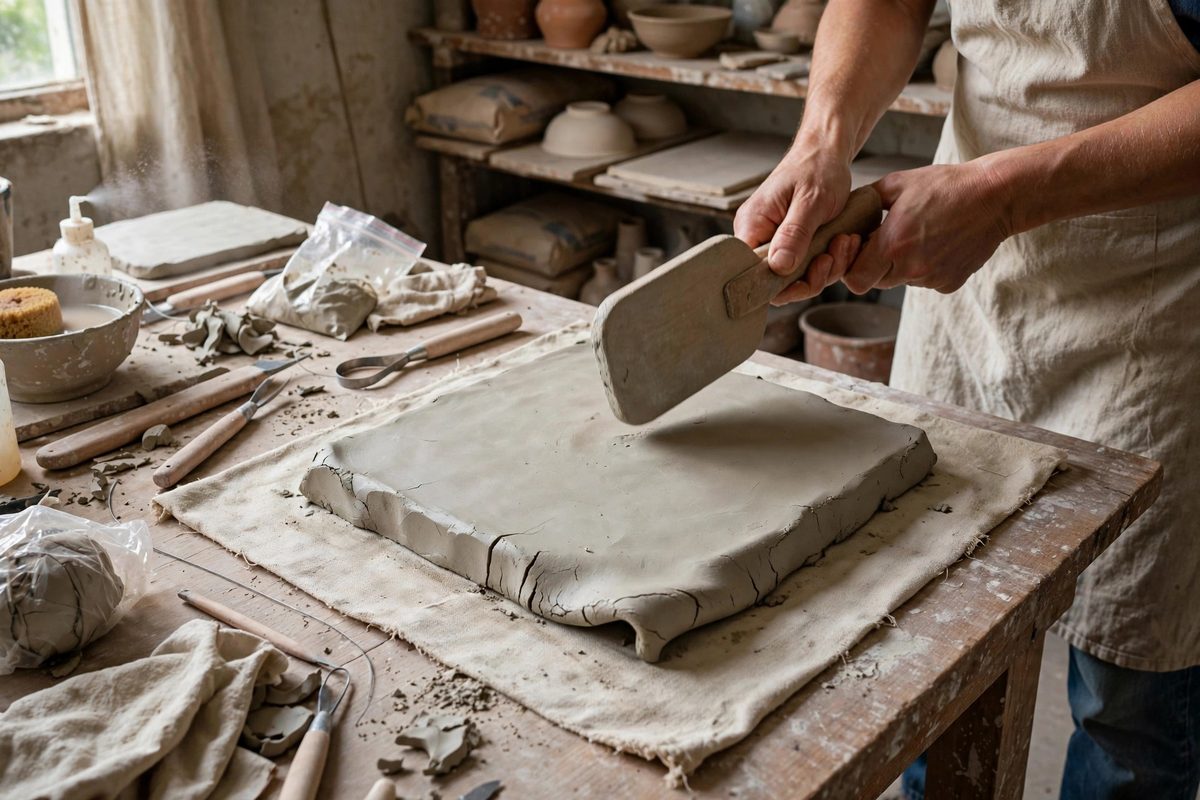
A clay slab looks uniform but often is not: rolling and handling leave internal stresses, with the top and bottom surfaces compressed differently than the core. As the slab dries, those stresses express themselves as warping, and the warp appears after you have built the piece. Paddle beating the slab, striking it firmly and evenly with a flat wooden paddle, relieves those internal stresses before construction begins.
Where the Internal Stress Comes From
Rolling a slab stretches the clay's particle alignment in the rolling direction, and the two faces experience different forces than the interior. Picking the slab up, flipping it, and moving it around adds bending stresses. The result is a slab with locked-in shear: layers wanting to move relative to each other. While the clay is wet and plastic, the stress stays hidden. As water leaves and the clay stiffens, the stress overcomes the clay's rigidity and the slab warps, usually cupping or twisting. The warp is not a drying problem; the drying only reveals the stress that was always there.
The Paddle Beating Technique
Lay the slab on a clean, flat surface, canvas or a ware board, and strike it with a flat wooden paddle using firm, even blows. Work systematically across the whole surface in overlapping rows, covering every area with similar force. Flip the slab and beat the other side the same way. The beating compresses the clay uniformly, realigning the particles and erasing the directional stress from rolling. You will feel the slab firm up slightly and lie flatter; that is the stress leaving. Beat both faces equally, because beating one side only creates a new asymmetry.
When to Beat in the Process
Beat the slab after rolling it to thickness but before cutting or assembling. The clay should be at a workable softness, not soupy and not leather-hard; too wet and the beating just displaces the slab, too stiff and the blows cannot realign the interior. If you cut pieces first and then beat them, the beating distorts the cut edges, so the order matters: roll, beat, then cut. For large slabs, beat in sections with overlap, keeping the pressure consistent so no zone ends up denser than its neighbors.
Combining With Other Stress Relief
Paddle beating handles rolling stress, but slabs also benefit from rest. After beating, let the slab sit covered for a while so moisture equalizes through the thickness; a slab drier on the faces than in the core will still warp regardless of beating. When joining beaten slabs into a form, score and slip the joints well and let the assembled piece dry slowly and evenly, covered loosely. The beating is one step in a stress-managed process, not a magic fix that excuses fast drying or poor joining.
Recognizing Success
A properly beaten slab lies flat on the ware board without rocking, cuts cleanly without curling at the edges, and stays flat as it dries to leather-hard. If a slab still warps after beating, the usual causes are uneven beating, beating at the wrong moisture, or drying too fast on one face. Adjust one variable at a time and the slabs will start behaving. The paddle is one of the oldest tools in ceramics precisely because this problem is as old as slabs themselves.
Roll the slab, beat both faces evenly with the paddle, rest it covered, then cut and build. The internal shear gets relieved before it can become warp, and the finished piece dries flat the way you built it.
Related Guides
- Internal Chamfer Ribbing for Tall Coil Built Vessels: Tall coil-built vessels want to slump, belly out, or crack at the coil joints as they rise. Internal chamfer ribbing, a series of angled ribs worked
- Scoring and Slumping Slab Joints Without Cracking: Slab-built pottery joins flat pieces of clay into three-dimensional forms, and every joint is a potential crack. The joint fails when the two pieces
- Compressing Base Clay to Stop S-Cracks in Pots: S-cracks are the spiral fractures that open in the bottom of thrown pots during drying or firing, shaped like a lazy S across the base. They are not