
A tarp shelter fails in wind for predictable reasons: the wind gets under an edge, the fabric bellies, a gust multiplies the load, and a tie-out rips or a stake pulls. Paracord rigging, tensioned at the right angles, is what keeps the tarp a taut aerodynamic surface instead of a sail. The geometry of the guy lines matters as much as the knots.
The angle that holds
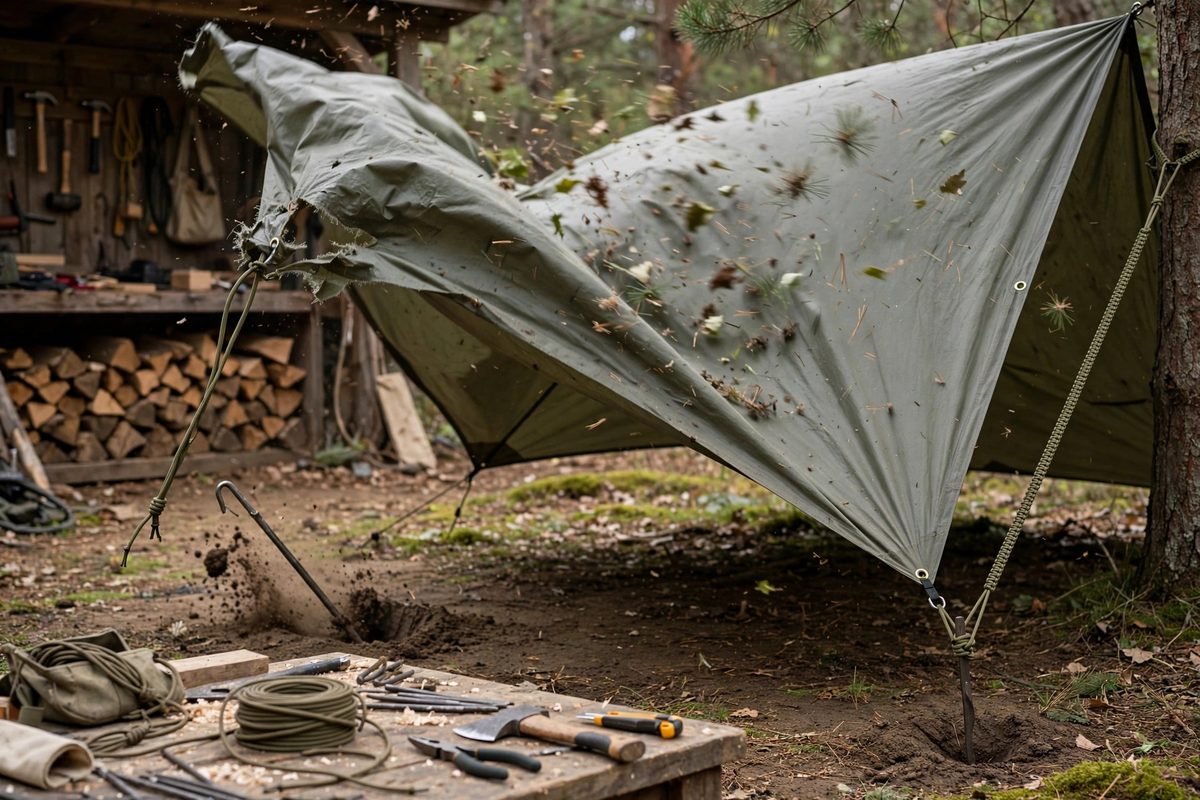
A guy line resists wind load best when it bisects the angle between the tarp edge and the ground, roughly 45 degrees from each. At this angle, the line's tension splits evenly between pulling the tarp edge down-and-out (keeping it taut) and pulling the stake into the ground at an angle the stake resists well. A guy line run nearly horizontal pulls the stake sideways, where stakes are weakest; a guy line run nearly vertical holds the edge down but does nothing against the sideways billow that precedes failure. Walk every guy line after pitching and eyeball the angle; adjust stake positions until each line runs at roughly 45 degrees.
Tension: taut, not guitar-string
The tarp should be drum-taut, but the cord should not be at its limit. Paracord stretches, especially when wet, and a line tensioned to maximum at pitch will either sag when it rains or shock-load the tie-outs when a gust hits. Tension firmly, then back off a touch; the line should have no visible sag but should give slightly under a hard pull. Use tensioners, taut-line hitches or hardware tensioners, on every guy line so the pitch can be re-tightened in seconds as conditions change. Re-tension after the first rain and after the first big gust; the initial set always loosens.
Ridgeline geometry
The ridgeline carries the whole shelter's wind load, so its angle and support matter most. Pitch the ridgeline with a slight downward slope from one end to the other for rain runoff, but keep it high enough that the tarp's sides can still angle outward to their stakes. Support the ridgeline at both ends with solid anchors, trees, trekking poles, or dedicated poles, and consider a mid-span support on long pitches; an unsupported ridgeline sags, and a sagging ridgeline flaps, and flapping destroys tarps. The ridgeline cord should be the strongest line in the system.
Edge and corner reinforcement
Wind load concentrates at corners and edges. Use all the tie-outs the tarp offers, not just the corners; intermediate tie-outs distribute the load and prevent the edge from bellowing between corners. At each tie-out, the load should pull along the tarp's reinforced hem, not perpendicular to raw fabric. If the tarp lacks a needed tie-out, add one with a proper reinforcement patch rather than clipping to the fabric edge; an unreinforced clip is a tear waiting for a gust.
Stakes and soil
The best guy-line angles fail if the stakes pull. Drive stakes at an angle leaning away from the tarp, so the pull seats them deeper rather than levering them out. In soft soil, use longer stakes or deadman anchors (a buried log or rock with the line tied to it). In sand or snow, deadmen are mandatory; no stake holds in those mediums. Carry a few extra stakes and cord; the field repair for a pulled stake is a second stake, not a wish.
Forty-five degrees, firm but not maxed, every tie-out used, stakes angled away. The tarp stays a roof instead of becoming a kite.
Related Guides
- Taut-Line Hitch Tension Limits in Extreme Storm Tarps: The taut-line hitch is the adjustable guyline knot that lets you tension a tarp and re-tension it as conditions change. In a real storm, though
- Prusik Hitch Retention on Paracord Ridge Lines: A tarp shelter lives or dies on its ridge line, and the prusik hitch is how that line becomes adjustable: a friction knot that grips under load but
- Shear Lashing Pole Tension in Bivouac Ridge Frames: A bivouac ridge frame, two A-frame shear legs joined by a ridgepole, is one of the oldest shelters in the book: fast to build from cut poles, strong
- Taut-Line Hitch Friction Under Extreme Storm Winds: The taut-line hitch is the adjustable guyline knot: it grips the standing line under tension so your tarp stays tight, yet slides when you push it so