
A tarp shelter lives or dies on its ridge line, and the prusik hitch is how that line becomes adjustable: a friction knot that grips under load but slides when you need to reposition it. On paracord, which is slick and stretchy, the prusik's retention, its ability to hold without slipping, needs deliberate attention.
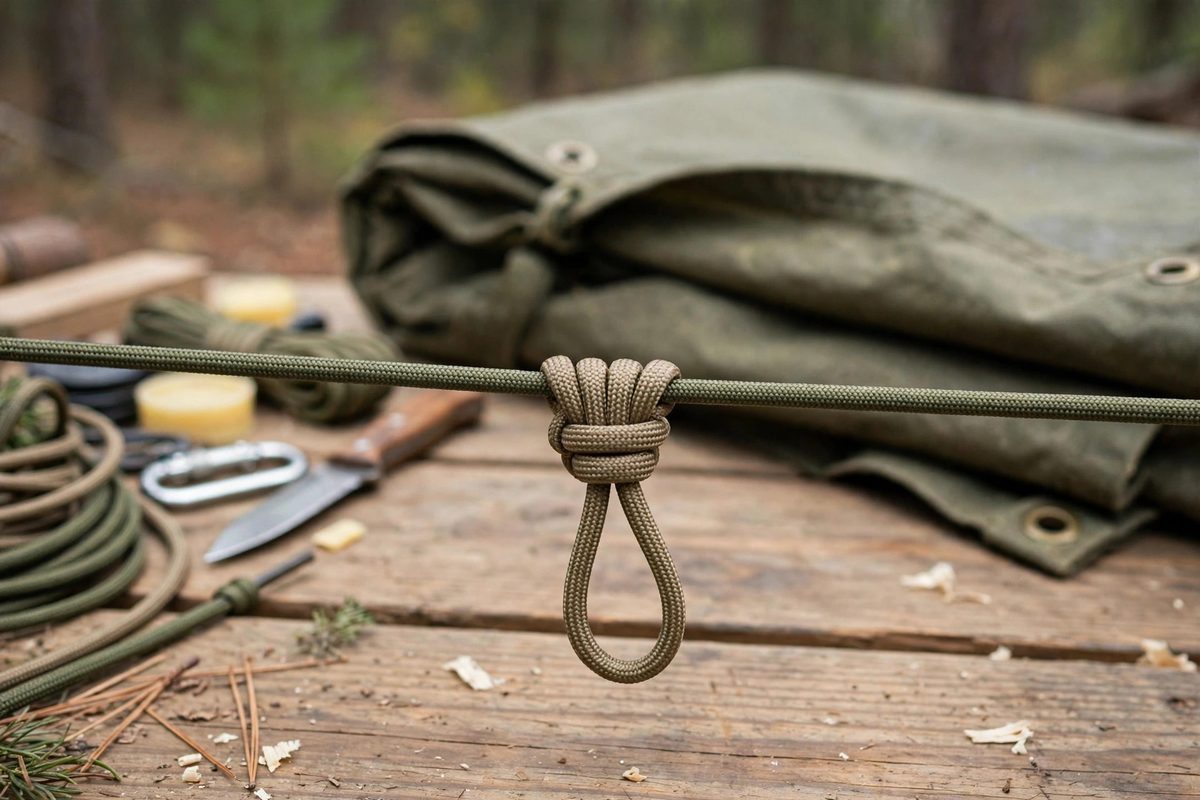
How the prusik grips
A prusik is a loop of cord wrapped several times around the main line, with the loop's ends forming the attachment point. Under load, the wraps constrict around the main line, and friction holds the knot in place; unloaded, the wraps can be slid along the line. The grip depends on the friction between the prusik cord and the main line, which depends on the materials, the number of wraps, and the load direction. Understanding that it is friction, not magic, tells you how to improve it.
The paracord challenge
Paracord's nylon sheath is smooth and its core is slightly elastic, both of which work against prusik retention. The smoothness reduces friction; the stretch lets the main line thin slightly under load, loosening the wraps. Compensate with more wraps than you would use on rougher cord: where three wraps might hold on natural fiber rope, paracord often wants four or five. Also consider the prusik loop's own material; a loop of slightly smaller, rougher cord grips paracord better than a loop of the same paracord.
Tying for maximum hold
Dress the prusik carefully: each wrap should lie neatly alongside the previous one, not crossing or bunching. Crossed wraps create uneven pressure and slip points. After tying, load the knot and let it set, then check that all wraps are snug and even. A well-dressed prusik on paracord holds remarkably well; a sloppy one slips at the worst moment, usually in the middle of the night when the tarp sags onto your face. Take the extra thirty seconds to dress it right.
Load direction and the knot's limits
A prusik holds best when loaded along the line, pulling the loop away from the wraps' direction. Sideways or shock loading can make it slip or even roll. In a ridge line setup, the loads are mostly along the line, which suits the knot, but wind gusts create dynamic loads that test the retention. Size the safety margin accordingly: if the prusik is all that holds the tarp's tension, back it up or use enough wraps that gusts do not defeat it. Know the knot's limits and stay inside them.
Wet conditions
Rain changes everything. Wet nylon is slicker than dry, and a prusik that held in the afternoon sun may slip in a midnight downpour. Add an extra wrap when rain is expected, and check the ridge line tension after the rain starts; nylon also stretches when wet, compounding the problem. The shelter system that works in fair weather needs a margin for foul weather, and the prusik is where that margin lives.
Inspection and replacement
Prusik loops wear: the wraps abrade the loop cord, UV degrades nylon, and repeated loading fatigues the fibers. Inspect the loops regularly for fuzzing, flat spots, or stiffness; replace any loop that shows real wear. The loops are cheap and quick to tie; the ridge line they protect is not. Carry spare cord for replacement loops on any trip where the shelter matters, which is every trip where you brought a shelter.
Use enough wraps for slick paracord, dress them neatly, expect less hold when wet, and inspect the loops. The prusik will grip the ridge line and slide when asked, which is exactly the adjustable reliability a tarp shelter needs.
Related Guides
- Paracord Tension Angles for Windproof Tarps: A tarp shelter fails in wind for predictable reasons: the wind gets under an edge, the fabric bellies, a gust multiplies the load, and a tie-out rips
- Shear Lashing Pole Tension in Bivouac Ridge Frames: A bivouac ridge frame, two A-frame shear legs joined by a ridgepole, is one of the oldest shelters in the book: fast to build from cut poles, strong
- Taut-Line Hitch Tension Limits in Extreme Storm Tarps: The taut-line hitch is the adjustable guyline knot that lets you tension a tarp and re-tension it as conditions change. In a real storm, though
- Taut-Line Hitch Friction Under Extreme Storm Winds: The taut-line hitch is the adjustable guyline knot: it grips the standing line under tension so your tarp stays tight, yet slides when you push it so