
The taut-line hitch is the adjustable guyline knot: it grips the standing line under tension so your tarp stays tight, yet slides when you push it so you can retension without retying. That sliding grip is friction, and friction is exactly what storm winds attack. When gusts hammer a shelter, the knot sees rapid load spikes, vibration, and shock, and understanding how the hitch behaves at those extremes is what keeps your tarp up at 3 a.m.
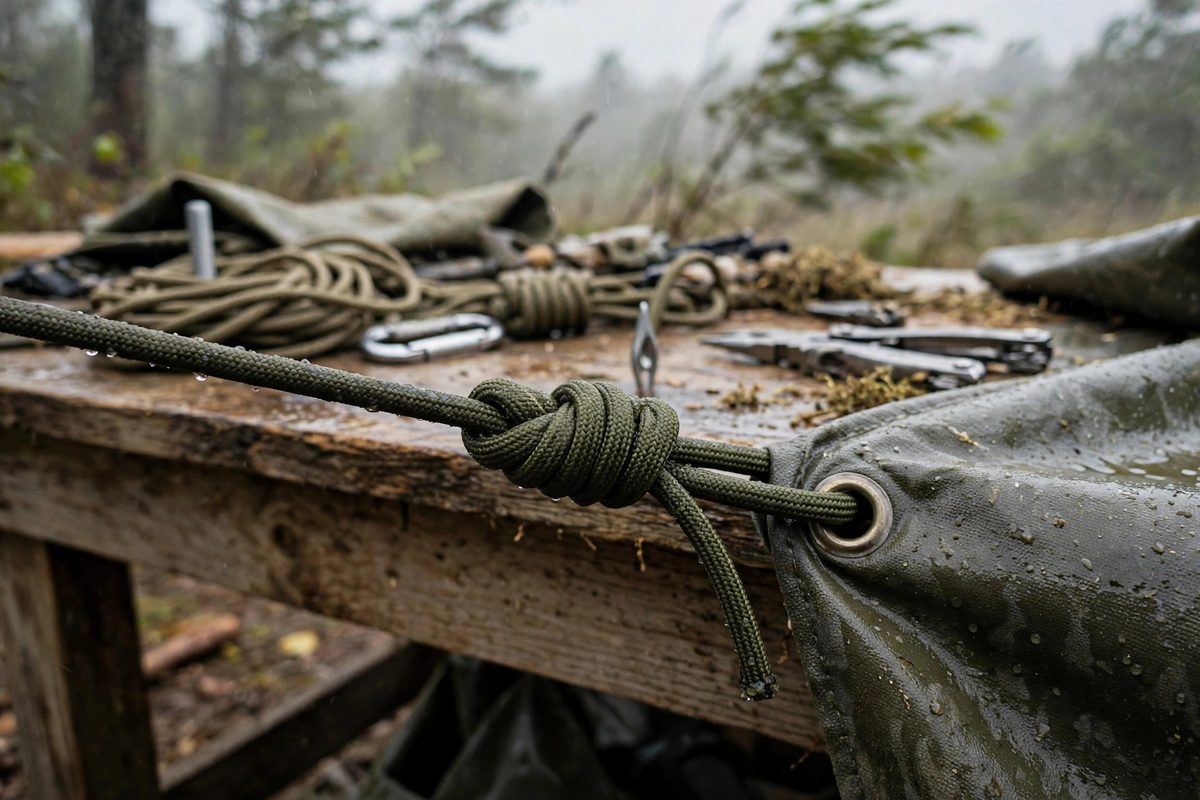
How the Hitch Grips
The taut-line hitch wraps the working end around the standing line two or three times inside the loop, then finishes with a half hitch outside. Under steady tension, those wraps constrict on the standing line and the friction holds the knot in place. Slide the knot by hand and the wraps loosen just enough to move; release, and tension re-seats them. It is a beautiful mechanism, and its holding power depends on the number of wraps, the rope's texture, and the load being relatively steady. Storms violate that last condition.
What Storm Winds Do to Friction Knots
Wind load is not steady; it is a series of sharp pulses as gusts hit the tarp and the fabric snaps. Each pulse spikes the tension, then releases it. Under cyclic loading, friction hitches can walk: each cycle lets the wraps creep a fraction of an inch, and hundreds of cycles add up to a slipped guyline. Vibration compounds the problem, shaking the wraps looser with every gust. A taut-line hitch that held perfectly in a breeze can migrate several inches in an hour of storm gusts, and a migrated hitch is a loosened tarp, which catches more wind, which migrates the hitch further.
Wraps, Rope, and Holding Power
More wraps mean more friction surface, so in storm conditions use three full wraps inside the loop instead of two. Rope choice matters enormously: rough, textured cordage (like braided nylon or polyester with a coarse sheath) grips far better than slick line (like Dyneema or smooth polypropylene), which can slip under shock loads no matter how many wraps you add. Wet rope generally grips better than dry, but some synthetics get slicker when wet; know your cordage. And never use the taut-line hitch on rope near its breaking strength, because the knot itself reduces the line's strength and storm gusts will find that margin.
Backing Up the Hitch for Storms
When serious wind is forecast, do not rely on the friction grip alone. After tensioning the taut-line hitch, add a backup: a simple half hitch snugged against the wraps locks them in place and converts the adjustable knot into a fixed one for the duration of the storm. You lose adjustability, but you gain certainty, and certainty is what you want when the wind is trying to dismantle your shelter. Alternatively, retension the hitches before dark and again at the first sign of rising wind; a freshly seated hitch resists walking far better than one that has been creeping all afternoon.
Guyline Angles and Anchor Quality
The knot is only half the system. Guyline anchors (stakes, trees, rocks) fail in storms more often than knots do, and a pulled stake makes the finest hitch irrelevant. Drive stakes at roughly 45 degrees away from the shelter, in line with the guyline's pull, and use longer or wider stakes in soft ground. Keep guyline angles low: a line running nearly horizontal to a distant anchor holds far better than a steep line to a close stake, because the horizontal component of tension does the work of resisting wind. In truly extreme conditions, double up critical guylines with a second independent anchor.
When to Abandon the Tarp
Know the limit. No knot and no anchor system holds a tarp against winds that are destroying the trees around it. If gusts are snapping branches and the tarp is deforming violently, the right move is to take the shelter down before it becomes a sail that injures someone or destroys your gear. A shelter you strike deliberately can be re-pitched; a shelter the storm strikes for you is just debris. The taut-line hitch is an excellent knot within its envelope, and wisdom is knowing where that envelope ends.
The taut-line hitch earns its place in every shelter kit, but storms demand respect for its friction limits. Three wraps, grippy cordage, a backup half hitch when it matters, solid anchors, and the judgment to strike the shelter when the wind wins: that is the complete storm system, and the knot is only one part of it.
Related Guides
- Taut-Line Hitch Tension Limits in Extreme Storm Tarps: The taut-line hitch is the adjustable guyline knot that lets you tension a tarp and re-tension it as conditions change. In a real storm, though
- Prusik Hitch Retention on Paracord Ridge Lines: A tarp shelter lives or dies on its ridge line, and the prusik hitch is how that line becomes adjustable: a friction knot that grips under load but
- Shear Lashing Pole Tension in Bivouac Ridge Frames: A bivouac ridge frame, two A-frame shear legs joined by a ridgepole, is one of the oldest shelters in the book: fast to build from cut poles, strong
- Paracord Tension Angles for Windproof Tarps: A tarp shelter fails in wind for predictable reasons: the wind gets under an edge, the fabric bellies, a gust multiplies the load, and a tie-out rips