
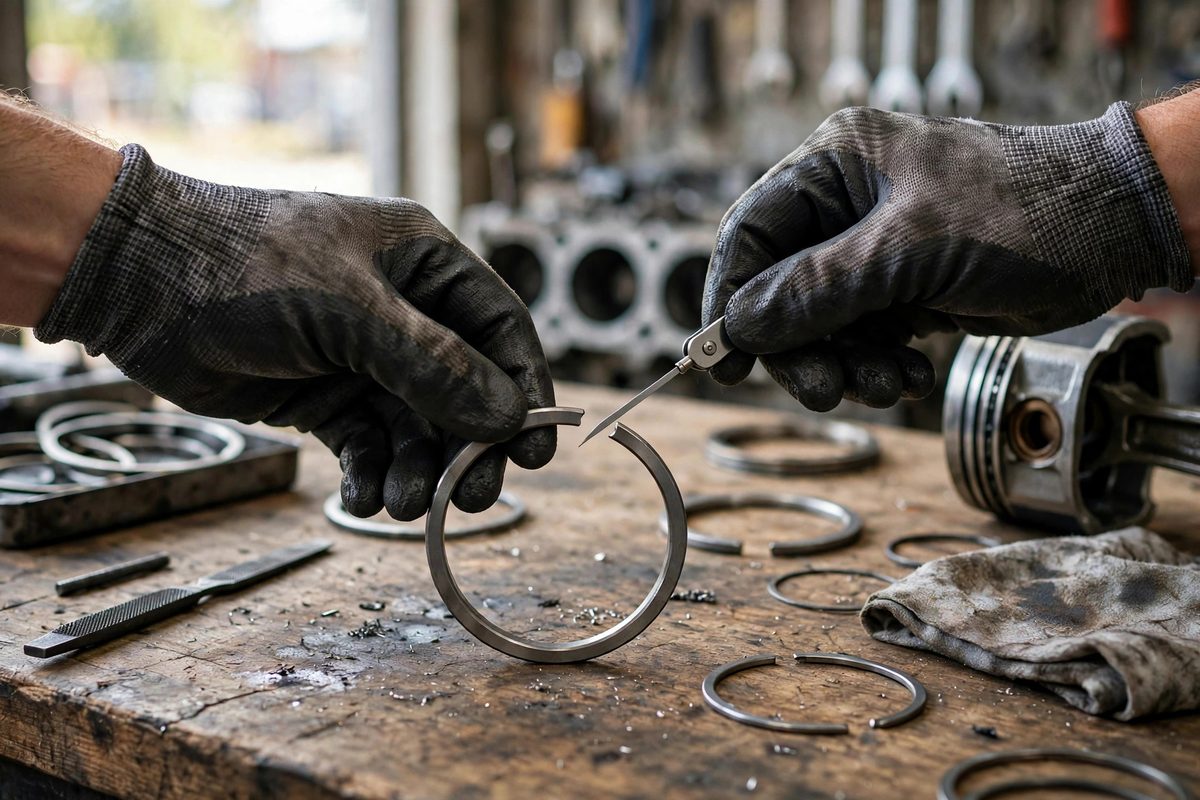
Piston rings seal the combustion chamber, but they are split rings with a gap at their ends, and that gap is a critical dimension. Too small and the ring's ends butt together as the engine heats up, scoring the cylinder or breaking the ring; too large and compression and oil control suffer. Filing the end gap to the correct specification for the engine's operating temperature is a fundamental rebuild skill.
Why the gap exists and grows
The ring needs its gap for installation (it must expand over the piston) and for thermal expansion in service. As the engine reaches operating temperature, the ring grows circumferentially; the gap closes by the amount of that growth. The filed gap must therefore be larger than the thermal growth, with margin: the specification accounts for the hottest the ring will get, which is hotter in a performance or forced-induction engine than in a stock rebuild. Filing to the minimum spec on a hard-working engine invites butted ends; when in doubt within the spec range, favor the wider side.
Measuring the gap
Square the ring in the cylinder bore it will run in, using the piston (inserted upside down) to push it down to the unworn part of the bore, typically about an inch below the deck. Measure the gap with feeler gauges; the correct gauge should slide through with slight drag. Measure in the actual bore because bore diameter sets the gap: the same ring in a freshly honed oversize bore needs a different gap than in a standard bore. Check every ring in its own cylinder; bores vary, and assuming uniformity is how one cylinder ends up wrong.
Filing technique
File from the outside inward, removing material from one end of the ring only, keeping the filed face square to the ring's circumference. Use a fine file or a dedicated ring-filing tool, and remove small amounts: check the gap frequently, since a few extra strokes overshoot quickly and there is no putting metal back. Deburr the filed end carefully with a fine stone; a burr left on the ring end scores the cylinder wall on the first revolution. File in a clean area and wipe the ring afterward; filing grit embedded in the ring is an abrasive the engine does not need.
Gap specifications and their logic
Top compression rings run hottest and need the largest gaps; second rings run cooler and gap smaller; oil rings have their own specification, often given as a range. Performance applications widen the top ring gap further to survive higher combustion temperatures. Always use the specification for your specific piston, ring, and application combination; generic "rules of thumb" exist but the ring manufacturer's spec for your parts is authoritative. When the spec gives a range, position within it based on use: street engines toward the tight side for better sealing, hard-use engines toward the loose side for safety.
Installation after filing
Stagger the ring gaps around the piston according to the manufacturer's pattern; aligned gaps form a leak path. Ensure the rings' markings face up where specified; many rings are directional. Use a proper ring compressor for installation, and confirm each ring moves freely in its groove after the piston is in the bore. A ring that binds after careful gap filing usually has a burr or debris in the groove, not a gap problem; find it before running the engine.
Measure in the bore, file square and deburr, respect the spec for your application, and stagger on assembly. The gap is small, but the engine's life depends on it.
Related Guides
- Plastigauge Clearance Checks on Crank Bearings: Crankshaft bearings live on a film of oil thinner than a human hair, and the thickness of that film is set by the clearance between the bearing and
- Connecting Rod Side Clearance Sizing on Crankshaft Pins: When two connecting rods share a single crankshaft pin, as they do on most V8s, the side clearance between them is a small measurement with large
- Dial Bore Indicator Calibration on Crank Journals: Crank journals live on clearances measured in thousandths, and the dial bore indicator is the tool that reads them. But the indicator only tells the