
Planetary gearheads, the compact concentric reducers that multiply a motor's torque, are rated with efficiency numbers that look reassuring on the datasheet: 90 percent per stage, sometimes more. Under real robotic loads, the achieved efficiency is often lower, and the gap between rated and real efficiency shows up as heat, reduced torque at the output, and battery drain that the power budget did not predict. Understanding where the losses come from and how load affects them lets you size actuators honestly and design within the gearhead's real capabilities.
Where the Efficiency Goes
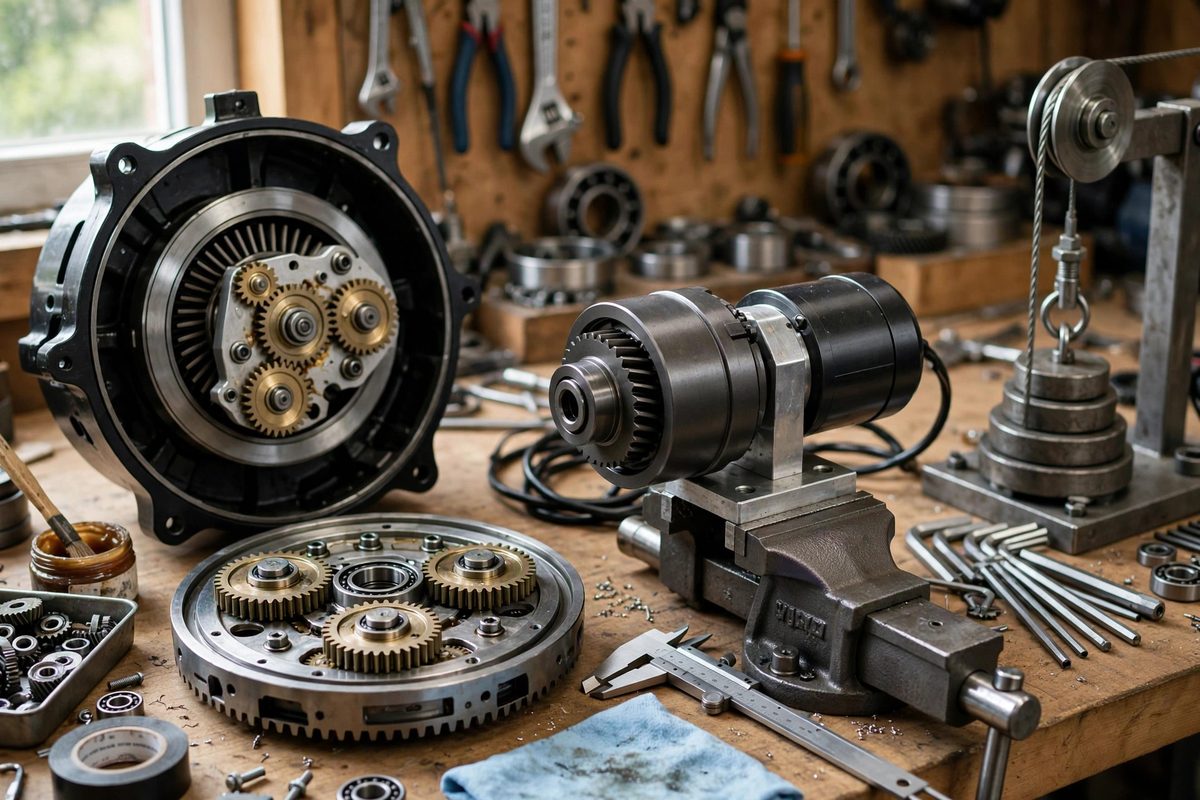
Gear mesh losses dominate: each planet-to-sun and planet-to-ring mesh slides as well as rolls, and sliding means friction. Bearing losses add their share, particularly in the planet bearings, which spin fast under load. Seal drag, lubricant churning, and at high speeds, windage, take smaller bites. A single planetary stage typically loses 3 to 10 percent of the transmitted power to these mechanisms; multi-stage gearheads multiply the losses, so a three-stage unit at 95 percent per stage delivers roughly 86 percent overall.
The datasheet's efficiency is usually measured at rated load and speed in steady conditions. Robotics rarely offers steady conditions: the loads are dynamic, the speeds vary, and the direction reverses. Real efficiency is a function of the operating point, not a constant.
Load Dependence: the Efficiency Curve
Planetary efficiency varies with load in a characteristic curve: at very light loads, efficiency is poor, because the fixed losses (seal drag, churning, preload friction) dominate the small transmitted power; at moderate to rated loads, efficiency peaks, with the fixed losses diluted across substantial power flow; at overload, efficiency falls again as tooth deflections increase sliding friction and the lubricant film struggles.
The practical consequence is to size the gearhead so its typical operating load falls in the efficient middle of the curve, not at the lightly-loaded end. An oversized gearhead running at 10 percent of its rating wastes more power to its own internal losses than a right-sized unit at 60 percent. Bigger is not more efficient; matched is more efficient.
Backdriving and Reverse Efficiency
Efficiency in the reverse direction, backdriving the gearhead from the output, is always lower than forward efficiency, sometimes dramatically. High-reduction planetary stacks may be effectively non-backdrivable: the reverse efficiency drops below 50 percent, which means the mechanism locks rather than transmitting motion backward. This is sometimes a feature (the joint holds position without power) and sometimes a hazard (the joint cannot be moved manually, and impact loads have nowhere to go).
- Check the reverse efficiency or backdrivability specification explicitly; do not assume it from the forward number.
- Design for the holding behavior you actually get; a non-backdrivable joint needs no brake but cannot absorb shocks.
- Account for breakaway torque separately; starting friction exceeds running friction.
- Test backdrivability on the bench before depending on it in the design.
Heat: the Visible Cost of Inefficiency
Lost efficiency becomes heat in the gearhead, and heat degrades everything: lubricant thins and loses film strength, seals age faster, and thermal expansion changes the mesh geometry. A gearhead running hot is announcing its losses; sustained operation above its thermal rating shortens its life regardless of what the torque ratings promise. Monitor temperature on prototypes under realistic duty cycles, not just at the datasheet's steady-state point.
Duty cycle matters enormously. A gearhead that handles its rated torque continuously in a catalog test may overheat in a robot that demands peak torque repeatedly with insufficient cooling time between. Size for the thermal reality of the application, derating for enclosed installations and high ambient temperatures.
Sizing With Honest Numbers
The sizing procedure that respects efficiency: start from the output torque and speed the joint actually needs, divide by the gearhead's realistic efficiency at that operating point (not the catalog peak) to get the required motor output, and select the motor with margin. Then check the thermal picture: the lost power as heat against the installation's cooling. A design that works on torque but fails on temperature is not a working design.
When comparing gearheads, compare efficiency at your operating point, not at the catalog point. Two units with identical peak ratings can differ substantially at light loads or high speeds; the curves, where available, tell the truth that the single numbers hide.
Size to the efficient middle of the curve, respect the reverse behavior, watch the heat, and compute with realistic efficiency. The planetary gearhead is a superb torque multiplier; its losses are manageable once they are acknowledged and designed around.
Related Guides
- Brushless Field-Oriented Control Setup: Field-oriented control, or FOC, is the technique that makes brushless motors run smoothly, quietly, and efficiently at any speed, by controlling the
- Harmonic Drive Backlash Measurement in Robot Arms: Harmonic drives, also called strain wave gears, are the precision gearboxes inside most robot arms: enormous reduction ratios, near-zero backlash
- Magnetic Absolute Encoder Drift in Robot Arm Joints: A robot arm that cannot trust its own joint angles is not a robot arm. It is a suggestion. Magnetic absolute encoders are popular in hobby and
- Cycloidal Drive Tolerances for High-Torque Joints: Cycloidal drives deliver enormous gear reduction in a compact package with near-zero backlash, which makes them attractive for robot joints that need