
Your grandmother's toaster lasted thirty years. Yours lasted four, and the replacement has a touchscreen that stopped getting updates after two. This is not nostalgia distorting the past: household appliances genuinely got harder to repair and shorter-lived as they went digital. Planned obsolescence, designing products with artificially limited lifespans, moved from an whispered-about business strategy to the default architecture of the modern appliance, and makers are among the few people positioned to push back.
How Obsolescence Gets Designed In
Planned obsolescence takes several forms, and digital appliances use all of them. There is the software cutoff: the appliance depends on a companion app or cloud service, and when the manufacturer ends support, features die even though the hardware is fine. There is the parts strategy: proprietary connectors, glued assemblies, and unavailable spare parts that make repair economically absurd. There is the cosmetic cycle: new models with trivial changes marketed as essential upgrades. And there is the quietest form, under-specification: capacitors, relays, and power supplies rated just barely above the expected load, so the appliance fails shortly after the warranty in a way that looks like bad luck rather than design. None of these require a conspiracy memo; they are just what profit-maximizing design looks like when durability is not a selling point anyone measures.
Why Digital Made It Worse
A mechanical appliance fails in ways a person can see and fix: a worn gear, a broken spring, a frayed cord. A digital appliance fails in a microcontroller, a firmware bug, or a cloud dependency, and the failure is invisible and often unfixable without the manufacturer's tools. Software also gives manufacturers a kill switch they never had before: an update can slow, limit, or brick a device, and the user has no way to roll back. The shift from mechanical to digital moved the locus of control from the owner to the manufacturer, and with it moved the lifespan decision. Your appliance now lasts as long as the manufacturer finds it profitable to support, not as long as its parts hold out.
The Maker's-Eye View of a Dead Appliance
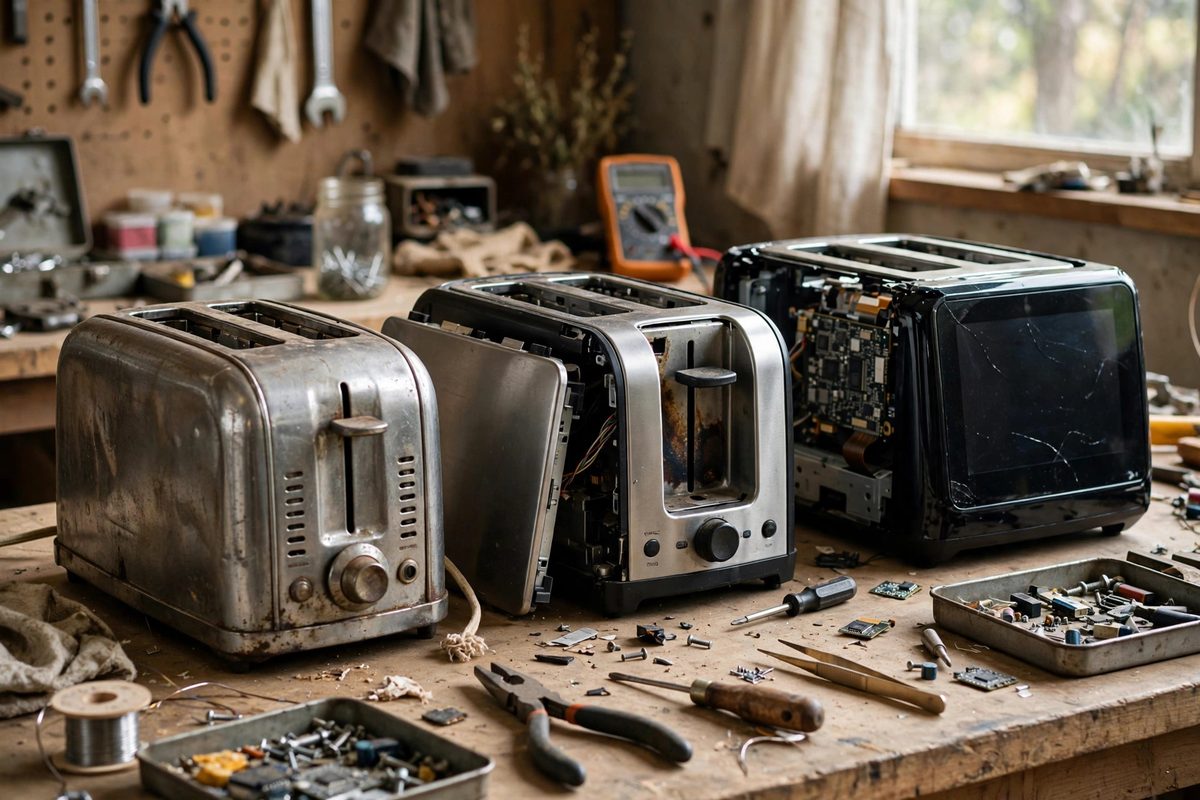
Open up a failed modern appliance and the story is usually depressing and instructive. You will find a main board with proprietary everything, a power supply section with the cheapest capacitors that meet the spec, and mechanical parts designed to be assembled once, never serviced. But you will also often find that the actual failure is trivial: a blown fuse, a swollen capacitor, a corroded connector. Makers who can solder and read a basic schematic routinely revive appliances the manufacturer declared unrepairable, which reveals the truth: the obsolescence is often in the repair ecosystem, not the physics. The parts to fix it exist; the documentation, the spare boards, and the legal permission to tinker are what got designed out.
The Right-to-Repair Countercurrent
The pushback is real and growing. Right-to-repair legislation in various places now requires manufacturers to provide parts, manuals, and diagnostic tools, and the maker community's teardown culture has made repairability a visible product attribute. Some manufacturers now advertise repairability as a feature, which would have been unthinkable a decade ago. But progress is uneven, and digital locks, parts pairing (where a replacement part will not work until the manufacturer's software blesses it), and cloud dependencies remain largely untouched by current rules. The fight has moved from screws and glue to software, which is harder to legislate and harder to work around.
What Makers Can Actually Do
The individual response starts with buying differently: favor appliances with mechanical controls where digital adds nothing, check repairability scores and teardown reports before buying, and prefer manufacturers with real parts availability. The community response is documentation: every teardown, every repair guide, every reverse-engineered schematic posted publicly makes the next repair easier and chips away at the information asymmetry manufacturers rely on. And the cultural response is the most important: treat repair as the default and replacement as the failure, teach it, normalize it, and refuse the story that a four-year-old appliance is naturally at the end of its life. A toaster is not a phone; there is no reason it should age like one.
Planned obsolescence is a design choice, and design choices can be unmade. Every repair is a small vote for a different economics of appliances: one where the maker's values, durability, transparency, repairability, are the product requirements, not the casualties.
Related Guides
- Planned Obsolescence Mechanics in Domestic Appliances: Planned obsolescence is the deliberate design of products to fail, become unusable, or fall out of fashion before their physical potential is
- The Sociology of Planned Redundancy in Modern Tools: Somewhere along the way, tools stopped being built to last and started being built to be replaced. The drill your grandfather handed down still runs
- Demystifying Repair Culture in the Open Source Era: Repair culture, the practice and ethic of fixing things rather than replacing them, has found a powerful ally in open source: shared schematics
- Scaffolding Bloom Taxonomy in Maker Work: Bloom's taxonomy, the classic ladder from remembering through creating, is usually discussed in classrooms. But it maps beautifully onto how makers
- Right to Repair Policies and Embedded Firmware Locks: The modern repair fight is not really about screws and service manuals. It is about firmware. A growing share of everyday devices, from tractors to