
The modern repair fight is not really about screws and service manuals. It is about firmware. A growing share of everyday devices, from tractors to phones to coffee makers, will refuse to work with a replacement part until that part has been cryptographically blessed by the manufacturer. The physical repair can be perfect and the device still dead, because an embedded lock decided the new component was unauthorized. Right to repair policies are converging on this exact problem: the question is no longer whether you may open the device, but whether the device is allowed to overrule your repair. Understanding the firmware lock landscape is essential for anyone who believes ownership should include fixing.
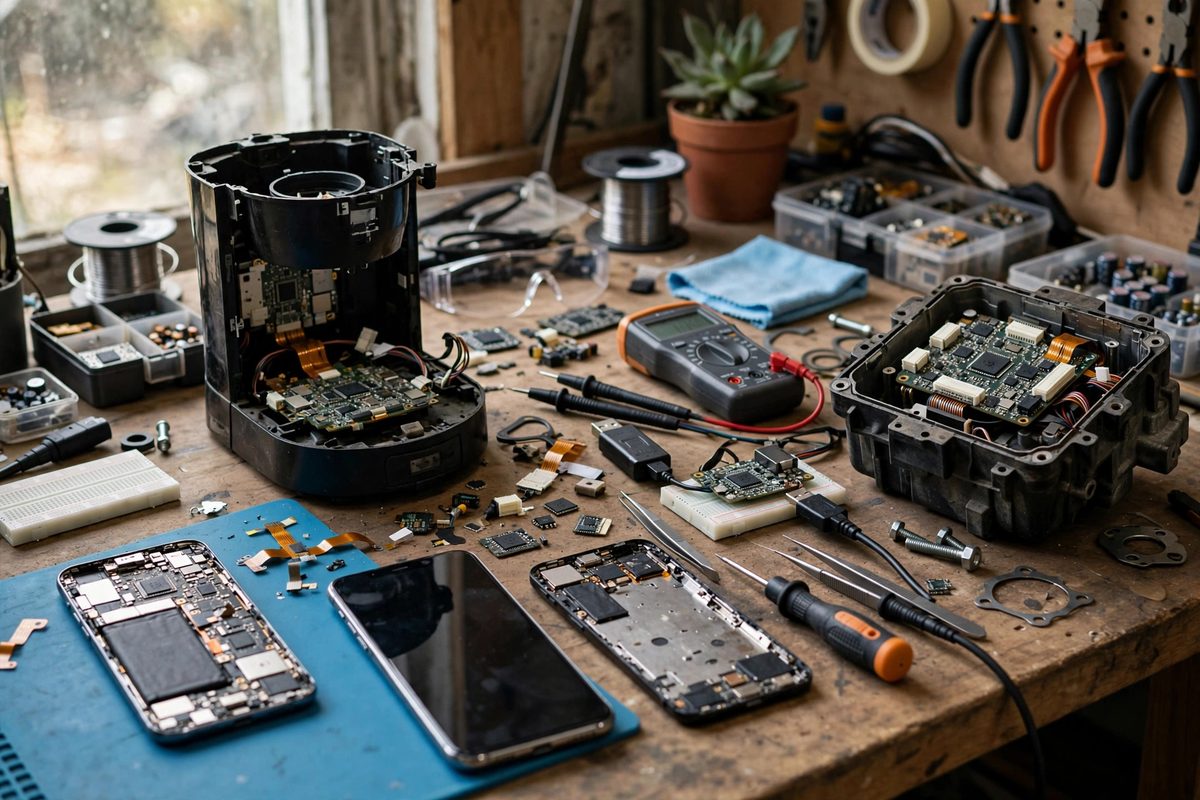
How firmware locks work
Manufacturers pair components to the main board using cryptographic serialization: each part carries a signed identity, and the firmware checks it at boot. Replace the part with an identical but unpaired one and the device throws an error, disables features, or refuses to boot. The stated justification is quality control and safety: only authorized parts are guaranteed to meet specifications. The effect, regardless of intent, is that independent repair becomes impossible without the manufacturer's pairing tool, which is typically restricted to authorized service networks. This is a fundamentally different barrier from a pentalobe screw. A screw can be defeated with a driver. A cryptographic check can only be defeated with the manufacturer's cooperation or by breaking the cryptography, which carries legal risk. The lock moves the repair question from the workbench to the policy arena.
What right to repair policies address
Right to repair legislation and regulation, advancing unevenly across jurisdictions, generally targets several manufacturer practices: withholding service manuals and schematics, restricting parts sales to authorized networks, designing products to thwart independent service, and, increasingly, using software locks to block third-party parts. The firmware lock provisions are the most contested because they sit at the intersection of repair rights, cybersecurity, and intellectual property. Manufacturers argue that pairing protects against counterfeit parts and preserves security boundaries. Repair advocates argue that owners should be able to reset pairing themselves, that security and repairability can coexist, and that a lock whose only function is market control is not a security feature. The policy outcomes differ by place and product category, but the direction of travel is toward requiring manufacturers to provide a path for independent repair, including dealing with the software locks.
The maker's stake in the fight
Makers have a particular interest here because the maker ethos, understand, modify, repair, improve, is directly incompatible with devices that treat their owners as untrusted. A locked device cannot be a platform for learning or experimentation. Worse, firmware locks create a perverse incentive structure: manufacturers profit from the authorized repair monopoly the locks protect, which funds further lock development. The community response has taken several forms. Some makers simply avoid locked products, voting with purchases for repairable designs. Others document workarounds and share them, operating in the legal gray areas around circumvention. Still others participate in the policy process directly, testifying about how locks affect real repair work. All of these matter, because the policy debate needs concrete evidence of harm, and makers generate that evidence every time a simple repair is blocked by software.
Designing for repairability
The most constructive maker response is to build the alternative. Products designed for repair use standard fasteners, publish schematics, sell parts openly, and, crucially, either avoid cryptographic pairing or provide owner-accessible pairing procedures. Open hardware projects demonstrate daily that repairability and quality coexist. For makers building products, even small ones, the design choices are straightforward: document the firmware interfaces, do not lock the bootloader against the owner's own modifications, and make replacement parts obtainable without a service contract. These choices are also good business in the maker market, where repairability is a selling point rather than a threat. Every repairable product in the world is an existence proof against the claim that locks are necessary.
The security argument, honestly examined
The claim that firmware locks are security features deserves honest scrutiny rather than dismissal. There are genuine cases where component authentication matters: a counterfeit battery with no protection circuitry is a fire hazard, and nobody benefits from fake safety-critical parts. But the honest version of this argument supports owner-controlled verification, not manufacturer-controlled monopoly. A device could verify that a replacement part meets a published safety specification without requiring that the part be sold by the manufacturer. The difference between a safety check and a market lock is who holds the keys. When evaluating any manufacturer's security claim, ask whether the mechanism protects the user or protects the revenue stream. The answer is usually visible in whether an independent path exists.
What you can do
Support repair-friendly policy in your jurisdiction by adding your voice and your evidence; legislators respond to concrete stories about blocked repairs. Buy repairable when you have the choice, and say why, because manufacturers track the reasons. Document your repairs, including the ones blocked by firmware, since that documentation becomes the evidentiary record the movement needs. Teach repair skills, because a public that cannot imagine fixing things will not demand the right to. And when you build, build open. The long-term answer to firmware locks is not just better laws but a thriving ecosystem of products that never needed them.
Firmware locks moved the repair battle from hardware to software, from the workbench to the legislature. Understand how pairing blocks independent repair, engage with the policies addressing it, scrutinize the security claims honestly, and build the repairable alternative. Ownership that ends at the firmware is not ownership. Makers know this in their bones, and it is time the law caught up.
Related Guides
- Demystifying Repair Culture in the Open Source Era: Repair culture, the practice and ethic of fixing things rather than replacing them, has found a powerful ally in open source: shared schematics
- Scaffolding Bloom Taxonomy in Maker Work: Bloom's taxonomy, the classic ladder from remembering through creating, is usually discussed in classrooms. But it maps beautifully onto how makers
- Planned Obsolescence Mechanics in Domestic Appliances: Planned obsolescence is the deliberate design of products to fail, become unusable, or fall out of fashion before their physical potential is
- The Sociology of Planned Redundancy in Modern Tools: Somewhere along the way, tools stopped being built to last and started being built to be replaced. The drill your grandfather handed down still runs
- Planned Obsolescence in Household Digital Appliances: Your grandmother's toaster lasted thirty years. Yours lasted four, and the replacement has a touchscreen that stopped getting updates after two. This