
Big saws, table saws, beam saws, large band saws, radial arm saws, command respect because their accidents are disproportionately severe. A pre-operational inspection, performed the same way every time before the saw is switched on, is the single most effective habit for preventing those accidents. It catches the loose guard, the dull blade, the damaged cord, and the misaligned fence before they become part of an incident. This guide lays out the inspection sequence as a repeatable procedure, suitable for posting at the machine and training new operators.
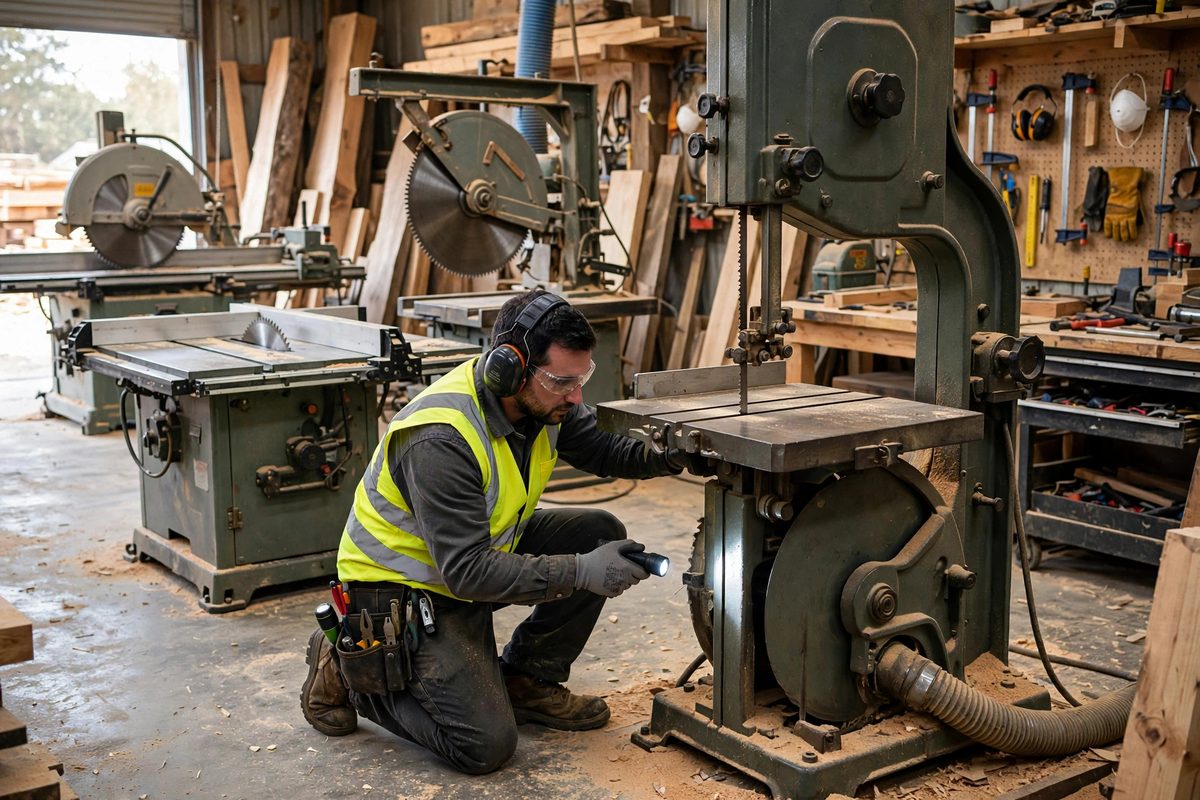
The principle: inspect before energy
The inspection happens with the saw de-energized and the blade at rest, because the goal is to verify the machine's condition, not to test it under power. Lockout discipline applies: if the inspection reveals a fault, the saw stays off until the fault is corrected, with no exceptions for quick cuts or experienced operators. The sequence should be the same every time, in the same order, so that it becomes muscle memory and no step gets skipped under time pressure. A written checklist at the machine supports the habit; even experienced operators benefit from the external memory, because familiarity is what makes steps feel skippable. The inspection takes minutes. The accidents it prevents take lifetimes.
Blade and cutting head inspection
Start at the business end. Verify the blade is the correct type and size for the intended cut; a ripping blade for crosscutting or a damaged blade for anything is a hazard. Inspect the blade for missing or damaged teeth, cracks in the plate, and warping; spin it by hand, with power disconnected, feeling for wobble and listening for the ring of a sound blade versus the dull thud of a cracked one. Check that the blade is mounted correctly: rotation direction matching the arbor, flanges clean and properly seated, arbor nut tight. Confirm the blade guard is present, moves freely, and returns to position; a guard tied up or removed for a previous operation must be restored before the next cut. On band saws, check blade tension, tracking, and the guide bearings; on radial arm saws, check the carriage return and the blade's rest position.
Fences, guides, and workholding
The devices that control the workpiece come next. Verify the rip fence locks parallel to the blade and holds its setting under pressure; a fence that drifts mid-cut binds the workpiece and invites kickback. Check the miter gauge for squareness and smooth travel in its slot. Inspect featherboards, hold-downs, and push sticks for condition and availability; safety accessories that are broken or missing get improvised around, which is how hands enter blade paths. Clear the table of everything not needed for the cut: offcuts, tools, and debris on the table become projectiles or distractions. Confirm the outfeed support is in place for long workpieces, since an unsupported cutoff that drops and binds is a classic kickback trigger.
Power, dust, and environment
Inspect the power side: cord condition with no cuts, nicks, or exposed conductors; plug integrity; and the switch's function, including the off position and any emergency stop. Verify dust collection is connected and functioning, since airborne dust is both a health hazard and a visibility hazard, and accumulated dust near the motor is a fire risk. Check the floor around the saw: clear of tripping hazards, offcuts, and slippery sawdust buildup, with stable footing for the operator's stance. Confirm lighting is adequate on the cut line; shadows across the blade area hide the very things the operator must watch. The environment is part of the machine's safety system, and it gets inspected as such.
Personal readiness check
The operator is part of the inspection. Eye protection on, hearing protection available, no loose clothing, jewelry, or unrestrained long hair that could catch in the machinery. Gloves off for most big saw operations, since gloves reduce feel and can catch; the specific exceptions depend on the material being cut. Verify the operator knows the cut plan: what is being cut, in what order, with what setup, and where hands will be throughout. An operator who cannot describe the cut should not start it. Fatigue, distraction, and rushing are inspection failures too; the honest assessment that today is not the day for the critical cut is a valid safety decision.
Documenting and acting on findings
Findings get documented and acted on, not noted and ignored. Keep a simple log at the machine: date, inspector, findings, corrective action. A developing pattern, a fence that needs realignment monthly, a guard that keeps getting tied up, signals a deeper problem worth fixing properly. When a fault takes the saw out of service, tag it clearly so the next operator does not discover the fault by using the machine. The inspection system only works if its findings have consequences; a checklist that never stops a cut is theater. Make the first time the inspection stops work a celebrated event, not an embarrassment, because it means the system functioned.
Inspect big saws the same way every time before power goes on: blade and guard, fences and workholding, power and environment, operator readiness, with findings logged and faults stopping work. Minutes of discipline against a lifetime of consequence. Post the checklist at the machine and use it until it is habit, then keep using it.
Related Guides
- Standardizing Machine Safety Checklists for PDF: A safety checklist that lives as a PDF on the shop wall only works if people actually use it, and people only use checklists that are clear
- Standardizing Daily Pre-Flight Machinery Check Sheets: Pilots run pre-flight checklists because the cost of forgetting is catastrophic and the checklist is cheap. Shop machinery deserves the same
- Troubleshooting Flowchart Logic for Machine Tool Manuals: When a machine tool misbehaves, the operator needs answers in minutes, not a literature review. Troubleshooting flowcharts serve that need: they turn
- Creating Digital Maintenance Checklists for Machine PDF: Every machine in the shop has maintenance tasks that somebody is supposed to remember: oil levels, belt tension, way lubrication, filter changes