
When a machine tool misbehaves, the operator needs answers in minutes, not a literature review. Troubleshooting flowcharts serve that need: they turn diagnostic reasoning into a visible path of questions and actions that anyone can follow under stress. A good flowchart encodes the technician's judgment about what to check first, what each answer means, and when to stop and call for help. A bad one sends the reader in circles or, worse, toward an unsafe action. The logic behind the chart matters more than its graphics.
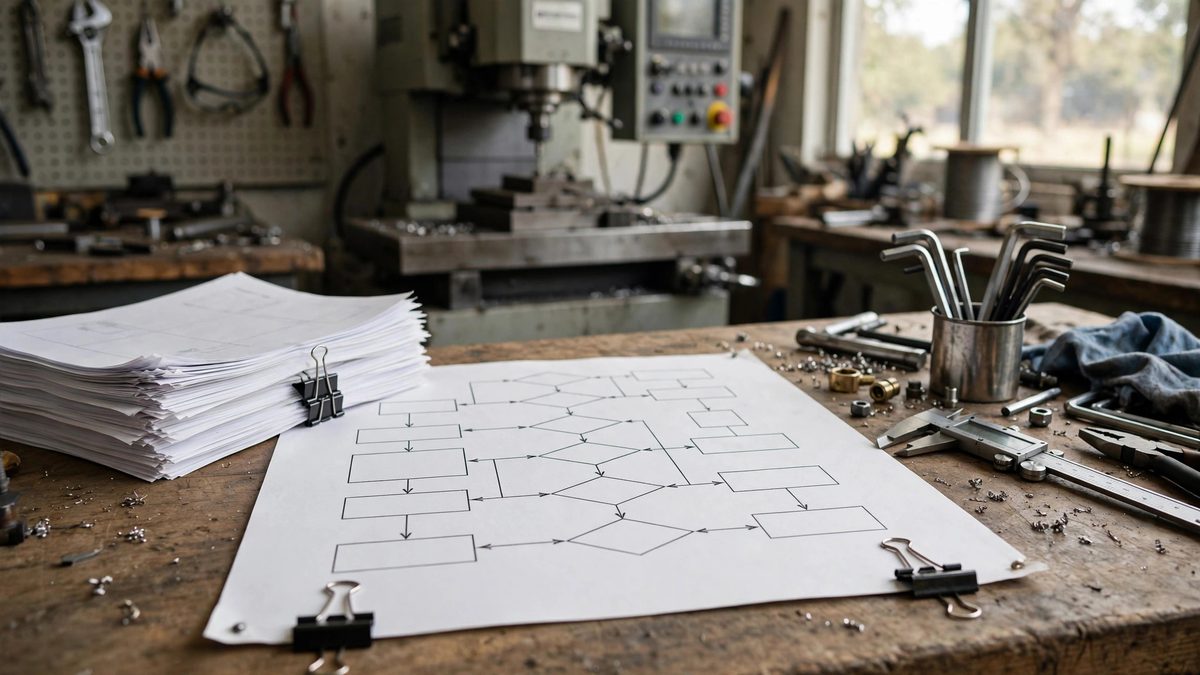
One symptom, one chart, one entry point
Each flowchart should address a single observable symptom: the spindle will not start, the finish is poor, the axis drifts. Mixing symptoms in one chart forces the reader to answer irrelevant questions and obscures the logic. The entry point is the symptom stated plainly, exactly as the operator would describe it, and from there the chart branches through diagnostic questions. Keep the symptom language concrete and observable rather than interpretive: "motor hums but spindle does not turn" is a usable entry; "spindle problem" is not. If a manual covers many symptoms, give each its own chart and provide a symptom index that routes the reader to the right one. The index is part of the logic; a chart nobody can find might as well not exist.
Decision diamonds that actually decide
The heart of the flowchart is the decision diamond, and its discipline is strict: each diamond asks exactly one question with exactly two possible answers, yes or no. "Is the emergency stop engaged?" is a proper decision. "Check the power and the fuses and the contactor" is not a decision; it is three checks disguised as one, and a "no" answer tells the reader nothing about which check failed. Phrase questions so the answers are observable without special tools where possible: indicator lights, sounds, visible damage. Order the questions by a deliberate strategy, and the best strategy for machine tools is almost always simplest and cheapest first: check the obvious operator-level causes before the internal faults, the five-minute checks before the five-hour teardowns. This ordering respects the reader's time and, importantly, it matches how experienced technicians actually diagnose.
Actions, terminals, and the stop rule
Rectangles in the chart hold actions: tighten, replace, clean, measure. Each action should be specific enough to perform without flipping to another section: "tighten the gib screws to the specified torque" rather than "adjust the gibs." Every path through the chart must end at a terminal: either the symptom is resolved, with a verification step to confirm, or the reader is told to stop and escalate. The stop rule is a safety feature as much as a logic feature. Some faults, like a suspected short in a high-voltage cabinet or a cracked spindle housing, are not operator-serviceable, and the chart must say so explicitly instead of letting the reader improvise. Never let a flowchart path dead-end without guidance; a reader who reaches a blank is a reader who starts guessing.
Loop guards and cross-references
Real diagnosis sometimes loops: you check a cause, rule it out, and return to an earlier branch. Flowcharts must handle this without creating infinite loops that trap the reader. The standard technique is the loop guard: allow a return to an earlier decision only with a changed condition, such as "if the replacement fuse also blows, do not repeat; proceed to the electrical fault chart." Number every shape in the chart and reference those numbers in the accompanying text, so the manual can say "see step 14" and the reader can find it instantly. Cross-references to other charts, to parts diagrams, and to specification tables turn the flowchart from a standalone puzzle into a node in the manual's information network. But keep the chart itself self-sufficient for the common path; a reader should not need three cross-references to fix a loose belt.
Safety woven into the logic
Safety in a troubleshooting chart is not a separate section; it is embedded in the sequence. Any step involving stored energy gets a de-energize action before it: lock out and tag the machine before opening the electrical cabinet, release hydraulic pressure before cracking a fitting, wait for the spindle to stop before touching the work area. State these as chart actions, not as footnotes, because footnotes get skipped under stress. Where a diagnostic step itself is hazardous, such as measuring live voltage, the chart should specify the precaution inline: the meter rating, the one-hand technique, the PPE. A flowchart that leads a reader to an energized cabinet without a lockout step has a logic error more serious than any misplaced diamond.
Test every troubleshooting chart by handing it to someone who does not already know the answer and watching them work. Every hesitation, every wrong turn, every skipped safety step is the chart telling you where its logic needs repair. The chart is finished when a stressed stranger can follow it to the right fix without improvising.
Related Guides
- Standardizing Machine Safety Checklists for PDF: A safety checklist that lives as a PDF on the shop wall only works if people actually use it, and people only use checklists that are clear
- Creating Digital Maintenance Checklists for Machine PDF: Every machine in the shop has maintenance tasks that somebody is supposed to remember: oil levels, belt tension, way lubrication, filter changes
- Standardizing Daily Pre-Flight Machinery Check Sheets: Pilots run pre-flight checklists because the cost of forgetting is catastrophic and the checklist is cheap. Shop machinery deserves the same
- Pre-Operational Safety Inspection Steps for Big Saws: Big saws, table saws, beam saws, large band saws, radial arm saws, command respect because their accidents are disproportionately severe. A