
A safety checklist that lives as a PDF on the shop wall only works if people actually use it, and people only use checklists that are clear, consistent, and quick. Standardizing the format across every machine in the shop turns a stack of mismatched documents into a system: operators learn one layout, find information in the same place every time, and the checklist becomes habit instead of wallpaper. Here is how to standardize well.
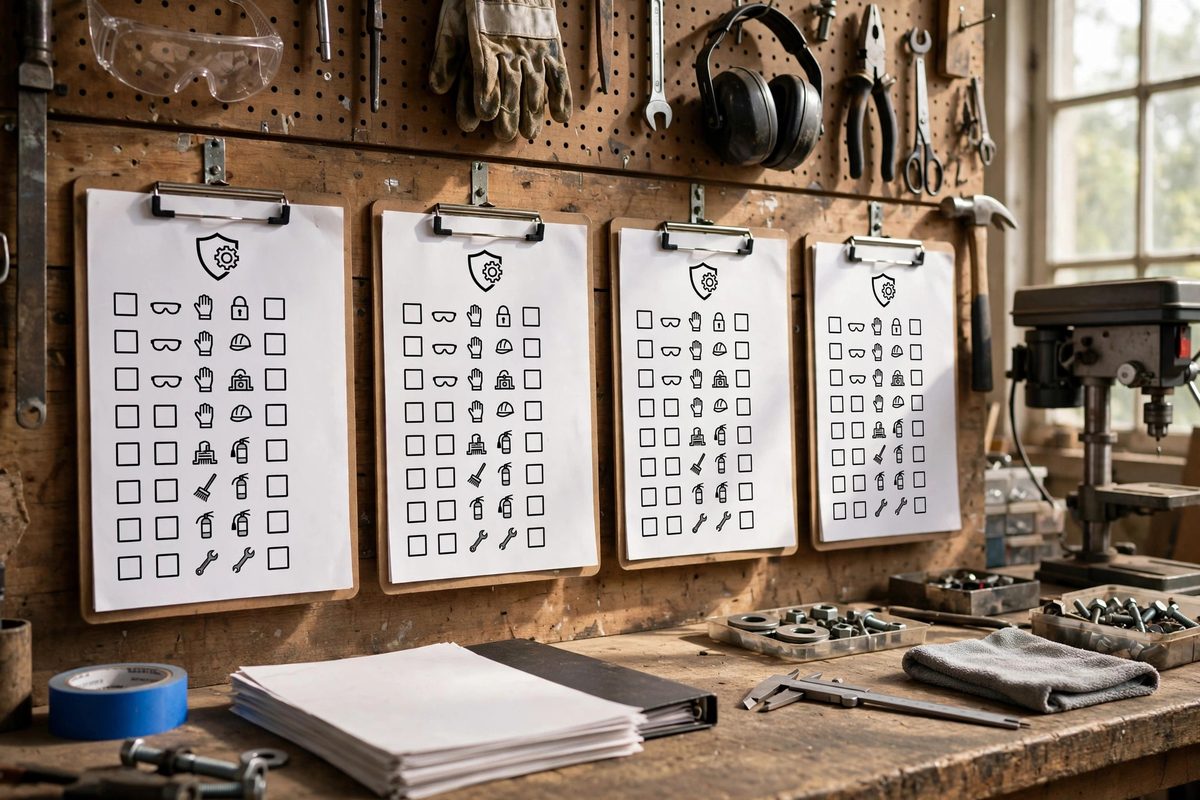
One layout for every machine
Every checklist in the shop should share the same structure: machine identification at the top, pre-operation checks first, operational checks second, shutdown and lockout last. Use the same section headings, the same checkbox style, and the same terminology everywhere. When an operator moves from the table saw checklist to the mill checklist, nothing about the format should require relearning. The content differs per machine, but the container is identical. This consistency is what makes the checklist fast to use under real working conditions.
Writing checks that get checked
Each checklist item must be a specific, observable action: "verify the blade guard is in place and moves freely" beats "check safety equipment." Vague items get pencil-whipped; specific items get done. Order items in the sequence the operator actually performs them, walking around the machine the way a person walks. Keep the whole pre-operation list short enough to complete in a few minutes; a twenty-item list before every cut will be skipped, and a skipped checklist is worse than none because it creates false confidence. If a machine genuinely needs twenty checks, it needs a maintenance procedure, not a longer checklist.
Designing the PDF for the shop environment
The PDF will be printed, posted near the machine, and read in poor light by people wearing safety glasses. Use large type, high contrast, and generous checkboxes that can be marked with a gloved hand or a shop pencil. Put the most critical items, the ones that prevent injury rather than damage, first and consider a bold border or shading to mark them. Include the date of the last review and a version number; an undated checklist invites the suspicion that nobody maintains it. Export the PDF in a print-ready format and test-print one copy before running the batch.
Review, sign-off, and currency
Standardization needs ownership. Assign each checklist to the person most qualified on that machine, and require a periodic review, at least annually or after any incident or modification. When a guard is added or a procedure changes, the checklist updates the same day, not "when we get around to it." Keep a master list of all checklists with their versions and review dates; the master list is how you prove the system is alive. Archive old versions rather than deleting them, so the history of safety decisions is traceable.
Training the habit
A checklist system fails at the human layer more often than the document layer. Train every operator on the standard format once, then train them on each machine's specific items before they run it unsupervised. Make the checklist physically unavoidable: posted at eye level at the machine's operating position, not in a binder in the office. And model the behavior from the top; when the experienced operators visibly run the checklist, the new ones follow. Culture eats documentation for breakfast, so feed the culture.
Same layout, specific items, readable in the shop, reviewed on schedule, used by everyone. That is a safety checklist system, not a pile of PDFs.
Related Guides
- Creating Digital Maintenance Checklists for Machine PDF: Every machine in the shop has maintenance tasks that somebody is supposed to remember: oil levels, belt tension, way lubrication, filter changes
- Pre-Operational Safety Inspection Steps for Big Saws: Big saws, table saws, beam saws, large band saws, radial arm saws, command respect because their accidents are disproportionately severe. A
- Standardizing Daily Pre-Flight Machinery Check Sheets: Pilots run pre-flight checklists because the cost of forgetting is catastrophic and the checklist is cheap. Shop machinery deserves the same
- Troubleshooting Flowchart Logic for Machine Tool Manuals: When a machine tool misbehaves, the operator needs answers in minutes, not a literature review. Troubleshooting flowcharts serve that need: they turn