
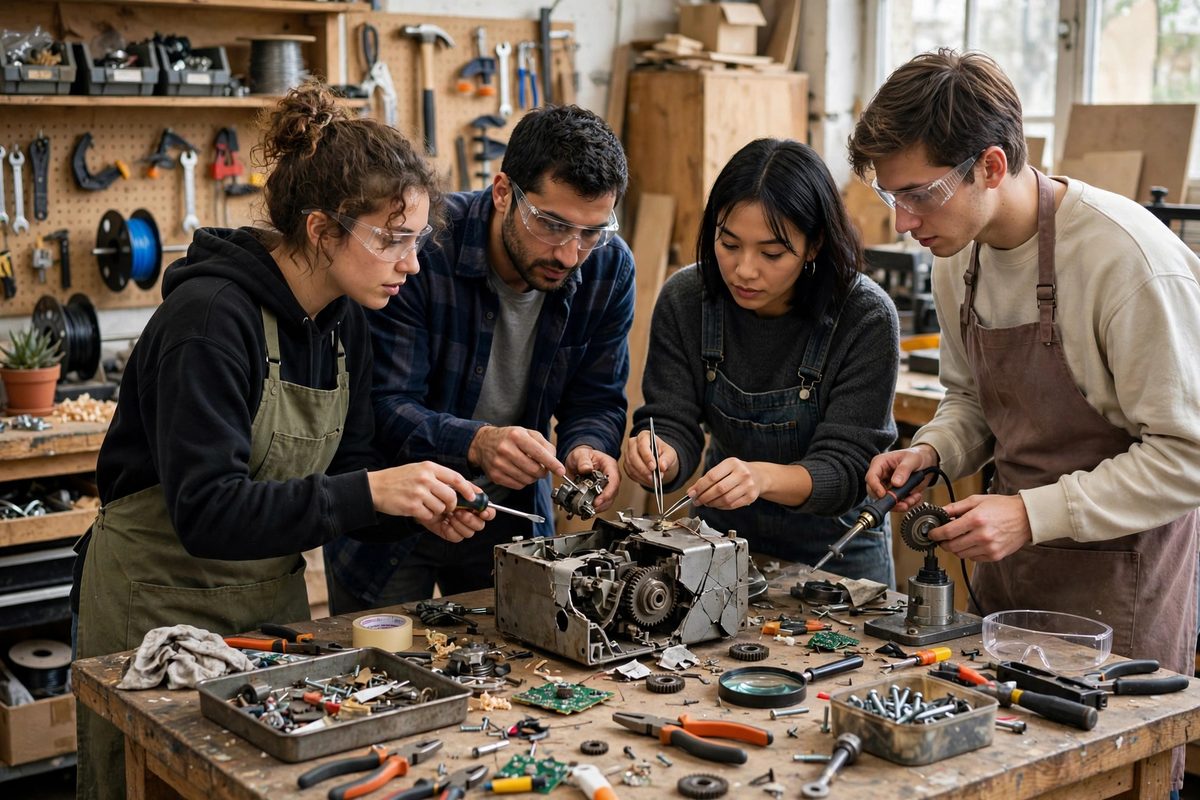
Hand a beginner a lathe and a set of plans and you get anxiety. Hand them a broken thing and ask them to figure out how to fix it, and you get engagement. Progressive problem-based learning takes that instinct and builds a curriculum around it: learners tackle real, open-ended problems that grow in complexity, developing skills because the problem demands them rather than because a lesson plan says so. In a maker space, where the tools and materials invite experimentation, this approach turns the shop into a classroom without ever feeling like school.
What Problem-Based Learning Means in a Shop
Problem-based learning starts with a challenge rather than a lecture. Instead of teaching measurement, then sawing, then joining as isolated skills, you present a problem like designing a stool that holds a specific weight using only offcuts, and the learner picks up measurement, sawing, and joining because the stool will not stand without them. The problem provides the motivation and the context; the skills arrive as solutions. This flips the usual order, and it works because human brains retain skills learned in service of a goal far better than skills learned in a vacuum.
Why Progressive Structure Matters
The word progressive is doing heavy lifting here. Throwing a true beginner at a genuinely hard problem produces frustration, not learning. A progressive sequence starts with tightly constrained problems where success is nearly guaranteed: build a box that holds a specific object, with all materials provided. Then the constraints loosen: build a container for an oddly shaped object, choosing your own materials. Then the problems open up: design something that solves a problem you have noticed. Each step reuses earlier skills while adding new ones, and the learner's confidence grows in proportion to the difficulty. The facilitator's job is calibrating the steps so each problem is hard enough to require real thought but achievable with the skills at hand.
Designing Good Problems
A good maker-space problem has a few traits. It is authentic: it resembles something someone might actually need or want, not an abstract exercise. It is constrained enough to be finishable: limits on time, materials, or tools force creative decisions instead of endless deliberation. It has multiple valid solutions, because the moment there is one right answer, the activity becomes a puzzle with a key rather than an engineering challenge. And it is assessable by testing: the stool either holds the weight or it does not, which gives the learner immediate, honest feedback no facilitator needs to deliver. Testing against reality is the most powerful teacher in the shop.
The Facilitator's Real Job
In problem-based learning, the facilitator resists the urge to teach directly and instead guides. When a learner is stuck, the move is a question, not an answer: what have you tried, what did the test show, what could you change? This is harder than lecturing, because it requires reading each learner's frustration level and intervening just enough to keep them moving without robbing them of the discovery. The facilitator also manages safety, which is non-negotiable: open-ended problems do not mean unsupervised tool use. Set clear safety boundaries up front, teach tool skills just in time as problems demand them, and supervise the risky steps closely while leaving the design decisions to the learner.
Assessment Without Killing the Spirit
Traditional grading sits uneasily with open-ended making, but you still need to know learning happened. The best assessment in this model is documentation: learners photograph, sketch, and write about what they built, what failed, and what they changed. A portfolio of problems attempted, with reflections on the failures, shows growth more honestly than any test. Peer review works well too: learners presenting their solutions to each other learn to articulate design decisions and to give useful critique. Judge the process and the iteration, not just the final object, because a beautiful object built by following someone else's instructions teaches less than an ugly one built through genuine problem-solving.
Scaling From One Session to a Program
A single problem-based session is a great workshop; a sequence of them is a curriculum. Map your problems across a term so skills spiral: measurement shows up in the box, the container, and the final project, each time in a more demanding context. Keep a library of proven problems with notes on what went wrong and what the common sticking points are, because good problems are reusable assets. And build in showcase moments where learners present finished work: public presentation cements learning and gives the program visible energy that attracts the next cohort.
Progressive problem-based learning trusts learners with real challenges and supports them with well-designed steps. The maker space provides the tools, the problems provide the purpose, and the facilitator provides the guidance. The result is learners who do not just know how to use the tools, but know how to think with them.
Related Guides
- Metacognitive Scaffolding in Open Maker Spaces: An open maker space gives people tools, materials, and freedom. What it does not automatically give them is the ability to think about their own
- Kinesthetic Learning Feedback in Shop Tool Mastery: Reading about a hand plane teaches you what a hand plane is; pushing one teaches you what sharp feels like. Tool mastery in the shop is kinesthetic
- Structuring Technical Maker Manuals for Print Delivery: A technical maker manual has to do something most books never attempt: teach hands-on skills through paper alone, in an order the reader can follow
- Pagination Imposition for Multi-Page Workshop Guides: A workshop guide that reads perfectly on screen can become a confusing mess when printed and bound, because print imposes a physical order on pages
- Typesetting Multi-Column Technical Handbooks for Print: A technical handbook has to be readable, referenceable, and dense with information, three demands that fight each other on the page. Multi-column