
Every antique AM radio contains wax paper capacitors, and after half a century or more, essentially all of them are bad. They leak DC, drift in value, and can take out transformers and tubes when they fail short. Recapping, the systematic replacement of these capacitors, is the single most important restoration step for any tube radio. It is routine work, but it must be done with the respect that high-voltage tube gear demands.
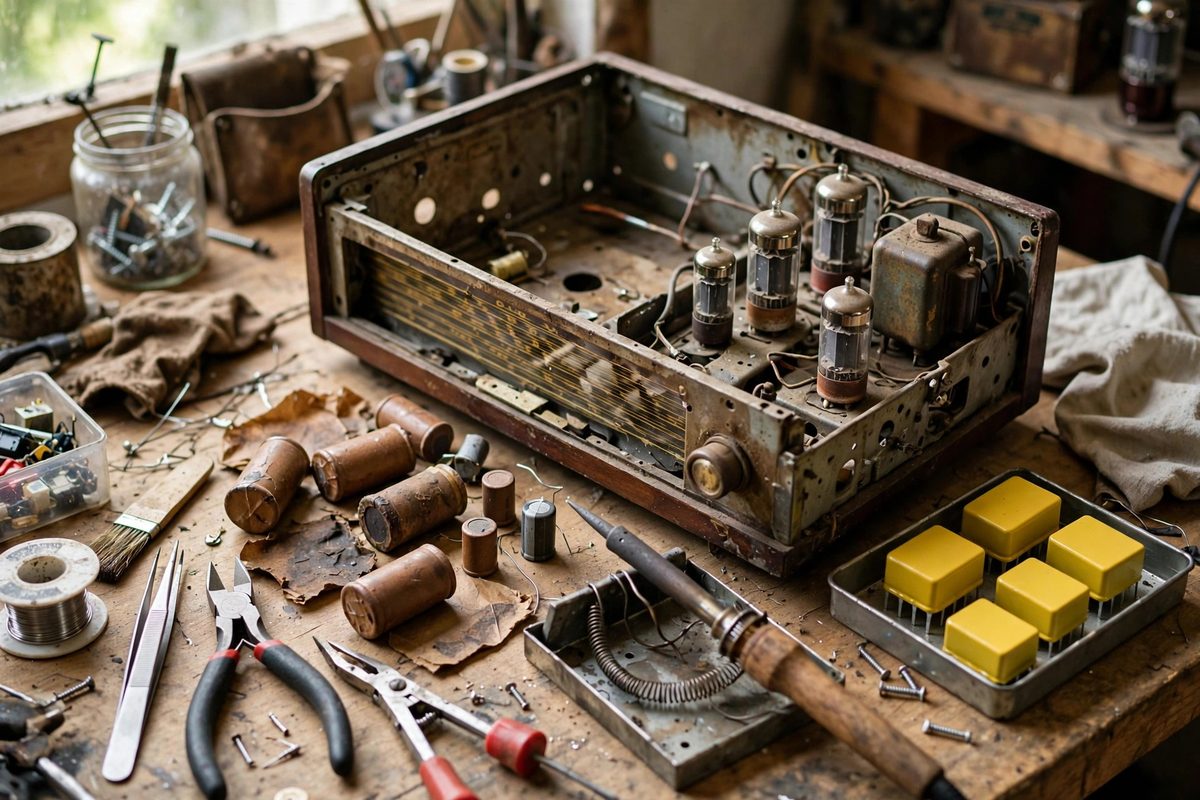
Why Wax Paper Capacitors Always Fail
A wax paper capacitor is two foil plates separated by wax-impregnated paper. Over decades, the wax dries and cracks, moisture enters, and the paper becomes conductive. The capacitor then passes DC current that it was meant to block. In a tube radio, that leakage shifts bias voltages: a leaky coupling capacitor feeds high voltage onto the grid of the output tube, which runs away, overheats, and can destroy the output transformer, one of the hardest parts to replace. This failure mode is so common and so destructive that experienced restorers replace all wax paper capacitors on principle, without bothering to test them individually. Testing is nearly pointless; the question is not whether they leak, but how badly.
Safety Before You Touch Anything
Tube radios contain lethal voltages, with power supplies running several hundred volts and filter capacitors that hold a charge after unplugging. Before working, unplug the radio and discharge the filter capacitors through a resistor, then verify with a meter. Keep one hand in your pocket when probing live circuits, and never work on a plugged-in chassis with both hands. Replace the power cord if it is cracked or frayed, and add a fuse if the radio lacks one; many antique sets have no fuse at all. These precautions are not paranoia. The voltages inside a tube radio can kill, and a moment's carelessness is all it takes.
Mapping and Sourcing Replacements
Work from the schematic for the specific model; without it, you are guessing at values and circuit positions. List every wax paper capacitor by its location designation, capacitance, and voltage rating. Replace with modern film capacitors of the same capacitance and equal or higher voltage rating; the voltage rating must meet or exceed the original because the circuit's voltages have not changed. Tolerance on capacitance is generally not critical in these circuits, so standard modern values are fine. Electrolytic filter capacitors should be replaced too, as they also age, but they are a separate task from the wax paper recap. Buy from reputable electronics suppliers; the parts are inexpensive, and quality matters in high-voltage service.
The Replacement Process
Replace one capacitor at a time, removing the old one and installing the new one before moving on. This discipline prevents wiring errors that are miserable to find later. Note the original lead dress: keep the new capacitor's leads routed the same way, with similar lengths, because lead placement affects hum and stability in tube circuits. Observe that wax paper capacitors are non-polarized, so modern film replacements can go in either way. For authenticity, some restorers stuff the new capacitor inside the old wax tube; this preserves the under-chassis appearance for collectors. Whether you restuff or not, make solid mechanical joints before soldering, and use enough heat to flow the solder without cooking nearby components.
Power-Up and Alignment Checks
After recapping, power the radio up gradually if possible, using a dim-bulb tester or variac to catch shorts before full voltage is applied. A bulb that glows brightly indicates a fault; find it before proceeding. Once the radio runs, check the key voltages against the schematic, particularly the bias on the output tube grid, which confirms the coupling capacitor is doing its job. Let the set play for an extended period and listen for hum, distortion, or fading, which point to remaining issues like weak tubes or bad electrolytics. A properly recapped radio is electrically stable for decades; the new film capacitors will likely outlast the restorer.
Wax paper capacitors are guilty until proven innocent, and the proof never comes. Replace them all with modern film types, one at a time, with the power off and the filters discharged. Do it right and the radio gets a new electrical life of fifty years or more.
Related Guides
- Reforming Electrolytic Capacitors in Tube Radios: A tube radio that has sat silent for decades often has electrolytic capacitors whose internal oxide layer, the dielectric that makes the capacitor
- Realigning Multi-Gang Air Variable Tuning Capacitors: The tuning capacitor is the heart of a vintage radio's dial, and when its gangs fall out of alignment the radio tunes deaf: stations drift
- Aligning Intermediate Frequency Transformers: The intermediate frequency (IF) transformers in a vintage superheterodyne radio are the tuned circuits that give the set its selectivity and much of