
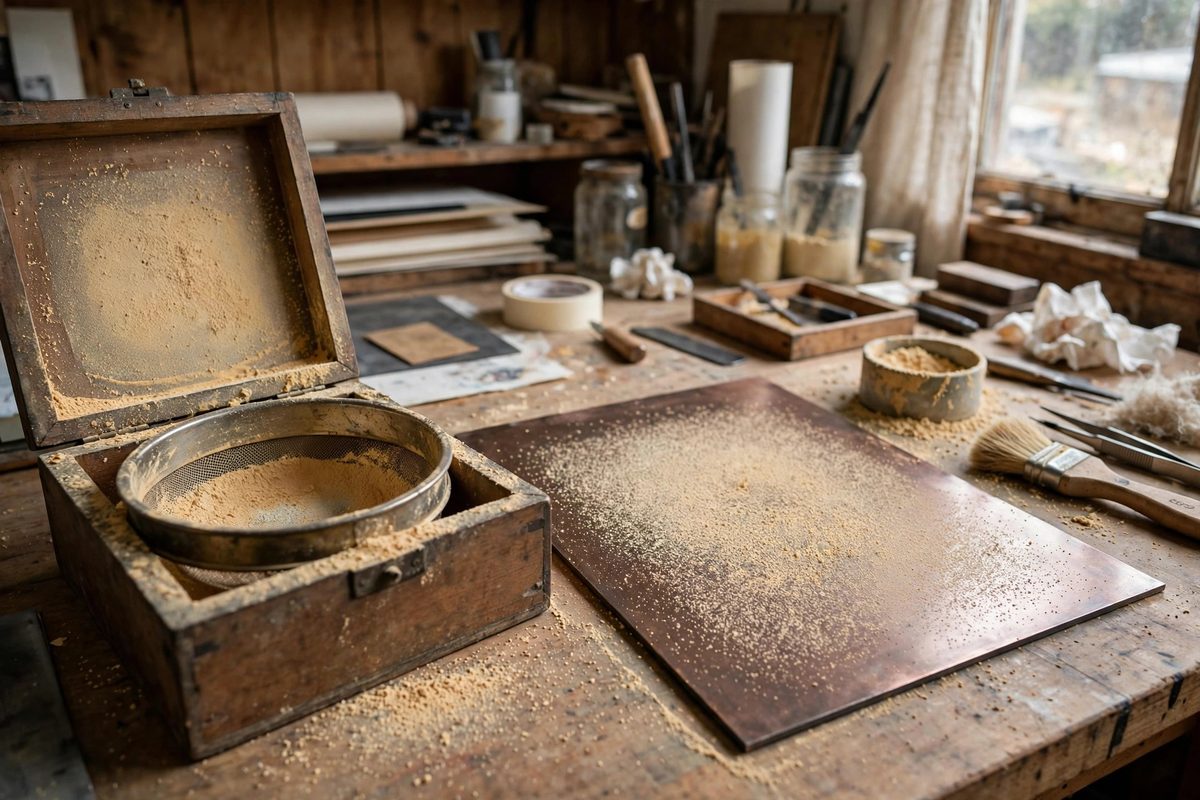
Aquatint's smooth tonal areas come from rosin dust melted onto the plate, and the density of that dust grain determines everything about the tone: too sparse and the tone is coarse and pale, too dense and it clogs into solid black. The dust box is the tool that deposits the rosin, and controlling grain density within it is the core aquatint skill.
How Rosin Grain Makes Tone
Rosin dust particles land on the copper plate and are heated until they melt into tiny discrete dots. When the plate goes into the acid, the acid bites around each dot but not through it; the dots become the white (unbitten) points in a field of bitten tone. Denser dust means more dots per area, which means less bitten surface between them, which means a darker, finer tone. Sparser dust gives a lighter, more open tone with visible grain. The grain density therefore maps directly to the tonal scale: fine, dense grain for dark smooth tones, open grain for light tones. This relationship is the entire logic of aquatint, and the dust box is where it is controlled.
The Dust Box and How It Works
A dust box is a sealed chamber containing powdered rosin. The printer agitates the box, spinning it or pumping air, to throw the rosin into a suspended cloud, then lets the cloud settle; the plate sits inside during the settling, collecting an even layer of dust. The key variables are the violence of the agitation, which determines how much rosin goes airborne, and the settling time, which determines how much lands on the plate. More agitation and longer settling give denser grain. The box must be still and draft-free during settling; air currents deposit the rosin unevenly. Keep the box closed between uses, since humidity clumps rosin and ruins its flow.
Calibrating Grain Density
Calibrate with test plates, not with finished work. Run a series of plates with different agitation and settling combinations, melt the rosin, etch them identically, and print them; the resulting tone scale is your calibration chart for that box and that rosin. Label each test with its parameters so the chart is reproducible. Finer rosin powder gives finer grain at any density; sift the rosin to remove lumps and oversized particles, which create visible spots in the tone. Note that the first dusting after refilling the box behaves differently than later ones, since fresh rosin is fluffier; run a throwaway settling cycle after refilling to stabilize conditions. Consistency in the box procedure produces consistency in the tones.
Melting the Rosin
After dusting, heat the plate gently until the rosin particles melt into glossy dots; under-melted rosin lifts off in the acid, and over-melted rosin flows together into a resist film that blocks the bite entirely. The visual cue is the change from matte dust to tiny glistening beads. Heat evenly with a hotplate or a careful torch pass; uneven heating gives uneven melting and patchy tone. Let the plate cool before etching. Some printers dust and melt in stages for complex tonal ranges, stopping out areas between bites; each stage needs its own density calibration if the tones must match. The melted rosin is the actual resist, so this step deserves as much care as the dusting.
Etching and Troubleshooting Tone
Etch the aquatinted plate in the usual acid, timing the bite for the desired darkness; the grain density sets the tone's character, the bite time sets its depth. If the printed tone is coarser than intended, the grain was too sparse; if it printed nearly solid, the grain was too dense or the bite too long. Mottled tone usually means uneven dusting from drafts or an unsettled box; re-dust with better conditions. White spots in the tone are oversized rosin particles or dust contamination; sift the rosin and clean the box. Keep the calibration chart posted by the box; aquatint rewards the printer who treats grain density as a measured variable, not a guess.
Fine aquatint is controlled rosin grain: calibrate the dust box with test plates, settle in still air, melt to glossy beads, and etch to depth. Grain density is the tone; measure it, do not guess it.
Related Guides
- Nitric Acid Bath Timing on Polished Copper Plates: Etching a copper plate in nitric acid is a timed chemical conversation: the acid bites the exposed lines while you watch the clock, and the
- Hard Ground Asphaltum Baking Limits on Copper: Hard ground, the waxy resist that protects the copper plate where you do not want the acid to bite, is traditionally hardened by baking: gentle heat
- Soft Ground Etching Textures With Botanical Pressed Leaves: Soft ground etching captures texture by letting objects press into a tacky etching ground, and pressed botanical leaves are among the most rewarding