
Soft ground etching captures texture by letting objects press into a tacky etching ground, and pressed botanical leaves are among the most rewarding things to press into it. The ground records every vein, edge, and surface variation of the leaf, and the etched plate prints those details with a fidelity that drawing cannot match. It is a direct, physical way to put the actual plant into the image, and the technique is forgiving enough for a first etching project while offering depth for experienced printmakers.
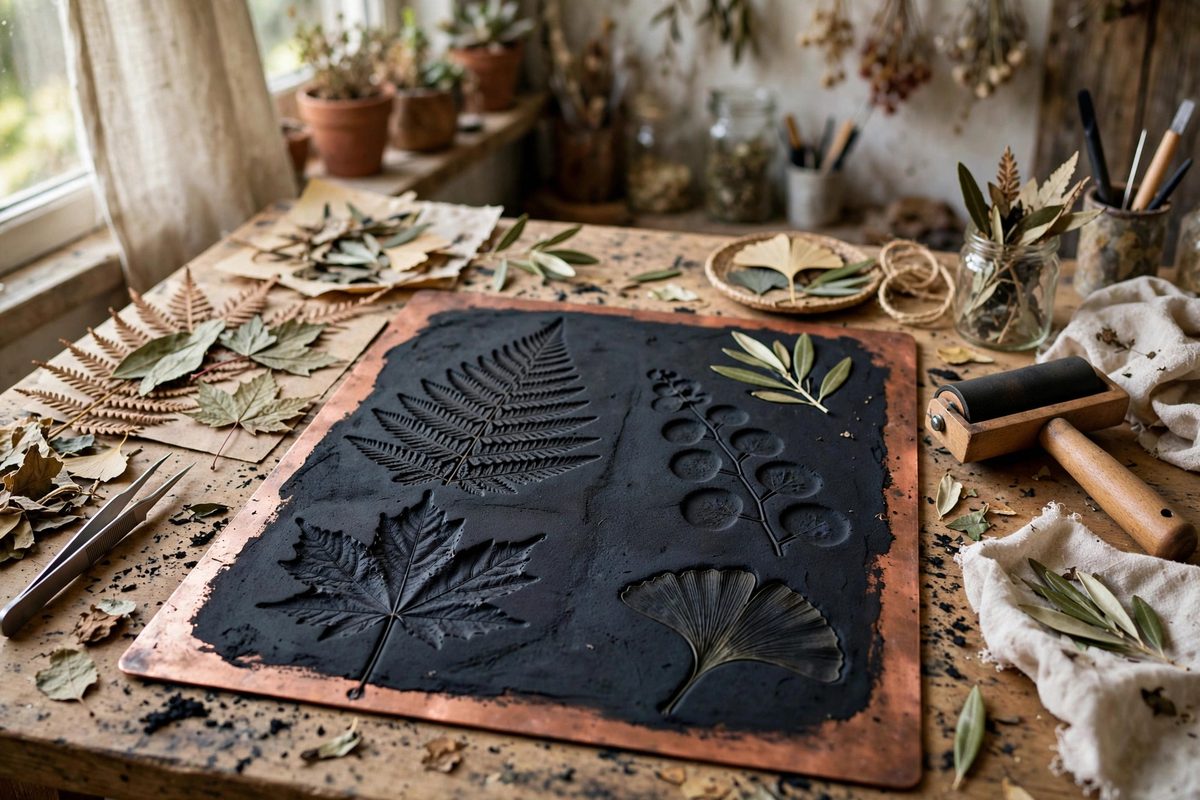
How soft ground records texture
Standard hard ground is a tough varnish that the needle scratches through. Soft ground stays tacky and impressionable: lay a textured object on the grounded plate, run it through the press or press it by hand, and the ground lifts away wherever the object pressed, exposing the metal beneath in exactly the object's pattern. The plate then etches in those exposed areas, biting the texture into the copper or zinc.
Leaves work beautifully because they combine bold shapes (the overall leaf form) with fine detail (veins, serrated edges, surface texture) in a single impression. A single pressing can yield an image with a full range of tonal information, from the solid dark of the leaf body to the delicate light lines of the veins, depending on how the ground lifts.
Preparing the leaves
Press the leaves flat before using them, between blotters under weight for several days, the way botanical specimens are traditionally pressed. A leaf that is still curled or dimensional will press unevenly, lifting ground in unpredictable patches and possibly tearing the ground where a thick stem or curled edge digs in. Fully flat, fully dry leaves give the cleanest impressions.
Choose leaves with strong vein structure and interesting edges. Smooth, featureless leaves print as simple silhouettes, which has its uses, but the technique shines with leaves that have something to say at the detail level. Remove or flatten thick stems and midribs that would punch through the ground too aggressively; a stem that lifts ground in a wide band will etch as a heavy dark line that dominates the image.
Applying and working the soft ground
Soft ground is applied like hard ground, rolled or dabbed onto a clean, degreased plate, but it must stay soft enough to take the impression. Work in a cool studio; warmth makes the ground too tacky and it will lift in unwanted areas, while cold makes it resist the impression. The ground should feel tacky to a light touch but not transfer to your finger.
Lay the leaf on the grounded plate, cover it with a sheet of newsprint or thin tissue to protect the press blankets, and run it through the press at normal printing pressure. One pass is enough. Peel the leaf away carefully; it will have lifted ground in its pattern, and the plate is now ready for the acid. Work efficiently from this point, since the exposed ground continues to be vulnerable to accidental marks.
Etching and controlling the bite
Etch the plate as you would any line etching, but expect the texture areas to bite faster than you might guess. The ground lifts in a stippled, irregular pattern around the leaf's details, exposing many small areas of metal that the acid attacks from all sides. Start with a short bite, proof the plate, and deepen in stages. It is easy to etch more; it is very difficult to etch less.
Consider a light aquatint over the whole plate before the leaf impression if you want tonal areas behind the leaf. The aquatint gives the background a tone to print, and the leaf texture etches into and over it, integrating the botanical image into a tonal field rather than leaving it floating on white paper.
Safety with grounds and acids
Etching grounds contain solvents; apply them with ventilation and keep the studio air moving. Mordants and acids demand respect: wear gloves and eye protection, know where the neutralizing agent and eyewash are, and never leave an acid bath unattended. Soft ground work adds no special hazards beyond standard etching practice, but the pressing step tempts people to rush the plate to the acid while still handling it casually. Slow down at the acid stage regardless of how smoothly the impression went.
Press flat leaves into tacky ground, etch in stages, and proof often. The plant does the drawing; your job is to give it a clean plate and a controlled bite.
Related Guides
- Hard Ground Asphaltum Baking Limits on Copper: Hard ground, the waxy resist that protects the copper plate where you do not want the acid to bite, is traditionally hardened by baking: gentle heat
- Nitric Acid Bath Timing on Polished Copper Plates: Etching a copper plate in nitric acid is a timed chemical conversation: the acid bites the exposed lines while you watch the clock, and the
- Rosin Dust Box Grain Density for Fine Aquatints: Aquatint's smooth tonal areas come from rosin dust melted onto the plate, and the density of that dust grain determines everything about the tone