
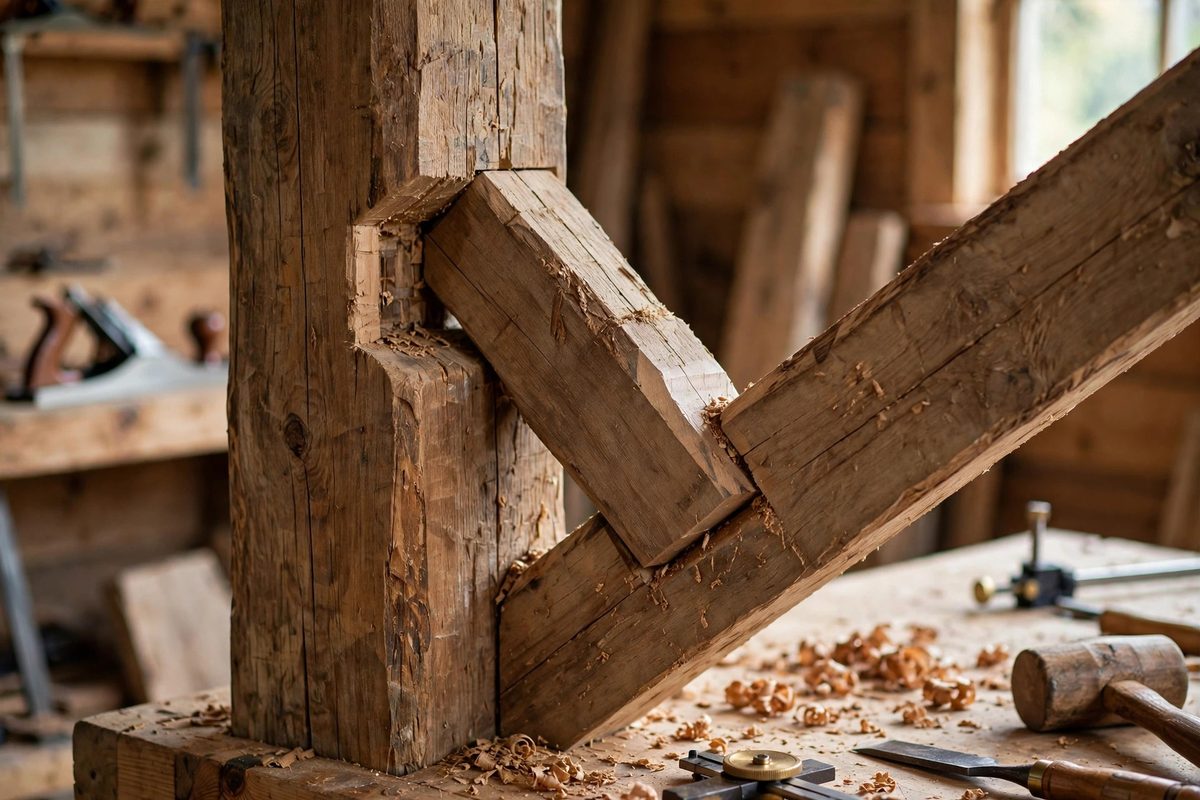
A tenon entering a mortise at an angle, the classic sloped timber joint of braces and rafters, needs shoulders that meet the mating timber's face fully. Because the timbers meet at compound angles, the shoulders are not simple square cuts; they must be scribed from the actual mating surfaces. A scribed shoulder seats along its full area and carries load; a guessed shoulder touches at one edge and crushes.
Why Scribing Beats Measuring
The angles in a sloped timber joint are compound: the brace meets the post at an angle in one plane and often at a different angle in another. Calculating the shoulder cuts from those angles is possible but error-prone, and the timbers themselves are rarely perfect; a degree of twist or a slightly irregular face throws off calculated cuts. Scribing transfers the actual geometry directly: the shoulder is marked from the real mating surface, so it fits the real timber, irregularities included. The scribe does not care about the theoretical angle; it copies what is there.
Setting Up the Joint
Position the tenon timber in its final orientation against the mortised timber, supported exactly as it will sit in the frame. This dry assembly is the reference for everything; if the timbers shift during scribing, the marks lie. Use wedges, clamps, or temporary bracing to hold the position rigidly. Mark a reference line across both timbers so any movement is immediately visible. The scribing is only as honest as the setup, so take the time to make the dry fit reflect the final assembly.
The Scribing Technique
With the timbers held in position, scribe the shoulder line on the tenon timber by tracing along the face of the mortised timber. Use a sharp pencil or a marking knife; the knife line is more precise and gives the saw a starting groove. Scribe all around the tenon, keeping the marker perpendicular to the surfaces being traced, because tilting the marker shifts the line. For compound shoulders with multiple faces, scribe each face from its corresponding mating surface in turn, repositioning as needed but always returning to the reference setup. The scribed lines are the cut lines; trust them over any calculation.
Cutting to the Scribe
Cut the shoulders with a saw, staying just outside the scribed line, then pare to the line with a chisel. The paring is where the fit is made: work down to the knife line in thin shavings, checking the fit frequently by reassembling the joint. The shoulder should seat fully against the mating face with no gaps visible in raking light. If one area touches before the rest, pare the high spot, not the whole shoulder; selective paring closes the joint faster than uniform cutting. The final fit should require only hand pressure to close, with the joint drawing tight under its own geometry.
Drawboring and Assembly
Once the shoulders seat, the joint is typically drawbored: peg holes drilled slightly offset so driving the peg pulls the joint tight. Lay out the peg holes with the joint assembled, then offset the hole in the tenon slightly toward the shoulder before drilling; the offset is small, roughly a sixteenth, and it is what draws the shoulders home. Drive seasoned hardwood pegs, and the joint locks with the shoulders in full bearing. A scribed, drawbored sloped tenon is the joint that holds timber frames together for centuries, and it starts with trusting the scribe.
Set the timbers in final position, scribe every shoulder from its true mating face, pare to the lines selectively, and drawbore the assembly. The compound angles resolve themselves in the scribe marks, and the joint seats the way timber joinery is supposed to seat.
Related Guides
- Miter Box Spline Reinforcement for Picture Frames: A picture frame miter joint is a structural weak point wearing a pretty face: two 45-degree cuts glued end-grain to end-grain, which is the weakest
- Hand-Cut Through Mortise Pin Wedging Angles: A through mortise with a wedged tenon is joinery at its most honest: the tenon passes all the way through, wedges driven into its end flare it like a
- Trueing Wooden Jack Plane Soles With Scraper Blades: A wooden jack plane only works as well as its sole is true. A sole with hollows and high spots rocks on the work, takes uneven shavings, and makes