
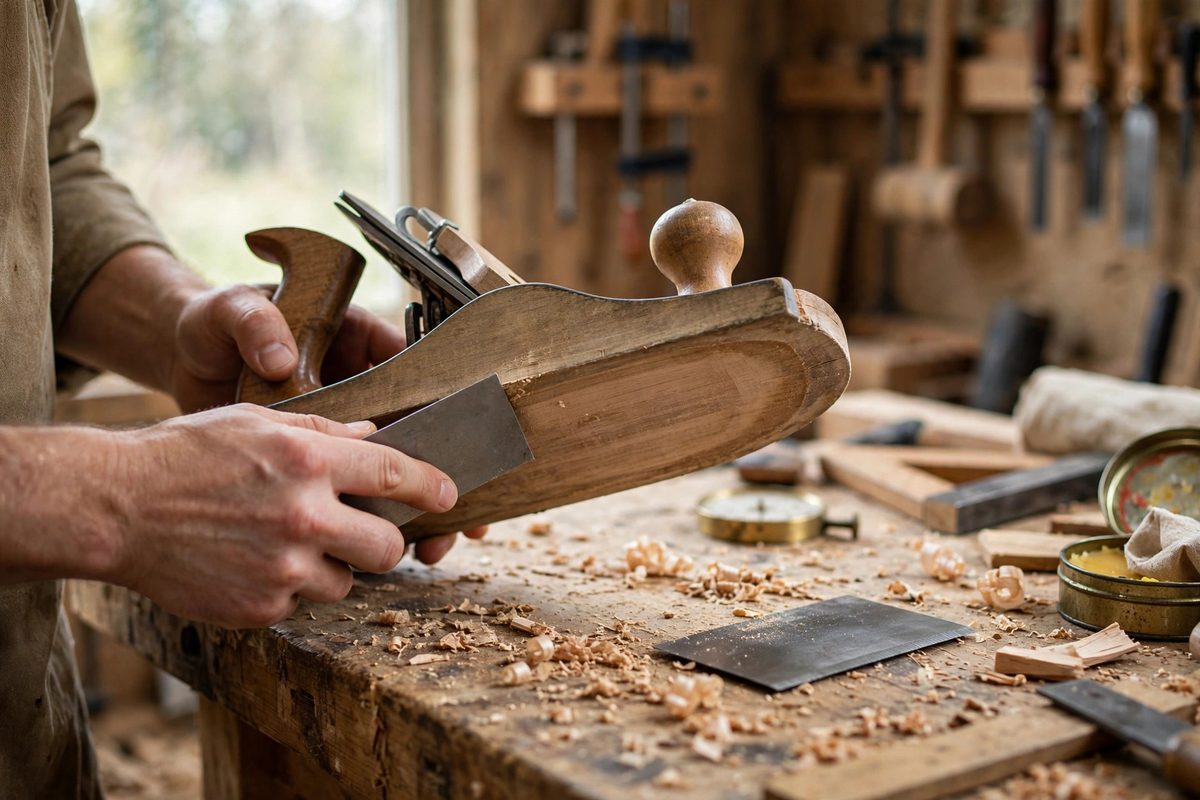
A wooden jack plane only works as well as its sole is true. A sole with hollows and high spots rocks on the work, takes uneven shavings, and makes the plane feel cursed. Trueing the sole with a scraper blade, rather than sandpaper on a flat surface, gives you control over exactly where wood comes off, which is the whole job.
Why Scraper Blades Instead of Abrasives
Sandpaper on a reference plate removes wood everywhere it touches, including the low spots you want to keep, and it rounds over the sole's edges as you work. A scraper blade removes wood only where you push it, shaving the high spots while leaving the hollows alone. This selectivity is what truing requires: you are not flattening the sole by grinding everything down to the lowest point, you are lowering the high spots to meet the rest. The scraper also leaves a clean surface that needs no further work, while abrasives leave scratches that must be dealt with.
Reading the Sole
Mark the sole with a pencil or marker scribbled across its full length and width, then take a few passes on a true reference surface or rub it on a flat plate with marking compound. The high spots show where the marking wears off first. Alternatively, sight along the sole against a straightedge, rocking it to find where it pivots; the pivot points are the high spots. Map the highs before cutting anything, because scraping blind just moves the error around. Wooden soles often wear hollow just ahead of the mouth and at the toe and heel, with high spots at the mouth edges, and knowing this pattern speeds the reading.
The Scraping Technique
Use a sharp scraper blade, a cabinet scraper or a purpose-ground blade, held at a slight angle and pushed firmly along the sole. Work the high spots with overlapping strokes, checking progress frequently against the straightedge. Take light cuts; the goal is to sneak up on true, and a scraper can remove wood faster than you expect when you lean into it. Work diagonally across the sole as well as lengthwise to avoid creating new lengthwise hollows. Keep the blade sharp throughout, because a dull scraper tears and compresses the wood instead of cutting it, which springs back later and undoes the truing.
Dealing With the Mouth Area
The sole around the mouth needs special attention. The area just ahead of the mouth must be flat and at the same level as the rest of the sole, or the plane will not register properly as the iron exits. Do not scrape the mouth opening itself wider; work the sole surface around it. If the mouth has worn excessively wide from years of use, that is a different repair involving a mouth patch, not a truing problem. Keep the sole's edges crisp and square to the sides while truing; rounded sole edges let the plane tip on narrow work.
Seasonal Movement and Maintenance
A wooden sole moves with humidity, so a sole trued in the dry of winter may not be true in summer damp. True the plane in conditions close to where it will be used, and expect to touch up the sole periodically as part of normal ownership. Store the plane on its side, not on its sole, to avoid wear and moisture uptake on the reference surface. A quick check with the straightedge before an important job takes seconds and catches the drift before it ruins work. The wooden plane is a living tool; its sole needs the occasional conversation with the scraper.
Read the high spots, scrape them down selectively, mind the mouth area, and recheck with the seasons. A true sole makes the wooden jack plane feel like it is reading your mind, taking full-width shavings exactly where you ask.
Related Guides
- Miter Box Spline Reinforcement for Picture Frames: A picture frame miter joint is a structural weak point wearing a pretty face: two 45-degree cuts glued end-grain to end-grain, which is the weakest
- Hand-Cut Through Mortise Pin Wedging Angles: A through mortise with a wedged tenon is joinery at its most honest: the tenon passes all the way through, wedges driven into its end flare it like a
- Scribing Compound Shoulders on Sloped Timber Tenons: A tenon entering a mortise at an angle, the classic sloped timber joint of braces and rafters, needs shoulders that meet the mating timber's face