
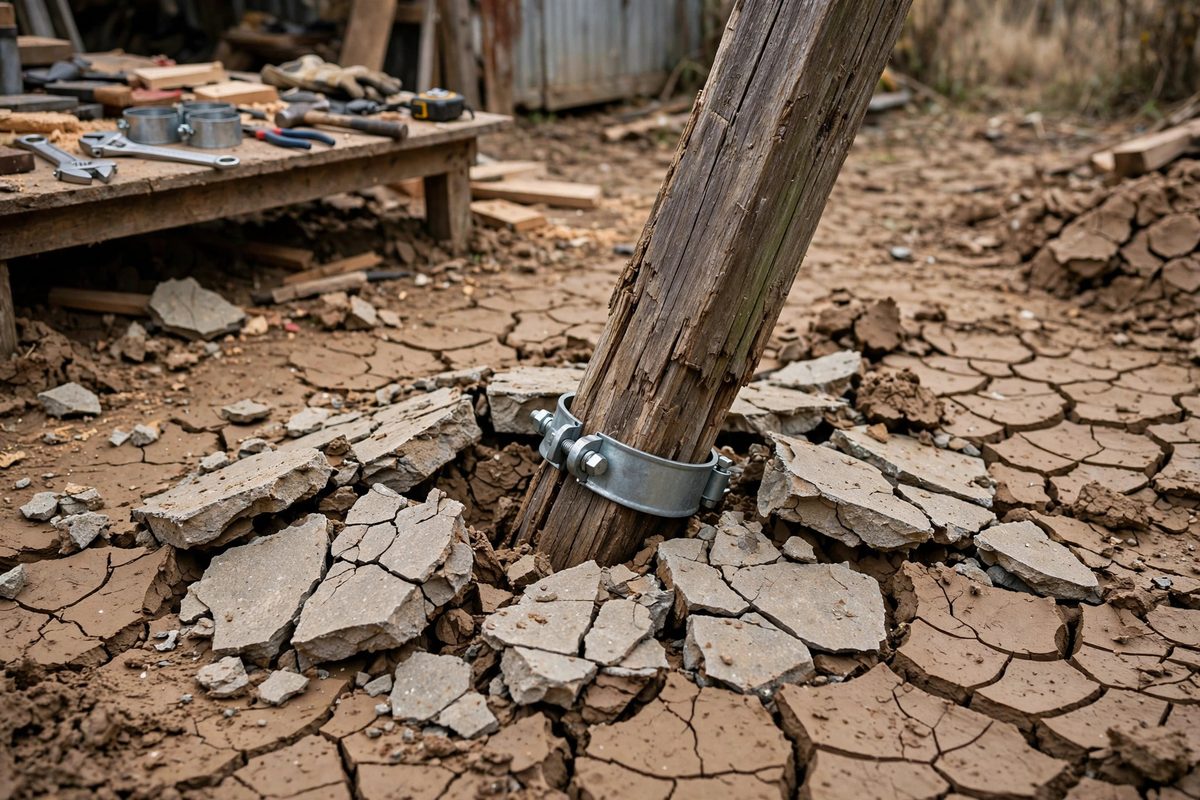
Expansive clay soils swell when wet and shrink when dry, heaving fence posts up, tilting them sideways, and cracking the concrete meant to hold them. A steel post collar, a sleeve around the post at the ground line, isolates the post from the soil's grip so the heaving clay slides past instead of grabbing the post. Sizing the collar correctly, its diameter, depth, and clearance, determines whether it actually defeats the heave or merely decorates the post. This is a soil-mechanics problem wearing a fence-building disguise.
How Expansive Clay Attacks Posts
Clay minerals absorb water between their plate-like particles and expand, generating swelling pressures that can reach thousands of pounds per square foot. A post set in concrete in expansive clay gets gripped by the swelling soil: the clay expands against the concrete pier, and friction plus adhesion drag the pier upward. When the soil dries and shrinks, the pier does not settle back fully; soil sloughs into the gap beneath it, ratcheting the post upward a little with each wet-dry cycle. Over seasons, posts heave inches out of the ground and tilt as the heave acts unevenly. The concrete pier, intended as an anchor, becomes a sail catching the soil's movement: its large surface area gives the swelling clay maximum grip. The collar strategy reverses this by minimizing the grippable surface and breaking the bond between soil and post.
What the Collar Does
The collar is a smooth steel sleeve, larger in diameter than the post, extending from above grade down past the zone of seasonal moisture change. The post sits inside the collar with clearance; the collar is what contacts the soil. Two mechanisms protect the post. First, the smooth steel surface gives the clay little to grip compared to rough concrete, reducing the friction that transmits heave. Second, and more importantly, the annular space between post and collar, or a compressible filler in that space, decouples the post from the collar's movement: the collar may move slightly with the soil, but the post inside remains undisturbed. For this to work, the collar must extend below the active zone, the depth to which seasonal moisture changes reach, because clay below that depth stays at constant moisture and does not heave. A collar that stops inside the active zone is gripped along its whole length and transmits the heave anyway.
Sizing the Diameter
The collar diameter must clear the post with enough annular space for the decoupling to work, typically an inch or more of clearance around the post, while not being so large that it becomes its own heave target. Oversized collars present more surface area to the swelling clay, increasing the total heave force on the collar, which then needs deeper embedment to resist. The practical sizing starts from the post: a standard fence post plus clearance for the annular gap, with the gap filled by a compressible material or left as an air space with a cap keeping soil out at the top. The collar wall should be sturdy enough to resist the soil pressure without deforming: thin-wall tubing can crumple under swelling pressure, defeating the smooth-surface advantage. Schedule-appropriate steel pipe or structural tubing, not flimsy sheet, is the right material.
Sizing the Depth
Depth is the critical dimension and the one most often undersized. The collar must reach below the active zone, which varies enormously by climate and soil: in regions with deep seasonal moisture change it can extend many feet, while in milder or consistently moist climates it is shallower. Local geotechnical knowledge, or the depth of existing stable foundations in the area, guides the number; when uncertain, deeper is safer, within reason. The post itself should extend deeper still, bearing on stable soil below the active zone, so the post is founded where nothing moves. Backfill around the collar's upper portion with non-expansive material, granular fill or controlled low-strength material, to further isolate it from the clay's grip. The top of the collar should stand slightly above grade with a cap or seal preventing soil and water from entering the annular space, because soil infiltration into the gap re-couples the post to the heave.
Installation Sequence
Drill or auger the hole to the full collar depth plus a little, keeping the hole diameter close to the collar diameter to minimize disturbed soil. Set the collar plumb and backfill around it with the non-expansive material, compacting in lifts. Set the post inside the collar, plumb and at the correct height, with the annular gap uniform. Fill the annular space with compressible filler or leave it open per the design, and cap the top. Do not concrete the post to the collar: that welds the decoupling shut and the whole assembly heaves as one. The most common installation failure is impatience with depth: a collar set "deep enough" by guesswork that stops in the active zone. When the fence heaves the next wet season, the diagnosis is immediate.
Expansive clay heaves what it can grip, so give it nothing to grip: a smooth steel collar past the active zone, a decoupled post inside it, non-expansive backfill, and a sealed top. Size for the local active depth, not for optimism, and the fence will still be plumb when the soil has finished its seasonal performance.
Related Guides
- Post Depth and Frost Line Anchoring Rules: Fence posts fail in two classic ways: they heave upward when frost grips them, and they rot at the ground line while the buried portion stays sound
- Tensioning High Tensile Wire for Perimeter Fences: High tensile wire fences stand or fall on tension. Too loose and the wires sag, snag, and lose their stock-tightening bite; too tight and posts pull
- Wind Load Resistance Calculations for Shadowbox Panels: A shadowbox fence looks open and airy, with its alternating boards front and back, and that appearance tempts builders to treat it as a low-wind-load
- Wind Load Shearing Limits on Heavy Cedar Privacy Slats: A solid cedar privacy fence is a beautiful thing until a storm turns it into a sail. Every slat you hang catches the wind, and the force multiplies