
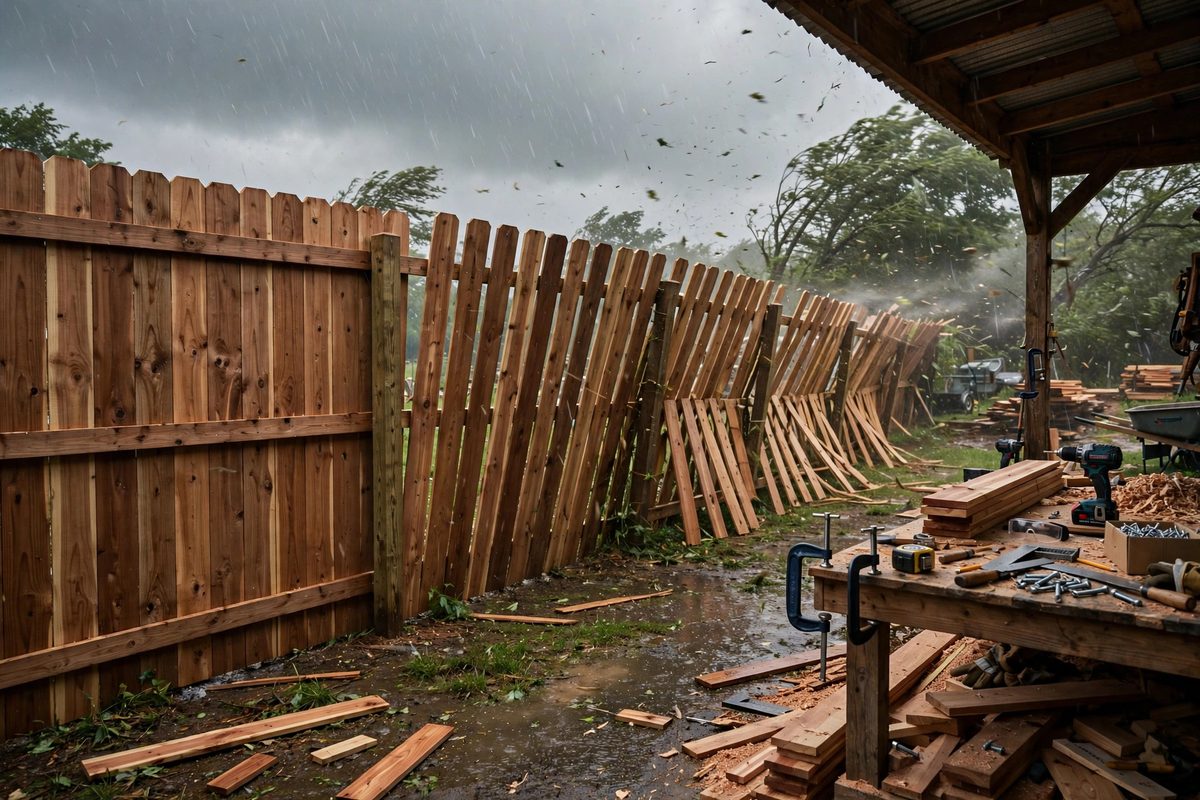
A solid cedar privacy fence is a beautiful thing until a storm turns it into a sail. Every slat you hang catches the wind, and the force multiplies across the full run of fence in a way most builders never think about until a section leans or a post snaps at grade. Understanding how wind load travels through a fence, and where the shearing forces concentrate, is the difference between a fence that stands for decades and one that slowly self-destructs in its first storm season.
How Wind Turns Your Fence Into a Sail
Wind pressure on a flat surface grows with the square of wind speed, which means doubling the wind speed roughly quadruples the push. A six-foot privacy fence with no gaps presents its full face to the wind, so a long run can catch thousands of pounds of lateral force in a serious gust. That force does not spread evenly: it concentrates at the posts and at every fastener holding slats to rails. The slats themselves rarely break first. Instead, the connection points fail, which is why a fence that looked rock solid in calm weather can shed slats or lean after one bad night. Building for wind means thinking of the fence as a load path: slats to rails, rails to posts, posts to ground.
Where Shear Actually Happens
Shear, in plain terms, is one part of a joint trying to slide past another. When wind pushes a slat, the screws or nails holding it to the rail resist that push in shear, meaning the fastener shank is being sliced sideways between the two pieces of wood. The highest shear loads sit where slats meet rails near the posts, because the rail cantilevers the load back to the post there. Fasteners at mid-span between posts carry far less. This is why experienced fence builders space fasteners evenly and use two fasteners per slat per rail: a single fastener gives the slat a pivot point, and the wood will rotate around it, split, or pull the screw through. Two fasteners share the shear and lock the slat against rotation.
Why Heavy Slats Change the Equation
Thick 5/4 or full 2-by cedar slats look premium, but their weight adds a constant gravity load on top of the wind load. Heavy slats stress horizontal rails more, especially when the wood is wet, because cedar can absorb a surprising amount of water weight in a rainstorm. A rail that carries heavy slats without sagging needs adequate depth and enough fastening into the posts to resist both the downward dead load and the sideways wind load at once. If you are set on thick slats, consider an extra rail. Three rails instead of two do more than hold slats straighter: they cut the unsupported span of each slat roughly in half and give every fastener a shorter lever arm to fight.
Gaps: The Easiest Way to Reduce Load
The single most effective wind strategy costs nothing: leave small gaps between slats. Even a quarter-inch gap between boards bleeds off a meaningful share of wind pressure because air slips through instead of piling up against the fence. Shadowbox and board-on-board patterns do this elegantly, with overlapping boards that block sightlines while letting gusts pass. Solid tongue-and-groove or gapless designs catch the maximum load, so if you must have a gapless look, that fence needs proportionally stronger posts and deeper footings. Think of gaps as free insurance: they reduce every downstream force, from fastener shear to post overturning.
Posts and Connections That Hold
Posts carry everything, so they deserve the most attention. A post set shallow in a dry concrete collar will pivot in the ground long before the slats fail, and wind load turns a shallow post into a lever prying itself out of its footing. Set posts deep enough that the buried portion can resist the overturning moment, bell out or use concrete at the bottom rather than the top of the hole so frost or swelling soil cannot lift the post, and make sure the post is sized to the fence height. Through-bolts at rail-to-post connections resist shear far better than screws alone, and metal post bases or brackets add holding power where wood-to-wood connections would crush or split over time.
Reading the Warning Signs Early
Fences talk before they fail. Slats that start rattling in moderate wind are telling you fasteners are working loose or holes are wallowing out. A post that leans even slightly after a storm is losing its grip underground, and it will only lean further with each gust because the tilt increases the leverage. Cracked rails near the posts mean the connection is being overworked in shear. Check your fence once or twice a year: tighten or replace fasteners, re-plumb leaning posts while they are still close to true, and replace cracked rails before they give way and dump their slats in the next storm.
Build the fence as a system, not a row of pretty boards. Keep slats light or add rails, leave breathing gaps, give every connection two fasteners, and set posts like they have to fight weather for twenty years, because they do. A fence designed with wind shear in mind does not just survive storms: it stays straight, tight, and quiet in ordinary wind, which is most of its life.
Related Guides
- Wind Load Resistance Calculations for Shadowbox Panels: A shadowbox fence looks open and airy, with its alternating boards front and back, and that appearance tempts builders to treat it as a low-wind-load
- Post Depth and Frost Line Anchoring Rules: Fence posts fail in two classic ways: they heave upward when frost grips them, and they rot at the ground line while the buried portion stays sound
- Steel Post Collar Sizing in Expansive Clay Soils: Expansive clay soils swell when wet and shrink when dry, heaving fence posts up, tilting them sideways, and cracking the concrete meant to hold them
- Tensioning High Tensile Wire for Perimeter Fences: High tensile wire fences stand or fall on tension. Too loose and the wires sag, snag, and lose their stock-tightening bite; too tight and posts pull