
High tensile wire fences stand or fall on tension. Too loose and the wires sag, snag, and lose their stock-tightening bite; too tight and posts pull, corner braces walk, and wire snaps in cold weather. Tensioning is a feel developed over miles of fence, but the principles behind it are straightforward.
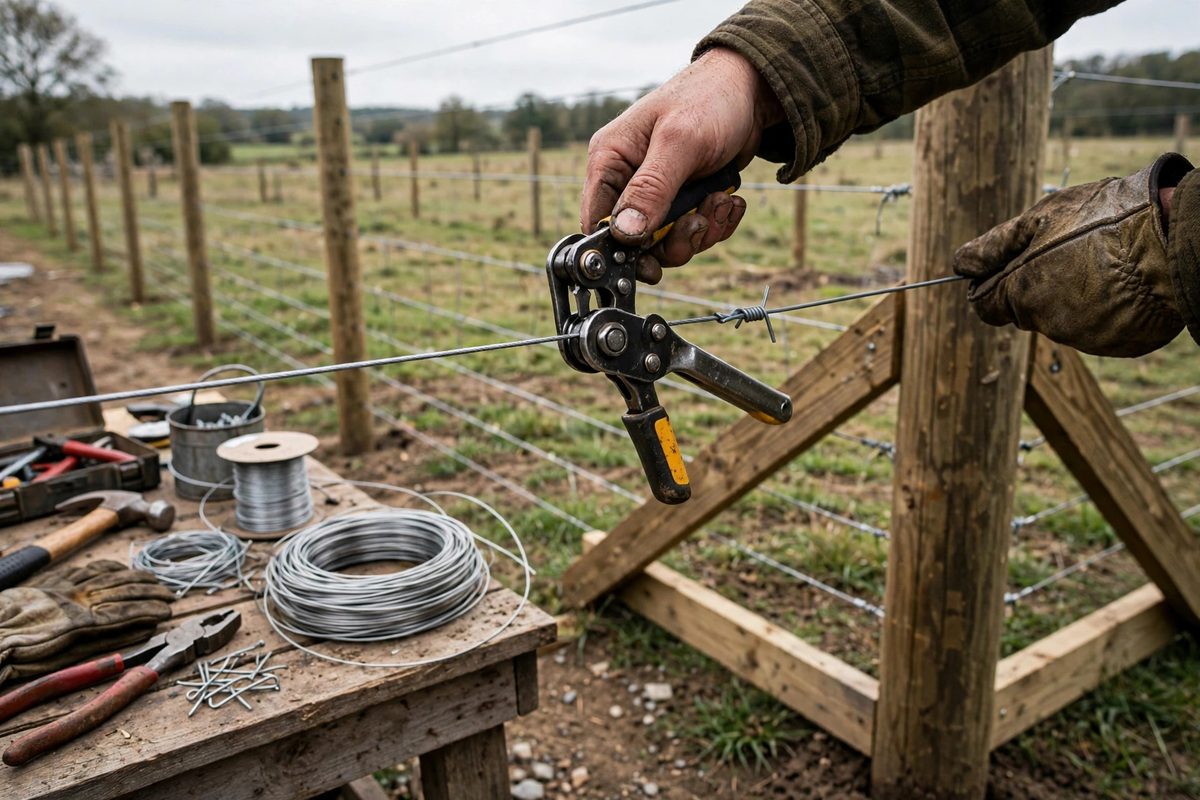
What tension the wire actually needs
High tensile wire wants to be under real working tension, much tighter than soft wire, because its strength is what lets it stay elastic and spring back from livestock pressure. The working range for a single wire is typically around 200 to 250 pounds of tension. You do not need a gauge to set this, though tension meters exist; experienced fencers judge by the wire's ring and by how it responds when pushed. A properly tensioned wire gives a clear tone when plucked and deflects only an inch or two under a firm hand push at midspan. Learn the feel on a short run before committing to a long perimeter.
Stretching before the final tie-off
Wire comes off the roll with memory and slack. Walk the full run out, attach at one end, then stretch it with a come-along or a fence stretcher toward the other end before tying off. This pre-stretching takes the coil set out of the wire so the tension you set is the tension that stays. Skipping this step is the classic beginner mistake: the fence looks tight at tie-off and goes slack within a week as the wire relaxes. Stretch each wire individually rather than pulling a whole bundle at once, so every strand carries its share.
Temperature and seasonal tension shifts
Wire expands and contracts with temperature. A fence tensioned drum-tight on a hot afternoon will be bar-tight in January, and one tensioned in winter will sag in July. The practical answer is to tension in moderate weather and to build in the fence's ability to absorb seasonal change. Tension springs or in-line strainers at intervals let the system breathe without going slack. In climates with real winters, this is not optional hardware; it is what keeps a fence tight year-round without snapping wire on the coldest night.
Corner and end assemblies carry the load
Every pound of wire tension ends up in the corner posts. A corner assembly that is adequate for barbed wire may not survive high tensile loads, because the forces are higher and more constant. H-braces or angled deadman anchors need depth, good wood, and tight diagonal wire or rod bracing that pulls the posts together rather than apart. Set corner posts deep, in tamped fill or concrete depending on your soil, and never trust a single shallow post to hold a tensioned run. A corner that creeps over a season undoes all your careful tensioning.
Equalizing tension across wires
A multi-wire fence works as a system, so the wires should share the load evenly. Tension each wire to the same feel before moving on, and recheck the earlier wires after the later ones are tight, because tying off one wire can shift the whole run slightly. Walking the line after tensioning and sighting along the wires reveals any strand that is looser than its neighbors. Consistency matters more than the exact number: a fence where every wire is at the same tension handles pressure uniformly.
Maintenance and re-tensioning
Even a well-built fence needs periodic attention. Check tension after the first season, when posts have settled and wire has fully relaxed, and again after severe weather or heavy animal pressure. In-line strainers make re-tensioning a quick job instead of a rebuild. Cut and re-splice any wire that has kinked, since a kink is a future break. Fence pliers, spare sleeves, and a stretcher in the truck turn maintenance from a project into a routine.
Tension each wire to a working load, pre-stretch before tie-off, build corners that can hold it, and leave the system room to breathe with the seasons. A high tensile fence done this way stays tight, springs back, and asks for little more than a yearly walk.
Related Guides
- Post Depth and Frost Line Anchoring Rules: Fence posts fail in two classic ways: they heave upward when frost grips them, and they rot at the ground line while the buried portion stays sound
- Steel Post Collar Sizing in Expansive Clay Soils: Expansive clay soils swell when wet and shrink when dry, heaving fence posts up, tilting them sideways, and cracking the concrete meant to hold them
- Wind Load Resistance Calculations for Shadowbox Panels: A shadowbox fence looks open and airy, with its alternating boards front and back, and that appearance tempts builders to treat it as a low-wind-load
- Wind Load Shearing Limits on Heavy Cedar Privacy Slats: A solid cedar privacy fence is a beautiful thing until a storm turns it into a sail. Every slat you hang catches the wind, and the force multiplies