
A wetting balance test measures, with a precision scale, exactly how well molten solder wets a component lead, and on heavily oxidized leads it answers the question that visual inspection cannot: is this lead solderable, or is it scrap? Oxidation builds up on leads during long storage or poor handling, and it ranges from a light tarnish that good flux handles easily to a thick crust that no flux can cut through. The wetting balance quantifies where a given lead falls on that spectrum.
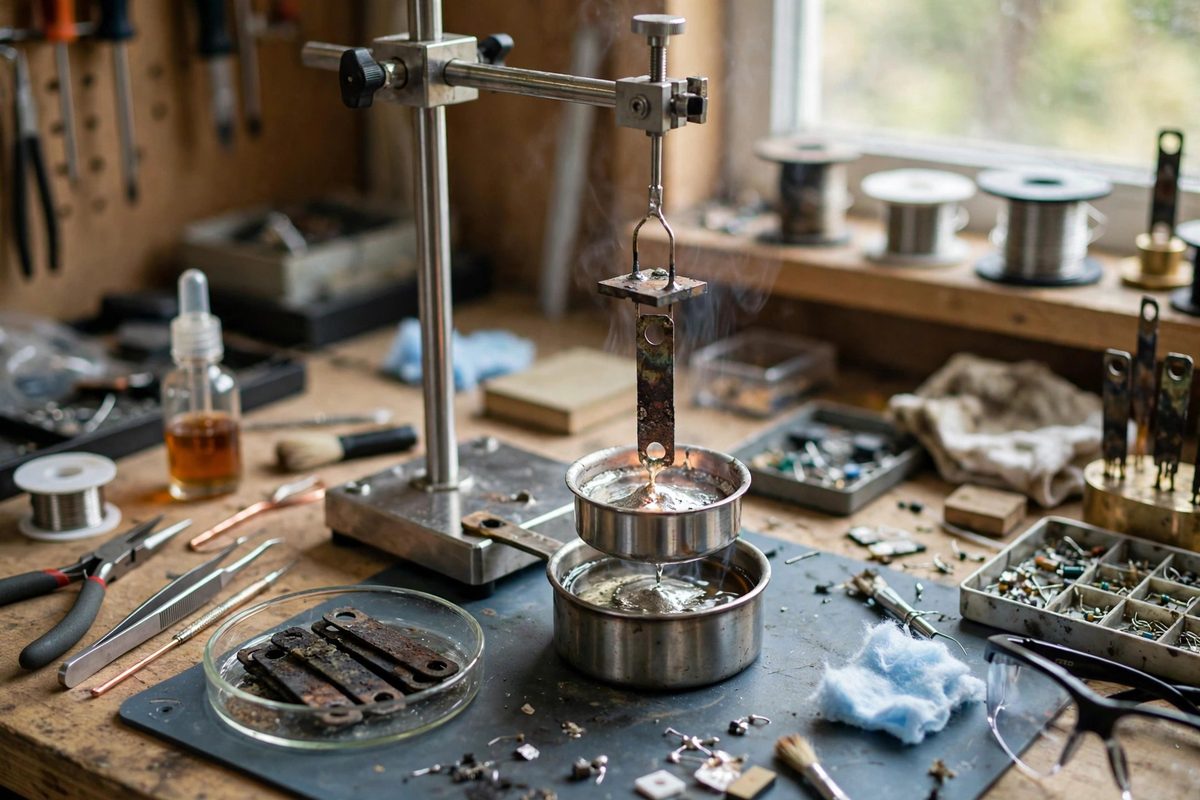
How the test works
The lead is suspended from a sensitive balance and dipped into a bath of molten solder at a controlled temperature and speed. The balance records the force on the lead over time: initially buoyancy pushes up, then, as the flux activates and the solder begins to wet the lead, surface tension pulls the solder up the lead and the measured force swings downward. The resulting curve, force versus time, is the wetting balance signature.
A clean, solderable lead shows rapid wetting: the force crosses zero quickly and reaches a strong negative (wetting) force, indicating the solder has climbed the lead with a small contact angle. An oxidized lead shows slow, weak, or absent wetting: the curve stays positive or crosses zero late and shallowly, meaning the solder never properly bonded. The numbers remove all subjectivity from the solderability judgment.
Reading the curve on oxidized leads
Heavily oxidized leads produce characteristic curve shapes. Light oxidation delays the wetting slightly but the curve still reaches a healthy final force: these leads are usable with an appropriately active flux. Moderate oxidation produces a long delay and a reduced final force, the solder wets partially, and the joint may be acceptable for non-critical use but is marginal. Heavy oxidation produces no meaningful wetting at all within the test time; the curve stays flat or positive, and the lead is not solderable as-is.
The test also distinguishes oxidation from contamination. Some contaminants produce de-wetting, where the solder initially wets and then pulls back, a distinctive curve shape that points to surface films rather than simple oxide. Knowing which you are dealing with determines the remedy.
What the test tells you to do
The wetting balance is a decision tool. Leads that wet well go into production with the standard process. Leads with delayed but adequate wetting may need a more active flux, a longer contact time, or a pre-cleaning step, and the test can verify that the chosen remedy actually works by re-testing treated leads. Leads that do not wet are rejected or reworked: mechanical cleaning, chemical stripping, or re-tinning, followed by re-testing to confirm the treatment restored solderability.
This is far cheaper than discovering unsolderable leads on the production line, where each bad joint costs rework time and risks board damage. Incoming inspection with a wetting balance on suspect lots, old stock, or components from unknown storage, pays for itself the first time it catches a bad batch before it hits the boards.
Test conditions that matter
The test is only meaningful under controlled, repeatable conditions: the solder bath temperature, the immersion depth and speed, the flux type and application, and the preconditioning of the leads must all be standardized. Steam aging, a controlled accelerated-aging step, simulates months of shelf storage and reveals leads whose solderability degrades quickly, which matters for stock that will sit before use.
Match the test flux to the production flux where possible, since a lead that wets with an aggressive test flux but not with the production no-clean flux will still fail on the line. The test should predict production behavior, not flatter the leads.
When testing is overkill and when it is not
For fresh components from reputable suppliers in normal production, visual inspection and process control suffice; wetting balance testing every lot would be wasteful. The test earns its keep on old stock, salvaged components, leads with visible discoloration, new suppliers, and any situation where solderability is genuinely in doubt. It is also the right tool for qualifying a cleaning or re-tinning process, since it measures the outcome directly.
When the leads are suspect, do not guess. Dip them, read the curve, and let the balance decide whether they are solderable or scrap.
Related Guides
- Solder Wicking and Thermal Mass on Big Pins: Big through-hole pins, connector shells, transformer leads, binding posts, are heatsinks wearing a component disguise. The iron pours heat in and the
- Solder Sucker Suction Velocity and Tip Sizing: The solder sucker, or desoldering pump, is a spring-loaded vacuum tool for clearing solder from through-holes, and its effectiveness comes down to
- Solder Pot Temperature Windows for Tinning Strands: Tinning stranded wire, coating the stripped end with solder so the strands behave as one conductor, is cleanest and fastest with a solder pot: dip
- Preheating Multi-Layer Ground Planes With Bottom Plates: Anyone who has tried to solder a connector into a board with solid internal ground planes knows the particular frustration: the iron is hot, the